 Movie
Movie Controller


+ Open data

- Basic information
| Entry | Database: PDB / ID: 9w3k | |||||||||||||||||||||||||||||||||
|---|---|---|---|---|---|---|---|---|---|---|---|---|---|---|---|---|---|---|---|---|---|---|---|---|---|---|---|---|---|---|---|---|---|---|
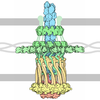
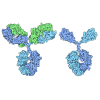
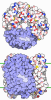
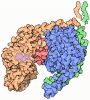
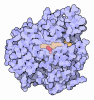
| Title | GPR151-Legobody complex | |||||||||||||||||||||||||||||||||
 Components Components |
| |||||||||||||||||||||||||||||||||
 Keywords Keywords | MEMBRANE PROTEIN / orphan GPCR / cryo-EM / Legobody | |||||||||||||||||||||||||||||||||
| Function / homology |  Function and homology information Function and homology informationcholinergic synapse / response to acidic pH / IgG binding / regulation of synaptic vesicle exocytosis / carbohydrate transmembrane transporter activity / maltose binding / maltose transport / maltodextrin transmembrane transport / response to ischemia / ATP-binding cassette (ABC) transporter complex, substrate-binding subunit-containing ...cholinergic synapse / response to acidic pH / IgG binding / regulation of synaptic vesicle exocytosis / carbohydrate transmembrane transporter activity / maltose binding / maltose transport / maltodextrin transmembrane transport / response to ischemia / ATP-binding cassette (ABC) transporter complex, substrate-binding subunit-containing / positive regulation of immune response / G protein-coupled receptor activity / synaptic vesicle membrane / outer membrane-bounded periplasmic space / presynaptic membrane / G protein-coupled receptor signaling pathway / identical protein binding / plasma membrane Similarity search - Function | |||||||||||||||||||||||||||||||||
| Biological species |   Escherichia coli O157:H7 (bacteria) Escherichia coli O157:H7 (bacteria) Staphylococcus aureus (bacteria)Staphylococcus aureus subsp. aureus Mu50 (bacteria)Streptococcus sp. 'group G' (bacteria) Staphylococcus aureus (bacteria)Staphylococcus aureus subsp. aureus Mu50 (bacteria)Streptococcus sp. 'group G' (bacteria) Homo sapiens (human) Homo sapiens (human)  Spodoptera frugiperda (fall armyworm) Spodoptera frugiperda (fall armyworm) | |||||||||||||||||||||||||||||||||
| Method | ELECTRON MICROSCOPY / single particle reconstruction / cryo EM / Resolution: 3.08 Å | |||||||||||||||||||||||||||||||||
 Authors Authors | Song, Q.Q. / Cong, Y. | |||||||||||||||||||||||||||||||||
| Funding support |  China, 1items China, 1items
| |||||||||||||||||||||||||||||||||
 Citation Citation | Journal: Proc Natl Acad Sci U S A / Year: 2026 Title: Decoding the structure of GPR151 via NELiS. Authors: Yumeng Wang / Luyu Fan / Qianqian Song / Yaning Li / Jiayu Jin / Qiaoyu Zhao / Weijie Gu / Xiangyi Shi / Dianfan Li / Yao Cong / Sheng Wang / Abstract: Structure determination of orphan G protein-coupled receptors (GPCRs) is hindered by lack of known ligands and their inherent instability during purification. Conventional thermostability screening ...Structure determination of orphan G protein-coupled receptors (GPCRs) is hindered by lack of known ligands and their inherent instability during purification. Conventional thermostability screening requires ligands or purified protein, limiting its utility for orphan GPCRs. Here, we present the Nb6-Enabled Ligand-Free Stabilization Platform (NELiS)-a ligand- and purification-independent method for identifying stabilizing mutations. Applied to GPR151, an orphan GPCR enriched in habenula and implicated in neuropsychiatric disorders, NELiS identified four mutations that significantly improved thermostability and expression, allowing receptor purification. Using the stabilized and purified receptor, we further found a high-affinity, GPR151-specific nanobody that facilitated structural determination. Structural analysis revealed unconventional activation-resistant features across canonical motifs and an autoinhibitory N-terminal region occupying the orthosteric pocket. Functional studies confirmed a unique activation mechanism and the critical role of the N terminus in receptor maturation and trafficking. These results establish NELiS as a generalizable tool for structural and functional investigation of orphan GPCRs. | |||||||||||||||||||||||||||||||||
| History |
|
- Structure visualization
| Structure viewer | Molecule: MolmilJmol/JSmol |
|---|
- Downloads & links
-Download
| PDBx/mmCIF format | 9w3k.cif.gz | 255.1 KB | Display | PDBx/mmCIF format |
|---|---|---|---|---|
| PDB format | pdb9w3k.ent.gz | 194.4 KB | Display | PDB format |
| PDBx/mmJSON format | 9w3k.json.gz | Tree view | PDBx/mmJSON format | |
| Others |  Other downloads Other downloads |
-Validation report
| Arichive directory | https://data.pdbj.org/pub/pdb/validation_reports/w3/9w3kftp://data.pdbj.org/pub/pdb/validation_reports/w3/9w3k | HTTPS FTP |
|---|
-Related structure data
| Related structure data |  65603MC  9w3lC M: map data used to model this data C: citing same article ( |
|---|---|
| Similar structure data |

-Links
 PDBj
PDBj
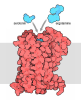
- Assembly
| Deposited unit | 
|
|---|---|
| 1 |
|
-Components
| #1: Antibody | Mass: 60575.715 Da / Num. of mol.: 1 Source method: isolated from a genetically manipulated source Details: His tag-MBP(PrAC-PrAD-PrG) Source: (gene. exp.) Escherichia coli O157:H7 (bacteria), (gene. exp.) Staphylococcus aureus (bacteria), (gene. exp.) Staphylococcus aureus subsp. aureus Mu50 (bacteria), (gene. exp.) Streptococcus ...Source: (gene. exp.) Escherichia coli O157:H7 (bacteria), (gene. exp.) Staphylococcus aureus (bacteria), (gene. exp.) Staphylococcus aureus subsp. aureus Mu50 (bacteria), (gene. exp.) Streptococcus sp. 'group G' (bacteria)Gene: malE, Z5632, ECs5017, spa, spa, SAV0111, spg / Strain: Mu50 / ATCC 700699 / Production host: Escherichia coli BL21 (bacteria)References: UniProt: P0AEY0, UniProt: P38507, UniProt: P0A015, UniProt: P06654 |
|---|---|
| #2: Antibody | Mass: 27396.742 Da / Num. of mol.: 1 Source method: isolated from a genetically manipulated source Source: (gene. exp.) Homo sapiens (human) / Production host: Homo sapiens (human) |
| #3: Antibody | Mass: 26317.523 Da / Num. of mol.: 1 Source method: isolated from a genetically manipulated source Source: (gene. exp.) Homo sapiens (human) / Production host: Homo sapiens (human) |
| #4: Protein | Mass: 46708.242 Da / Num. of mol.: 1 Source method: isolated from a genetically manipulated source Source: (gene. exp.) Homo sapiens (human) / Gene: GPR151, GALR4, GALRL, PGR7 / Production host: Spodoptera frugiperda (fall armyworm) / References: UniProt: Q8TDV0 |
| #5: Antibody | Mass: 14057.646 Da / Num. of mol.: 1 Source method: isolated from a genetically manipulated source Source: (gene. exp.) Spodoptera frugiperda (fall armyworm) / Production host: Spodoptera frugiperda (fall armyworm) |
| Has protein modification | Y |
-Experimental details
-Experiment
| Experiment | Method: ELECTRON MICROSCOPY |
|---|---|
| EM experiment | Aggregation state: PARTICLE / 3D reconstruction method: single particle reconstruction |
- Sample preparation
| Component | Name: GPR151-Legobody complex / Type: COMPLEX / Entity ID: all / Source: RECOMBINANT | ||||||||||||
|---|---|---|---|---|---|---|---|---|---|---|---|---|---|
| Source (natural) |
| ||||||||||||
| Source (recombinant) | Organism: Spodoptera frugiperda (fall armyworm) | ||||||||||||
| Buffer solution | pH: 7.4 | ||||||||||||
| Specimen | Embedding applied: NO / Shadowing applied: NO / Staining applied: NO / Vitrification applied: YES | ||||||||||||
| Vitrification | Cryogen name: ETHANE |
- Electron microscopy imaging
| Microscopy | Model: TFS GLACIOS |
|---|---|
| Electron gun | Electron source:  FIELD EMISSION GUN / Accelerating voltage: 200 kV / Illumination mode: FLOOD BEAM FIELD EMISSION GUN / Accelerating voltage: 200 kV / Illumination mode: FLOOD BEAM |
| Electron lens | Mode: BRIGHT FIELD / Nominal defocus max: 1600 nm / Nominal defocus min: 900 nm |
| Image recording | Electron dose: 47.5 e/Å2 / Film or detector model: FEI FALCON IV (4k x 4k) |
- Processing
| EM software |
| ||||||||||||||||||||||||
|---|---|---|---|---|---|---|---|---|---|---|---|---|---|---|---|---|---|---|---|---|---|---|---|---|---|
| CTF correction | Type: PHASE FLIPPING AND AMPLITUDE CORRECTION | ||||||||||||||||||||||||
| 3D reconstruction | Resolution: 3.08 Å / Resolution method: FSC 0.143 CUT-OFF / Num. of particles: 869552 / Symmetry type: POINT | ||||||||||||||||||||||||
| Refinement | Highest resolution: 3.08 Å Stereochemistry target values: REAL-SPACE (WEIGHTED MAP SUM AT ATOM CENTERS) | ||||||||||||||||||||||||
| Refine LS restraints |
|
