 Movie
Movie Controller

[English] 日本語
 Yorodumi
- PDB-9vuf: Structure of human proteasome ATPase-CP intermediate assembles wi... -
+ Open data

- Basic information
| Entry | Database: PDB / ID: 9vuf | |||||||||||||||||||||
|---|---|---|---|---|---|---|---|---|---|---|---|---|---|---|---|---|---|---|---|---|---|---|
| Title | Structure of human proteasome ATPase-CP intermediate assembles with 90min rapaprotin addition | |||||||||||||||||||||
 Components Components |
| |||||||||||||||||||||
 Keywords Keywords | HYDROLASE / Proteasome / Rapaprotin / AAA-ATPase / Dissociation | |||||||||||||||||||||
| Function / homology |  Function and homology information Function and homology informationpositive regulation of inclusion body assembly / thyrotropin-releasing hormone receptor binding / nuclear proteasome complex / host-mediated perturbation of viral transcription / proteasome accessory complex / purine ribonucleoside triphosphate binding / cytosolic proteasome complex / proteasome regulatory particle / structural constituent of proteasome / positive regulation of proteasomal protein catabolic process ...positive regulation of inclusion body assembly / thyrotropin-releasing hormone receptor binding / nuclear proteasome complex / host-mediated perturbation of viral transcription / proteasome accessory complex / purine ribonucleoside triphosphate binding / cytosolic proteasome complex / proteasome regulatory particle / structural constituent of proteasome / positive regulation of proteasomal protein catabolic process / transcription factor binding / CD8-positive, alpha-beta T cell differentiation / CD8-positive, alpha-beta T cell homeostasis / thymic T cell selection / Antigen processing: Ub, ATP-independent proteasomal degradation / proteasome-activating activity / spermatoproteasome complex / negative regulation of programmed cell death / negative regulation of regulatory T cell differentiation / T-helper 1 cell differentiation / Regulation of ornithine decarboxylase (ODC) / proteasome core complex / Proteasome assembly / cellular response to type I interferon / T-helper 17 cell differentiation / Cross-presentation of soluble exogenous antigens (endosomes) / Somitogenesis / flagellated sperm motility / sperm end piece / myofibril / immune system process / proteasomal ubiquitin-independent protein catabolic process / positive regulation of RNA polymerase II transcription preinitiation complex assembly / general transcription initiation factor binding / : / ciliary tip / proteasome storage granule / proteasome endopeptidase complex / NF-kappaB binding / proteasome core complex, beta-subunit complex / threonine-type endopeptidase activity / proteasome core complex, alpha-subunit complex / proteasome assembly / SARS-CoV-1 targets host intracellular signalling and regulatory pathways / proteasome complex / regulation of G1/S transition of mitotic cell cycle / positive regulation of interleukin-2 production / ERAD pathway / response to type II interferon / inclusion body / Activation of STAT3 by cadherin engagement / TBP-class protein binding / regulation of proteasomal protein catabolic process / meiotic cell cycle / sarcomere / Regulation of activated PAK-2p34 by proteasome mediated degradation / negative regulation of inflammatory response to antigenic stimulus / proteasomal protein catabolic process / Autodegradation of Cdh1 by Cdh1:APC/C / APC/C:Cdc20 mediated degradation of Securin / N-glycan trimming in the ER and Calnexin/Calreticulin cycle / lipopolysaccharide binding / protein catabolic process / Asymmetric localization of PCP proteins / Ubiquitin-dependent degradation of Cyclin D / SCF-beta-TrCP mediated degradation of Emi1 / AUF1 (hnRNP D0) binds and destabilizes mRNA / NIK-->noncanonical NF-kB signaling / positive regulation of type II interferon production / TNFR2 non-canonical NF-kB pathway / P-body / Assembly of the pre-replicative complex / Vpu mediated degradation of CD4 / Cdc20:Phospho-APC/C mediated degradation of Cyclin A / Dectin-1 mediated noncanonical NF-kB signaling / Degradation of DVL / Degradation of AXIN / Degradation of CRY and PER proteins / Hh mutants are degraded by ERAD / Activation of NF-kappaB in B cells / G2/M Checkpoints / Degradation of GLI1 by the proteasome / Hedgehog ligand biogenesis / Regulation of RUNX3 expression and activity / Autodegradation of the E3 ubiquitin ligase COP1 / Defective CFTR causes cystic fibrosis / GSK3B and BTRC:CUL1-mediated-degradation of NFE2L2 / response to virus / Negative regulation of NOTCH4 signaling / AMPK-induced ERAD and lysosome mediated degradation of PD-L1(CD274) / Hedgehog 'on' state / APC/C:Cdh1 mediated degradation of Cdc20 and other APC/C:Cdh1 targeted proteins in late mitosis/early G1 / Vif-mediated degradation of APOBEC3G / FBXL7 down-regulates AURKA during mitotic entry and in early mitosis / Degradation of GLI2 by the proteasome / GLI3 is processed to GLI3R by the proteasome / GSK3B-mediated proteasomal degradation of PD-L1(CD274) / MAPK6/MAPK4 signaling / Degradation of CDH1 / Degradation of beta-catenin by the destruction complex Similarity search - Function | |||||||||||||||||||||
| Biological species |  Homo sapiens (human) Homo sapiens (human) | |||||||||||||||||||||
| Method | ELECTRON MICROSCOPY / single particle reconstruction / cryo EM / Resolution: 3.1 Å | |||||||||||||||||||||
 Authors Authors | Wang, W.L. / Yin, D.Y. / Mao, Y.D. | |||||||||||||||||||||
| Funding support |  United States, United States,  China, 2items China, 2items
| |||||||||||||||||||||
 Citation Citation | Journal: Angew Chem Int Ed Engl / Year: 2025 Title: Rapaprotin, an Endopeptidase-Activated Proteasome Inhibitor that Induces 26S Disassembly. Authors: Hanjing Peng / Zufeng Guo / Wei Li Wang / Deyao Yin / Shitao Zou / Thomas Asbell / Brett R Ullman / Maya Thakar / Feiran Zhang / Sam Y Hong / A V Subba Rao / Kunyu Wang / Shuwen Zhang / ...Authors: Hanjing Peng / Zufeng Guo / Wei Li Wang / Deyao Yin / Shitao Zou / Thomas Asbell / Brett R Ullman / Maya Thakar / Feiran Zhang / Sam Y Hong / A V Subba Rao / Kunyu Wang / Shuwen Zhang / Zhaolong Wu / Xuemei Li / Aidan A Kendra / Seth S Margolis / William H Matsui / Christian B Gocke / Youdong Mao / Jun O Liu / Abstract: The 19S regulatory particle (RP) associates with the 20S core particle (CP) to form the 26S proteasome, an evolutionarily conserved holoenzyme that plays key roles in both physiological and ...The 19S regulatory particle (RP) associates with the 20S core particle (CP) to form the 26S proteasome, an evolutionarily conserved holoenzyme that plays key roles in both physiological and pathological processes. Proteasome inhibitors that target the catalytic subunits within the 20S have proven to be valuable research tools and therapeutics for various cancers. Herein we report the discovery of rapaprotin, a 26S proteasome assembly inhibitor from our natural product-inspired hybrid macrocycle rapafucin library. Rapaprotin induces apoptosis in both myeloma and leukemia cell lines. Genome-wide CRISPR-Cas9 screen identified a cytosolic enzyme, prolyl endopeptidase (PREP) that is required for the pro-apoptotic activity of rapaprotin. Further mechanistic studies revealed that rapaprotin acts as a molecular transformer, changing from an inactive cyclic form into an active linear form, rapaprotin-L, upon PREP cleavage, to block 26S proteasome activity. Time-resolved cryogenic electron microscopy (cryo-EM) revealed that rapaprotin-L induces dissociation of the 19S RP from the 26S holoenzyme, which was verified in cells. Furthermore, rapaprotin exhibits a marked synergistic effect with FDA-approved proteasome inhibitors and resensitizes drug-resistant multiple myeloma cells from patients to bortezomib. Taken together, these results suggest that rapaprotin is a new chemical tool to probe the dynamics of the 26S proteasome assembly and a promising anticancer drug lead. | |||||||||||||||||||||
| History |
|
- Structure visualization
| Structure viewer | Molecule: MolmilJmol/JSmol |
|---|
- Downloads & links
-Download
| PDBx/mmCIF format | 9vuf.cif.gz | 1.6 MB | Display | PDBx/mmCIF format |
|---|---|---|---|---|
| PDB format | pdb9vuf.ent.gz | 1.2 MB | Display | PDB format |
| PDBx/mmJSON format | 9vuf.json.gz | Tree view | PDBx/mmJSON format | |
| Others |  Other downloads Other downloads |
-Validation report
| Arichive directory | https://data.pdbj.org/pub/pdb/validation_reports/vu/9vufftp://data.pdbj.org/pub/pdb/validation_reports/vu/9vuf | HTTPS FTP |
|---|
-Related structure data
| Related structure data |  65361MC  9vueC  9vugC M: map data used to model this data C: citing same article ( |
|---|---|
| Similar structure data |


-Links
 PDBj
PDBj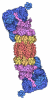

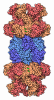
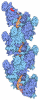

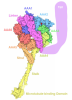
- Assembly
| Deposited unit | 
|
|---|---|
| 1 |
|
-Components
-26S proteasome regulatory subunit ... , 6 types, 6 molecules ABCDEF
| #1: Protein | Mass: 48700.805 Da / Num. of mol.: 1 Source method: isolated from a genetically manipulated source Source: (gene. exp.) Homo sapiens (human) / Gene: PSMC2, MSS1 / Production host: Homo sapiens (human) / References: UniProt: P35998 |
|---|---|
| #2: Protein | Mass: 49260.504 Da / Num. of mol.: 1 Source method: isolated from a genetically manipulated source Source: (gene. exp.) Homo sapiens (human) / Gene: PSMC1 / Production host: Homo sapiens (human) / References: UniProt: P62191 |
| #3: Protein | Mass: 45694.047 Da / Num. of mol.: 1 Source method: isolated from a genetically manipulated source Source: (gene. exp.) Homo sapiens (human) / Gene: PSMC5, SUG1 / Production host: Homo sapiens (human) / References: UniProt: P62195 |
| #4: Protein | Mass: 47426.141 Da / Num. of mol.: 1 Source method: isolated from a genetically manipulated source Source: (gene. exp.) Homo sapiens (human) / Gene: PSMC4, MIP224, TBP7 / Production host: Homo sapiens (human) / References: UniProt: P43686 |
| #5: Protein | Mass: 44241.008 Da / Num. of mol.: 1 Source method: isolated from a genetically manipulated source Source: (gene. exp.) Homo sapiens (human) / Gene: PSMC6, SUG2 / Production host: Homo sapiens (human) / References: UniProt: P62333 |
| #6: Protein | Mass: 49266.457 Da / Num. of mol.: 1 Source method: isolated from a genetically manipulated source Source: (gene. exp.) Homo sapiens (human) / Gene: PSMC3, TBP1 / Production host: Homo sapiens (human) / References: UniProt: P17980 |
-Proteasome subunit alpha type- ... , 6 types, 12 molecules GgHhIiJjKkMm
| #7: Protein | Mass: 27432.459 Da / Num. of mol.: 2 Source method: isolated from a genetically manipulated source Source: (gene. exp.) Homo sapiens (human) / Gene: PSMA6, PROS27 / Production host: Homo sapiens (human) / References: UniProt: P60900#8: Protein | Mass: 25927.535 Da / Num. of mol.: 2 Source method: isolated from a genetically manipulated source Source: (gene. exp.) Homo sapiens (human) / Gene: PSMA2, HC3, PSC3 / Production host: Homo sapiens (human) / References: UniProt: P25787#9: Protein | Mass: 29525.842 Da / Num. of mol.: 2 Source method: isolated from a genetically manipulated source Source: (gene. exp.) Homo sapiens (human) / Gene: PSMA4, HC9, PSC9 / Production host: Homo sapiens (human) / References: UniProt: P25789#10: Protein | Mass: 27929.891 Da / Num. of mol.: 2 Source method: isolated from a genetically manipulated source Source: (gene. exp.) Homo sapiens (human) / Gene: PSMA7, HSPC / Production host: Homo sapiens (human) / References: UniProt: O14818#11: Protein | Mass: 26435.977 Da / Num. of mol.: 2 Source method: isolated from a genetically manipulated source Source: (gene. exp.) Homo sapiens (human) / Gene: PSMA5 / Production host: Homo sapiens (human) / References: UniProt: P28066#13: Protein | Mass: 28469.252 Da / Num. of mol.: 2 Source method: isolated from a genetically manipulated source Source: (gene. exp.) Homo sapiens (human) / Gene: PSMA3, HC8, PSC8 / Production host: Homo sapiens (human) / References: UniProt: P25788 |
|---|
-Protein , 1 types, 2 molecules Ll
| #12: Protein | Mass: 30281.473 Da / Num. of mol.: 2 Source method: isolated from a genetically manipulated source Source: (gene. exp.) Homo sapiens (human) / Gene: PSMA1, HC2, NU, PROS30, PSC2 / Production host: Homo sapiens (human) / References: UniProt: P25786 |
|---|
-Proteasome subunit beta type- ... , 7 types, 14 molecules NnOoPpQqRrSsTt
| #14: Protein | Mass: 25377.652 Da / Num. of mol.: 2 Source method: isolated from a genetically manipulated source Source: (gene. exp.) Homo sapiens (human) / Gene: PSMB6, LMPY, Y / Production host: Homo sapiens (human)References: UniProt: P28072, proteasome endopeptidase complex #15: Protein | Mass: 30000.418 Da / Num. of mol.: 2 Source method: isolated from a genetically manipulated source Source: (gene. exp.) Homo sapiens (human) / Gene: PSMB7, Z / Production host: Homo sapiens (human)References: UniProt: Q99436, proteasome endopeptidase complex #16: Protein | Mass: 22972.896 Da / Num. of mol.: 2 Source method: isolated from a genetically manipulated source Source: (gene. exp.) Homo sapiens (human) / Gene: PSMB3 / Production host: Homo sapiens (human) / References: UniProt: P49720#17: Protein | Mass: 22864.277 Da / Num. of mol.: 2 Source method: isolated from a genetically manipulated source Source: (gene. exp.) Homo sapiens (human) / Gene: PSMB2 / Production host: Homo sapiens (human) / References: UniProt: P49721#18: Protein | Mass: 28510.248 Da / Num. of mol.: 2 Source method: isolated from a genetically manipulated source Source: (gene. exp.) Homo sapiens (human) / Gene: PSMB5, LMPX, MB1, X / Production host: Homo sapiens (human)References: UniProt: P28074, proteasome endopeptidase complex #19: Protein | Mass: 26522.396 Da / Num. of mol.: 2 Source method: isolated from a genetically manipulated source Source: (gene. exp.) Homo sapiens (human) / Gene: PSMB1, PSC5 / Production host: Homo sapiens (human) / References: UniProt: P20618#20: Protein | Mass: 29231.178 Da / Num. of mol.: 2 Source method: isolated from a genetically manipulated source Source: (gene. exp.) Homo sapiens (human) / Gene: PSMB4, PROS26 / Production host: Homo sapiens (human) / References: UniProt: P28070 |
|---|
-Non-polymers , 2 types, 6 molecules 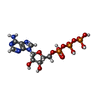
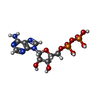
| #21: Chemical | ChemComp-ATP / 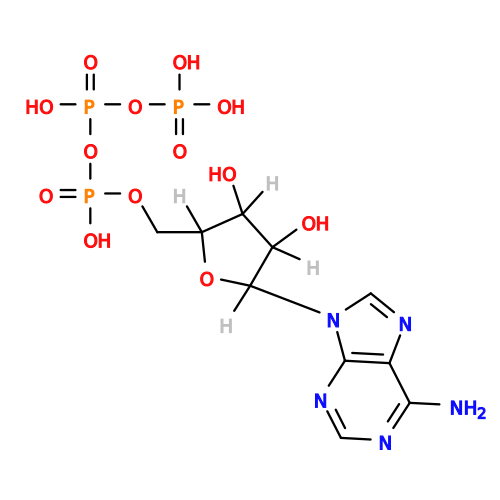 Mass: 507.181 Da / Num. of mol.: 4 / Source method: obtained synthetically / Formula: C10H16N5O13P3 / Feature type: SUBJECT OF INVESTIGATION / Comment: ATP, energy-carrying molecule*YM Mass: 507.181 Da / Num. of mol.: 4 / Source method: obtained synthetically / Formula: C10H16N5O13P3 / Feature type: SUBJECT OF INVESTIGATION / Comment: ATP, energy-carrying molecule*YM#22: Chemical | 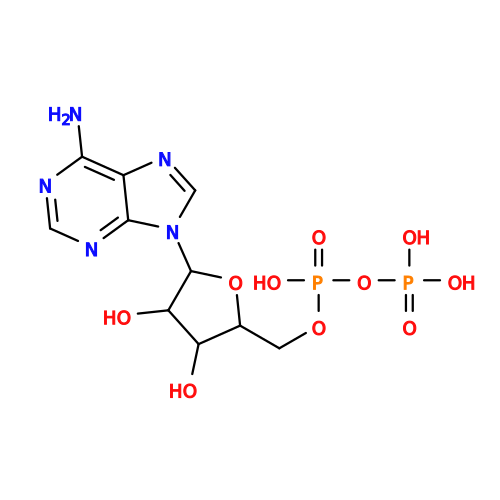 Mass: 427.201 Da / Num. of mol.: 2 / Source method: obtained synthetically / Formula: C10H15N5O10P2 / Feature type: SUBJECT OF INVESTIGATION / Comment: ADP, energy-carrying molecule*YM Mass: 427.201 Da / Num. of mol.: 2 / Source method: obtained synthetically / Formula: C10H15N5O10P2 / Feature type: SUBJECT OF INVESTIGATION / Comment: ADP, energy-carrying molecule*YM |
|---|
-Details
| Has ligand of interest | Y |
|---|---|
| Has protein modification | Y |
-Experimental details
-Experiment
| Experiment | Method: ELECTRON MICROSCOPY |
|---|---|
| EM experiment | Aggregation state: PARTICLE / 3D reconstruction method: single particle reconstruction |
- Sample preparation
| Component | Name: 26S proteasome / Type: COMPLEX / Entity ID: #1-#20 / Source: RECOMBINANT |
|---|---|
| Molecular weight | Value: 1.6 MDa / Experimental value: YES |
| Source (natural) | Organism: Homo sapiens (human) |
| Source (recombinant) | Organism: Homo sapiens (human) |
| Buffer solution | pH: 7.5 |
| Specimen | Embedding applied: NO / Shadowing applied: NO / Staining applied: NO / Vitrification applied: YES |
| Vitrification | Cryogen name: ETHANE |
- Electron microscopy imaging
| Experimental equipment |  Model: Titan Krios / Image courtesy: FEI Company |
|---|---|
| Microscopy | Model: TFS KRIOS |
| Electron gun | Electron source:  FIELD EMISSION GUN / Accelerating voltage: 300 kV / Illumination mode: FLOOD BEAM FIELD EMISSION GUN / Accelerating voltage: 300 kV / Illumination mode: FLOOD BEAM |
| Electron lens | Mode: BRIGHT FIELD / Nominal defocus max: 5000 nm / Nominal defocus min: 400 nm |
| Image recording | Electron dose: 50 e/Å2 / Film or detector model: GATAN K2 SUMMIT (4k x 4k) |
- Processing
| EM software |
| ||||||||||||||||||||||||
|---|---|---|---|---|---|---|---|---|---|---|---|---|---|---|---|---|---|---|---|---|---|---|---|---|---|
| CTF correction | Type: PHASE FLIPPING AND AMPLITUDE CORRECTION | ||||||||||||||||||||||||
| 3D reconstruction | Resolution: 3.1 Å / Resolution method: FSC 0.143 CUT-OFF / Num. of particles: 88200 / Symmetry type: POINT | ||||||||||||||||||||||||
| Refinement | Highest resolution: 3.1 Å Stereochemistry target values: REAL-SPACE (WEIGHTED MAP SUM AT ATOM CENTERS) | ||||||||||||||||||||||||
| Refine LS restraints |
|
