 Movie
Movie Controller


+ Open data

- Basic information
| Entry | Database: PDB / ID: 9vfi | ||||||||||||||||||||||||||||||
|---|---|---|---|---|---|---|---|---|---|---|---|---|---|---|---|---|---|---|---|---|---|---|---|---|---|---|---|---|---|---|---|
| Title | Structure of hTRPC3 solubilized with 4F peptide at 2.72 angstrom | ||||||||||||||||||||||||||||||
 Components Components | Green fluorescence protein,Maltose/maltodextrin-binding periplasmic protein,Short transient receptor potential channel 3,Maltose/maltodextrin-binding periplasmic protein,Short transient receptor potential channel 3,Maltose/maltodextrin-binding periplasmic protein,Short transient receptor potential channel 3 | ||||||||||||||||||||||||||||||
 Keywords Keywords | METAL TRANSPORT / TRPC3 / 4F peptide / native lipid environment | ||||||||||||||||||||||||||||||
| Function / homology |  Function and homology information Function and homology informationpositive regulation of cardiac muscle hypertrophy in response to stress / Role of second messengers in netrin-1 signaling / store-operated calcium channel activity / Effects of PIP2 hydrolysis / Elevation of cytosolic Ca2+ levels / cation channel complex / inositol 1,4,5 trisphosphate binding / calcium-activated cation channel activity / single fertilization / response to ATP ...positive regulation of cardiac muscle hypertrophy in response to stress / Role of second messengers in netrin-1 signaling / store-operated calcium channel activity / Effects of PIP2 hydrolysis / Elevation of cytosolic Ca2+ levels / cation channel complex / inositol 1,4,5 trisphosphate binding / calcium-activated cation channel activity / single fertilization / response to ATP / TRP channels / positive regulation of calcium ion transport into cytosol / phototransduction / carbohydrate transmembrane transporter activity / maltose binding / maltose transport / maltodextrin transmembrane transport / regulation of cytosolic calcium ion concentration / ATP-binding cassette (ABC) transporter complex, substrate-binding subunit-containing / MECP2 regulates neuronal receptors and channels / response to calcium ion / calcium ion transmembrane transport / calcium channel activity / calcium ion transport / outer membrane-bounded periplasmic space / metal ion binding / plasma membrane Similarity search - Function | ||||||||||||||||||||||||||||||
| Biological species |  Homo sapiens (human) Homo sapiens (human) | ||||||||||||||||||||||||||||||
| Method | ELECTRON MICROSCOPY / single particle reconstruction / cryo EM / Resolution: 2.72 Å | ||||||||||||||||||||||||||||||
 Authors Authors | Chen, L. / Zang, J. | ||||||||||||||||||||||||||||||
| Funding support |  China, 2items China, 2items
| ||||||||||||||||||||||||||||||
 Citation Citation | Journal: J Mol Biol / Year: 2025 Title: Unveiling Eukaryotic Membrane Proteins in High Resolution Using Peptide Solubilization. Authors: Jiahe Zang / Yiting Shi / Weiyu Tao / Xiaoyu Liu / Wenjun Guo / Lei Chen / Abstract: Integral membrane proteins are vital for numerous biological functions and their structures are typically studied using X-ray crystallography and cryo-electron microscopy (cryo-EM). However, these ...Integral membrane proteins are vital for numerous biological functions and their structures are typically studied using X-ray crystallography and cryo-electron microscopy (cryo-EM). However, these techniques require the extraction of target membrane proteins from their native membranes using detergents, which might disrupt the lipid environments and alter protein behavior. In this study, we present a novel method for solubilizing membrane proteins using 4F peptide, thereby eliminating the need for detergents throughout the procedure. We demonstrate that the 4F peptide effectively solubilizes a range of membrane proteins and complexes into 4F-discs, while preserving their functionality and structural integrity. Converting these 4F-discs into nanodiscs further enhances particle homogeneity and facilitates high-resolution structural determination of membrane proteins. Our findings highlight the potential of membrane-solubilizing peptides to advance membrane protein research. | ||||||||||||||||||||||||||||||
| History |
|
- Structure visualization
| Structure viewer | Molecule: MolmilJmol/JSmol |
|---|
- Downloads & links
-Download
| PDBx/mmCIF format | 9vfi.cif.gz | 578 KB | Display | PDBx/mmCIF format |
|---|---|---|---|---|
| PDB format | pdb9vfi.ent.gz | Display | PDB format | |
| PDBx/mmJSON format | 9vfi.json.gz | Tree view | PDBx/mmJSON format | |
| Others |  Other downloads Other downloads |
-Validation report
| Arichive directory | https://data.pdbj.org/pub/pdb/validation_reports/vf/9vfiftp://data.pdbj.org/pub/pdb/validation_reports/vf/9vfi | HTTPS FTP |
|---|
-Related structure data
| Related structure data |  65025MC M: map data used to model this data C: citing same article ( |
|---|---|
| Similar structure data |
-Links
 PDBj
PDBj
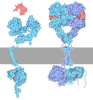
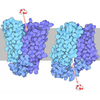
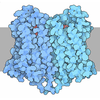
- Assembly
| Deposited unit | 
|
|---|---|
| 1 |
|
-Components
| #1: Protein | Mass: 173360.250 Da / Num. of mol.: 4 Source method: isolated from a genetically manipulated source Source: (gene. exp.) Homo sapiens (human) / Gene: BTE48_16205, malE, Z5632, ECs5017, TRPC3, TRP3 / Production host: Homo sapiens (human) / References: UniProt: P0AEY0, UniProt: Q13507#2: Chemical | ChemComp-CA /   Mass: 40.078 Da / Num. of mol.: 8 / Source method: obtained synthetically / Formula: Ca Mass: 40.078 Da / Num. of mol.: 8 / Source method: obtained synthetically / Formula: Ca#3: Chemical | ChemComp-ZN /   Mass: 65.409 Da / Num. of mol.: 4 / Source method: obtained synthetically / Formula: Zn Mass: 65.409 Da / Num. of mol.: 4 / Source method: obtained synthetically / Formula: Zn#4: Chemical | ChemComp-A1L5I / [( Mass: 620.986 Da / Num. of mol.: 4 / Source method: obtained synthetically / Formula: C39H72O5 / Feature type: SUBJECT OF INVESTIGATION #5: Water | ChemComp-HOH / |  Mass: 18.015 Da / Num. of mol.: 32 / Source method: isolated from a natural source / Formula: H2O Mass: 18.015 Da / Num. of mol.: 32 / Source method: isolated from a natural source / Formula: H2OHas ligand of interest | Y | Has protein modification | N | |
|---|
-Experimental details
-Experiment
| Experiment | Method: ELECTRON MICROSCOPY |
|---|---|
| EM experiment | Aggregation state: PARTICLE / 3D reconstruction method: single particle reconstruction |
- Sample preparation
| Component | Name: TRPC3 tetramer solubilized with 4F peptide / Type: COMPLEX / Entity ID: #1 / Source: RECOMBINANT |
|---|---|
| Source (natural) | Organism: Homo sapiens (human) |
| Source (recombinant) | Organism: Homo sapiens (human) |
| Buffer solution | pH: 8 |
| Specimen | Embedding applied: NO / Shadowing applied: NO / Staining applied: NO / Vitrification applied: YES |
| Vitrification | Cryogen name: ETHANE |
- Electron microscopy imaging
| Experimental equipment |  Model: Titan Krios / Image courtesy: FEI Company |
|---|---|
| Microscopy | Model: TFS KRIOS |
| Electron gun | Electron source:  FIELD EMISSION GUN / Accelerating voltage: 300 kV / Illumination mode: FLOOD BEAM FIELD EMISSION GUN / Accelerating voltage: 300 kV / Illumination mode: FLOOD BEAM |
| Electron lens | Mode: BRIGHT FIELD / Nominal defocus max: 1800 nm / Nominal defocus min: 1500 nm |
| Image recording | Electron dose: 50 e/Å2 / Film or detector model: GATAN K3 (6k x 4k) |
- Processing
| EM software |
| |||||||||
|---|---|---|---|---|---|---|---|---|---|---|
| CTF correction | Type: NONE | |||||||||
| Particle selection | Num. of particles selected: 591309 | |||||||||
| 3D reconstruction | Resolution: 2.72 Å / Resolution method: FSC 0.143 CUT-OFF / Num. of particles: 65480 / Symmetry type: POINT |
