 Movie
Movie Controller

[English] 日本語
 Yorodumi
- PDB-9uxw: RNA polymerase II elongation complex stalled at SHL(-0.5) in the ... -
+ Open data

- Basic information
| Entry | Database: PDB / ID: 9uxw | ||||||||||||||||||||||||||||||||||||||||||
|---|---|---|---|---|---|---|---|---|---|---|---|---|---|---|---|---|---|---|---|---|---|---|---|---|---|---|---|---|---|---|---|---|---|---|---|---|---|---|---|---|---|---|---|
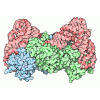
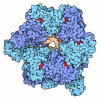
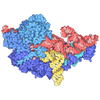
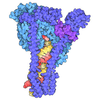
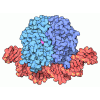
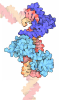
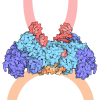
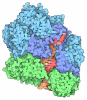
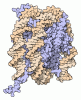
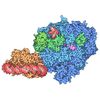
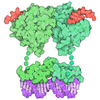
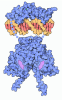
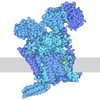
| Title | RNA polymerase II elongation complex stalled at SHL(-0.5) in the hexasome of the overlapping dinucleosome | ||||||||||||||||||||||||||||||||||||||||||
 Components Components |
| ||||||||||||||||||||||||||||||||||||||||||
 Keywords Keywords | TRANSCRIPTION / Chromatin / RNA Polymerase II / Overlapping dinucleosome | ||||||||||||||||||||||||||||||||||||||||||
| Function / homology |  Function and homology information Function and homology informationco-transcriptional lncRNA 3' end processing, cleavage and polyadenylation pathway / intracellular phosphate ion homeostasis / chromatin-protein adaptor activity / nuclear-transcribed mRNA catabolic process, deadenylation-dependent decay / kinetochore assembly / positive regulation of nuclear-transcribed mRNA poly(A) tail shortening / termination of RNA polymerase II transcription / termination of RNA polymerase I transcription / maintenance of transcriptional fidelity during transcription elongation by RNA polymerase II / positive regulation of translational initiation ...co-transcriptional lncRNA 3' end processing, cleavage and polyadenylation pathway / intracellular phosphate ion homeostasis / chromatin-protein adaptor activity / nuclear-transcribed mRNA catabolic process, deadenylation-dependent decay / kinetochore assembly / positive regulation of nuclear-transcribed mRNA poly(A) tail shortening / termination of RNA polymerase II transcription / termination of RNA polymerase I transcription / maintenance of transcriptional fidelity during transcription elongation by RNA polymerase II / positive regulation of translational initiation / transcription initiation at RNA polymerase I promoter / nuclear-transcribed mRNA catabolic process / mitotic metaphase chromosome alignment / negative regulation of tumor necrosis factor-mediated signaling pathway / nucleolar large rRNA transcription by RNA polymerase I / RNA polymerase II core promoter sequence-specific DNA binding / termination of RNA polymerase III transcription / transcription initiation at RNA polymerase III promoter / RNA polymerase I complex / RNA polymerase III complex / transcription elongation by RNA polymerase I / tRNA transcription by RNA polymerase III / negative regulation of megakaryocyte differentiation / RNA polymerase II, core complex / protein localization to CENP-A containing chromatin / Replacement of protamines by nucleosomes in the male pronucleus / CENP-A containing nucleosome / Packaging Of Telomere Ends / transcription-coupled nucleotide-excision repair / Recognition and association of DNA glycosylase with site containing an affected purine / Cleavage of the damaged purine / translation initiation factor binding / telomere organization / ChAHP complex assembly / Deposition of new CENPA-containing nucleosomes at the centromere / Recognition and association of DNA glycosylase with site containing an affected pyrimidine / Cleavage of the damaged pyrimidine / RNA Polymerase I Promoter Opening / Inhibition of DNA recombination at telomere / Assembly of the ORC complex at the origin of replication / FXIIa activates plasma kallikrein-kinin system / SUMOylation of chromatin organization proteins / Regulation of endogenous retroelements by the Human Silencing Hub (HUSH) complex / Meiotic synapsis / DNA methylation / Condensation of Prophase Chromosomes / Chromatin modifications during the maternal to zygotic transition (MZT) / HCMV Late Events / SIRT1 negatively regulates rRNA expression / ERCC6 (CSB) and EHMT2 (G9a) positively regulate rRNA expression / PRC2 methylates histones and DNA / NuRD complex assembly / Regulation of endogenous retroelements by KRAB-ZFP proteins / Interaction of NuRD complexes with transcription factors / Defective pyroptosis / HDACs deacetylate histones / CHD1 and CHD2 subfamily / Transcriptional regulation by small RNAs / lipopolysaccharide binding / Regulation of endogenous retroelements by Piwi-interacting RNAs (piRNAs) / RNA Polymerase I Promoter Escape / Nonhomologous End-Joining (NHEJ) / P-body / transcription initiation at RNA polymerase II promoter / CHD6, CHD7, CHD8, CHD9 subfamily / HDMs demethylate histones / Activated PKN1 stimulates transcription of AR (androgen receptor) regulated genes KLK2 and KLK3 / RUNX1 regulates genes involved in megakaryocyte differentiation and platelet function / transcription elongation by RNA polymerase II / Negative Regulation of CDH1 Gene Transcription / NoRC negatively regulates rRNA expression / PKMTs methylate histone lysines / G2/M DNA damage checkpoint / Formation of the beta-catenin:TCF transactivating complex / B-WICH complex positively regulates rRNA expression / DNA Damage/Telomere Stress Induced Senescence / kinetochore / transcription by RNA polymerase II / Meiotic recombination / Pre-NOTCH Transcription and Translation / Activation of anterior HOX genes in hindbrain development during early embryogenesis / ribonucleoside binding / Transcriptional regulation of granulopoiesis / RMTs methylate histone arginines / HCMV Early Events / Metalloprotease DUBs / DNA-directed RNA polymerase / nucleosomal DNA binding / innate immune response in mucosa / DNA-directed RNA polymerase activity / structural constituent of chromatin / nucleosome assembly / Regulation of PD-L1(CD274) transcription / UCH proteinases / positive regulation of cell growth / nucleosome / single-stranded DNA binding / HATs acetylate histones / E3 ubiquitin ligases ubiquitinate target proteins / killing of cells of another organism Similarity search - Function | ||||||||||||||||||||||||||||||||||||||||||
| Biological species |  Homo sapiens (human) Homo sapiens (human) Komagataella phaffii GS115 (fungus) Komagataella phaffii GS115 (fungus)synthetic construct (others) | ||||||||||||||||||||||||||||||||||||||||||
| Method | ELECTRON MICROSCOPY / single particle reconstruction / cryo EM / Resolution: 3.74 Å | ||||||||||||||||||||||||||||||||||||||||||
 Authors Authors | Chen, Z. / Ho, C. / Tanaka, H. / Kujirai, T. / Ogasawara, M. / Ehara, H. / Sekine, S. / Takizawa, Y. / Kurumizaka, H. | ||||||||||||||||||||||||||||||||||||||||||
| Funding support |  Japan, 13items Japan, 13items
| ||||||||||||||||||||||||||||||||||||||||||
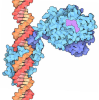
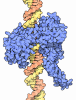
 Citation Citation | Journal: Nat Struct Mol Biol / Year: 2026 Title: Structural basis of asymmetric transcription through a composite nucleosome formed by a hexasome and an octasome. Authors: Zhihui Chen / Cheng-Han Ho / Hiroki Tanaka / Tomoya Kujirai / Mitsuo Ogasawara / Haruhiko Ehara / Shun-Ichi Sekine / Yoshimasa Takizawa / Hitoshi Kurumizaka / Abstract: The overlapping dinucleosome (OLDN), a composite chromatin particle consisting of a hexasome and a canonical octasome, forms immediately downstream of transcription start sites, probably through ...The overlapping dinucleosome (OLDN), a composite chromatin particle consisting of a hexasome and a canonical octasome, forms immediately downstream of transcription start sites, probably through chromatin remodeling activity, and has been proposed to act as a transient regulatory intermediate during transcription. Nevertheless, how RNA polymerase II (RNAPII) engages with and transcribes through this unusual structure has remained unclear. Here we reconstituted OLDNs in vitro and performed transcription assays with RNAPII. We found that transcription efficiency was markedly higher when RNAPII initiated from the hexasome side than from the octasome side. Cryo-electron microscopy further revealed that transcription from the hexasome side induced pronounced conformational rearrangements, in which RNAPII progression dramatically opened the hexasome-octasome interface. These results identify a mechanism by which RNAPII senses the intrinsic transcriptional polarity of OLDNs and suggest that OLDNs function as dynamic, directionally sensitive regulators of transcription elongation. | ||||||||||||||||||||||||||||||||||||||||||
| History |
|
- Structure visualization
| Structure viewer | Molecule: MolmilJmol/JSmol |
|---|
- Downloads & links
-Download
| PDBx/mmCIF format | 9uxw.cif.gz | 1.1 MB | Display | PDBx/mmCIF format |
|---|---|---|---|---|
| PDB format | pdb9uxw.ent.gz | Display | PDB format | |
| PDBx/mmJSON format | 9uxw.json.gz | Tree view | PDBx/mmJSON format | |
| Others |  Other downloads Other downloads |
-Validation report
| Arichive directory | https://data.pdbj.org/pub/pdb/validation_reports/ux/9uxwftp://data.pdbj.org/pub/pdb/validation_reports/ux/9uxw | HTTPS FTP |
|---|
-Related structure data
| Related structure data |  64603MC  9uz9C M: map data used to model this data C: citing same article ( |
|---|---|
| Similar structure data |

-Links
 PDBj
PDBj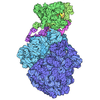

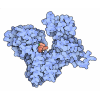
- Assembly
| Deposited unit | 
|
|---|---|
| 1 |
|
-Components
-DNA-directed RNA polymerase ... , 3 types, 3 molecules ABI
| #1: Protein | Mass: 194107.422 Da / Num. of mol.: 1 / Source method: isolated from a natural source / Source: (natural) Komagataella phaffii GS115 (fungus) / References: UniProt: C4R4Y0, DNA-directed RNA polymerase |
|---|---|
| #2: Protein | Mass: 139746.094 Da / Num. of mol.: 1 / Source method: isolated from a natural source / Source: (natural) Komagataella phaffii GS115 (fungus) / References: UniProt: C4QZQ7, DNA-directed RNA polymerase |
| #9: Protein | Mass: 13612.320 Da / Num. of mol.: 1 / Source method: isolated from a natural source / Source: (natural) Komagataella phaffii GS115 (fungus) / References: UniProt: F2QPE6 |
-RNA polymerase II ... , 4 types, 4 molecules CDGK
| #3: Protein | Mass: 34216.293 Da / Num. of mol.: 1 / Source method: isolated from a natural source / Source: (natural) Komagataella phaffii GS115 (fungus) / References: UniProt: C4R7L2 |
|---|---|
| #4: Protein | Mass: 20622.980 Da / Num. of mol.: 1 / Source method: isolated from a natural source / Source: (natural) Komagataella phaffii GS115 (fungus) / References: UniProt: C4R2U9 |
| #7: Protein | Mass: 18802.625 Da / Num. of mol.: 1 / Source method: isolated from a natural source / Source: (natural) Komagataella phaffii GS115 (fungus) / References: UniProt: C4R9A1 |
| #11: Protein | Mass: 13832.896 Da / Num. of mol.: 1 / Source method: isolated from a natural source / Source: (natural) Komagataella phaffii GS115 (fungus) / References: UniProt: C4R3Z5 |
-RNA polymerase subunit ... , 4 types, 4 molecules EFJL
| #5: Protein | Mass: 24962.680 Da / Num. of mol.: 1 / Source method: isolated from a natural source / Source: (natural) Komagataella phaffii GS115 (fungus) / References: UniProt: C4R3P8 |
|---|---|
| #6: Protein | Mass: 17803.588 Da / Num. of mol.: 1 / Source method: isolated from a natural source / Source: (natural) Komagataella phaffii GS115 (fungus) / References: UniProt: C4R1V1 |
| #10: Protein | Mass: 8554.064 Da / Num. of mol.: 1 / Source method: isolated from a natural source / Source: (natural) Komagataella phaffii GS115 (fungus) / References: UniProt: C4R009 |
| #12: Protein | Mass: 7862.048 Da / Num. of mol.: 1 / Source method: isolated from a natural source / Source: (natural) Komagataella phaffii GS115 (fungus) / References: UniProt: F2QMI1 |
-Protein , 5 types, 15 molecules Haekmbflncgodhp
| #8: Protein | Mass: 16249.220 Da / Num. of mol.: 1 / Source method: isolated from a natural source / Source: (natural) Komagataella phaffii GS115 (fungus) / References: UniProt: C4R273 | ||||||
|---|---|---|---|---|---|---|---|
| #15: Protein | Mass: 15643.262 Da / Num. of mol.: 4 Source method: isolated from a genetically manipulated source Source: (gene. exp.) Homo sapiens (human) / Gene: H3F3A, H3.3A, H3F3, PP781, H3F3B, H3.3B / Production host:   Escherichia coli (E. coli) / References: UniProt: P84243 Escherichia coli (E. coli) / References: UniProt: P84243#16: Protein | Mass: 11676.703 Da / Num. of mol.: 4 Source method: isolated from a genetically manipulated source Source: (gene. exp.) Homo sapiens (human)Gene: H4C1, H4/A, H4FA, HIST1H4A, H4C2, H4/I, H4FI, HIST1H4B, H4C3, H4/G, H4FG, HIST1H4C, H4C4, H4/B, H4FB, HIST1H4D, H4C5, H4/J, H4FJ, HIST1H4E, H4C6, H4/C, H4FC, HIST1H4F, H4C8, H4/H, H4FH, ...Gene: H4C1, H4/A, H4FA, HIST1H4A, H4C2, H4/I, H4FI, HIST1H4B, H4C3, H4/G, H4FG, HIST1H4C, H4C4, H4/B, H4FB, HIST1H4D, H4C5, H4/J, H4FJ, HIST1H4E, H4C6, H4/C, H4FC, HIST1H4F, H4C8, H4/H, H4FH, HIST1H4H, H4C9, H4/M, H4FM, HIST1H4I, H4C11, H4/E, H4FE, HIST1H4J, H4C12, H4/D, H4FD, HIST1H4K, H4C13, H4/K, H4FK, HIST1H4L, H4C14, H4/N, H4F2, H4FN, HIST2H4, HIST2H4A, H4C15, H4/O, H4FO, HIST2H4B, H4C16, H4-16, HIST4H4 Production host: Escherichia coli BL21(DE3) (bacteria) / References: UniProt: P62805#17: Protein | Mass: 14447.825 Da / Num. of mol.: 3 Source method: isolated from a genetically manipulated source Source: (gene. exp.) Homo sapiens (human) / Gene: H2AC4, H2AFM, HIST1H2AB, H2AC8, H2AFA, HIST1H2AE / Production host: Escherichia coli BL21(DE3) (bacteria) / References: UniProt: P04908#18: Protein | Mass: 14217.516 Da / Num. of mol.: 3 Source method: isolated from a genetically manipulated source Source: (gene. exp.) Homo sapiens (human) / Gene: H2BC11, H2BFR, HIST1H2BJ / Production host: Escherichia coli BL21(DE3) (bacteria) / References: UniProt: P06899 |
-RNA chain , 1 types, 1 molecules P
| #13: RNA chain | Mass: 4312.555 Da / Num. of mol.: 1 / Source method: obtained synthetically / Source: (synth.) synthetic construct (others) |
|---|
-DNA chain , 2 types, 2 molecules TN
| #14: DNA chain | Mass: 79008.250 Da / Num. of mol.: 1 / Source method: obtained synthetically / Source: (synth.) synthetic construct (others) |
|---|---|
| #19: DNA chain | Mass: 77862.406 Da / Num. of mol.: 1 / Source method: obtained synthetically / Source: (synth.) synthetic construct (others) |
-Non-polymers , 2 types, 9 molecules 

| #20: Chemical | ChemComp-ZN /  Mass: 65.409 Da / Num. of mol.: 8 / Source method: obtained synthetically / Formula: Zn Mass: 65.409 Da / Num. of mol.: 8 / Source method: obtained synthetically / Formula: Zn#21: Chemical | ChemComp-MG / |  Mass: 24.305 Da / Num. of mol.: 1 / Source method: obtained synthetically / Formula: Mg Mass: 24.305 Da / Num. of mol.: 1 / Source method: obtained synthetically / Formula: Mg |
|---|
-Details
| Has ligand of interest | N |
|---|---|
| Has protein modification | N |
-Experimental details
-Experiment
| Experiment | Method: ELECTRON MICROSCOPY |
|---|---|
| EM experiment | Aggregation state: PARTICLE / 3D reconstruction method: single particle reconstruction |
- Sample preparation
| Component |
| ||||||||||||||||||||||||||||||||||||
|---|---|---|---|---|---|---|---|---|---|---|---|---|---|---|---|---|---|---|---|---|---|---|---|---|---|---|---|---|---|---|---|---|---|---|---|---|---|
| Molecular weight | Experimental value: NO | ||||||||||||||||||||||||||||||||||||
| Source (natural) |
| ||||||||||||||||||||||||||||||||||||
| Source (recombinant) | Organism: Escherichia coli BL21(DE3) (bacteria) | ||||||||||||||||||||||||||||||||||||
| Buffer solution | pH: 7.5 | ||||||||||||||||||||||||||||||||||||
| Specimen | Embedding applied: NO / Shadowing applied: NO / Staining applied: NO / Vitrification applied: YES | ||||||||||||||||||||||||||||||||||||
| Vitrification | Cryogen name: ETHANE |
- Electron microscopy imaging
| Experimental equipment |  Model: Titan Krios / Image courtesy: FEI Company |
|---|---|
| Microscopy | Model: TFS KRIOS |
| Electron gun | Electron source:  FIELD EMISSION GUN / Accelerating voltage: 300 kV / Illumination mode: FLOOD BEAM FIELD EMISSION GUN / Accelerating voltage: 300 kV / Illumination mode: FLOOD BEAM |
| Electron lens | Mode: BRIGHT FIELD / Nominal defocus max: 2500 nm / Nominal defocus min: 1000 nm |
| Image recording | Electron dose: 59.8 e/Å2 / Film or detector model: GATAN K3 BIOQUANTUM (6k x 4k) |
- Processing
| EM software |
| ||||||||||||||||||||
|---|---|---|---|---|---|---|---|---|---|---|---|---|---|---|---|---|---|---|---|---|---|
| CTF correction | Type: NONE | ||||||||||||||||||||
| 3D reconstruction | Resolution: 3.74 Å / Resolution method: FSC 0.143 CUT-OFF / Num. of particles: 33000 / Symmetry type: POINT | ||||||||||||||||||||
| Refinement | Highest resolution: 3.74 Å Stereochemistry target values: REAL-SPACE (WEIGHTED MAP SUM AT ATOM CENTERS) |
