 Movie
Movie Controller


+ Open data

- Basic information
| Entry | Database: PDB / ID: 9uux | ||||||||||||||||||||||||
|---|---|---|---|---|---|---|---|---|---|---|---|---|---|---|---|---|---|---|---|---|---|---|---|---|---|
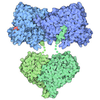
| Title | The complex of human pMEK1 and ERK1 pT202 (ANP) | ||||||||||||||||||||||||
 Components Components |
| ||||||||||||||||||||||||
 Keywords Keywords | TRANSFERASE / MEK1. ERK1 / Complex / Kinase / MAPK pathway | ||||||||||||||||||||||||
| Function / homology |  Function and homology information Function and homology informationnegative regulation of cholesterol efflux / epithelial cell proliferation involved in lung morphogenesis / negative regulation of homotypic cell-cell adhesion / positive regulation of endodermal cell differentiation / negative regulation of hypoxia-induced intrinsic apoptotic signaling pathway / positive regulation of xenophagy / xenophagy / regulation of vascular associated smooth muscle contraction / regulation of axon regeneration / mitogen-activated protein kinase kinase ...negative regulation of cholesterol efflux / epithelial cell proliferation involved in lung morphogenesis / negative regulation of homotypic cell-cell adhesion / positive regulation of endodermal cell differentiation / negative regulation of hypoxia-induced intrinsic apoptotic signaling pathway / positive regulation of xenophagy / xenophagy / regulation of vascular associated smooth muscle contraction / regulation of axon regeneration / mitogen-activated protein kinase kinase / negative regulation of T cell mediated immune response to tumor cell / positive regulation of muscle contraction / placenta blood vessel development / Golgi inheritance / MAP kinase scaffold activity / RAF-independent MAPK1/3 activation / Suppression of apoptosis / cerebellar cortex formation / labyrinthine layer development / Gastrin-CREB signalling pathway via PKC and MAPK / Signaling by Activin / melanosome transport / cardiac neural crest cell development involved in heart development / interleukin-34-mediated signaling pathway / caveolin-mediated endocytosis / response to epidermal growth factor / Signaling by NODAL / Signaling by MAP2K mutants / RSK activation / ERKs are inactivated / positive regulation of cyclase activity / peptidyl-tyrosine autophosphorylation / type B pancreatic cell proliferation / phosphorylation / Regulation of the apoptosome activity / Golgi Cisternae Pericentriolar Stack Reorganization / central nervous system neuron differentiation / positive regulation of macrophage proliferation / cartilage development / outer ear morphogenesis / vesicle transport along microtubule / : / positive regulation of Ras protein signal transduction / regulation of Golgi inheritance / Signaling by LTK in cancer / mitogen-activated protein kinase kinase kinase binding / interleukin-1-mediated signaling pathway / positive regulation of axonogenesis / trachea formation / triglyceride homeostasis / regulation of early endosome to late endosome transport / Negative feedback regulation of MAPK pathway / regulation of stress-activated MAPK cascade / IFNG signaling activates MAPKs / positive regulation of neuroinflammatory response / Frs2-mediated activation / MAPK3 (ERK1) activation / Activation of the AP-1 family of transcription factors / ERBB2-ERBB3 signaling pathway / response to exogenous dsRNA / RUNX2 regulates osteoblast differentiation / ERK/MAPK targets / regulation of cytoskeleton organization / positive regulation of macrophage chemotaxis / face development / MAP kinase kinase activity / endodermal cell differentiation / regulation of neurotransmitter receptor localization to postsynaptic specialization membrane / Bergmann glial cell differentiation / positive regulation of protein serine/threonine kinase activity / thyroid gland development / pseudopodium / lung morphogenesis / positive regulation of telomere maintenance / positive regulation of ATP biosynthetic process / MAP kinase activity / regulation of ossification / Uptake and function of anthrax toxins / Advanced glycosylation endproduct receptor signaling / mitogen-activated protein kinase / Regulation of HSF1-mediated heat shock response / Estrogen-dependent nuclear events downstream of ESR-membrane signaling / RHO GTPases Activate NADPH Oxidases / Signal attenuation / protein kinase activator activity / BMP signaling pathway / RHO GTPases Activate WASPs and WAVEs / response to axon injury / Growth hormone receptor signaling / Schwann cell development / stress-activated MAPK cascade / phosphatase binding / keratinocyte differentiation / ERK1 and ERK2 cascade / NPAS4 regulates expression of target genes / phosphotyrosine residue binding / signal transduction in response to DNA damage / neuron projection morphogenesis / negative regulation of TORC1 signaling / Nuclear events stimulated by ALK signaling in cancer Similarity search - Function | ||||||||||||||||||||||||
| Biological species |  Homo sapiens (human) Homo sapiens (human) | ||||||||||||||||||||||||
| Method | ELECTRON MICROSCOPY / single particle reconstruction / cryo EM / Resolution: 3.12 Å | ||||||||||||||||||||||||
 Authors Authors | Peng, C. / Sun, Y. / Liu, S. / Zhou, F. / Hu, Q. | ||||||||||||||||||||||||
| Funding support |  China, 1items China, 1items
| ||||||||||||||||||||||||
 Citation Citation | Journal: Biorxiv / Year: 2026 Title: Mechanistic insight into the phosphorylation of ERK by MEK Authors: Sun, Y. / Peng, C. / Liu, S. / Zhou, F. / Huang, G. / Wang, J. / Hu, Q. | ||||||||||||||||||||||||
| History |
|
- Structure visualization
| Structure viewer | Molecule: MolmilJmol/JSmol |
|---|
- Downloads & links
-Download
| PDBx/mmCIF format | 9uux.cif.gz | 149.1 KB | Display | PDBx/mmCIF format |
|---|---|---|---|---|
| PDB format | pdb9uux.ent.gz | 111.5 KB | Display | PDB format |
| PDBx/mmJSON format | 9uux.json.gz | Tree view | PDBx/mmJSON format | |
| Others |  Other downloads Other downloads |
-Validation report
| Arichive directory | https://data.pdbj.org/pub/pdb/validation_reports/uu/9uuxftp://data.pdbj.org/pub/pdb/validation_reports/uu/9uux | HTTPS FTP |
|---|
-Related structure data
| Related structure data |  64519MC  9uurC  9uw3C  9uw4C M: map data used to model this data C: citing same article ( |
|---|---|
| Similar structure data |


-Links
 PDBj
PDBj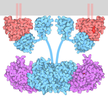






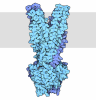
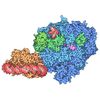
- Assembly
| Deposited unit | 
|
|---|---|
| 1 |
|
-Components
| #1: Protein | Mass: 45001.320 Da / Num. of mol.: 1 Source method: isolated from a genetically manipulated source Details: Recombinant human MEK1 with additional C-terminal His-tag expressed in E. coli, with phosphorylation sites on S218 and S222. Source: (gene. exp.) Homo sapiens (human) / Gene: MAP2K1, MEK1, PRKMK1 / Production host:   Escherichia coli (E. coli) Escherichia coli (E. coli)References: UniProt: Q02750, mitogen-activated protein kinase kinase | ||||||
|---|---|---|---|---|---|---|---|
| #2: Protein | Mass: 44479.754 Da / Num. of mol.: 1 Source method: isolated from a genetically manipulated source Details: Recombinant human ERK1 with additional C-terminal His-tag expressed in E. coli, with phosphorylation site on T202. Source: (gene. exp.) Homo sapiens (human) / Gene: MAPK3, ERK1, PRKM3 / Production host: Escherichia coli (E. coli)References: UniProt: P27361, mitogen-activated protein kinase | ||||||
| #3: Chemical | 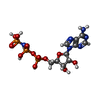 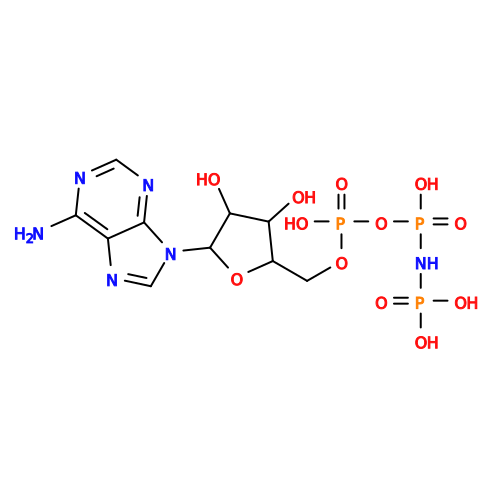 Mass: 506.196 Da / Num. of mol.: 2 / Source method: obtained synthetically / Formula: C10H17N6O12P3 / Feature type: SUBJECT OF INVESTIGATION / Comment: AMP-PNP, energy-carrying molecule analogue*YM Mass: 506.196 Da / Num. of mol.: 2 / Source method: obtained synthetically / Formula: C10H17N6O12P3 / Feature type: SUBJECT OF INVESTIGATION / Comment: AMP-PNP, energy-carrying molecule analogue*YM#4: Chemical | ChemComp-MG / |   Mass: 24.305 Da / Num. of mol.: 1 / Source method: obtained synthetically / Formula: Mg / Feature type: SUBJECT OF INVESTIGATION Mass: 24.305 Da / Num. of mol.: 1 / Source method: obtained synthetically / Formula: Mg / Feature type: SUBJECT OF INVESTIGATIONHas ligand of interest | Y | Has protein modification | Y | |
-Experimental details
-Experiment
| Experiment | Method: ELECTRON MICROSCOPY |
|---|---|
| EM experiment | Aggregation state: PARTICLE / 3D reconstruction method: single particle reconstruction |
- Sample preparation
| Component | Name: The complex of human pMEK1 and ERK1 pT202 at the presence of AMPPNP Type: COMPLEX / Entity ID: #1-#2 / Source: RECOMBINANT |
|---|---|
| Molecular weight | Experimental value: NO |
| Source (natural) | Organism: Homo sapiens (human) |
| Source (recombinant) | Organism: Escherichia coli (E. coli) |
| Buffer solution | pH: 7.4 |
| Specimen | Embedding applied: NO / Shadowing applied: NO / Staining applied: NO / Vitrification applied: YES |
| Vitrification | Cryogen name: ETHANE |
- Electron microscopy imaging
| Experimental equipment |  Model: Titan Krios / Image courtesy: FEI Company |
|---|---|
| Microscopy | Model: TFS KRIOS |
| Electron gun | Electron source:  FIELD EMISSION GUN / Accelerating voltage: 300 kV / Illumination mode: SPOT SCAN FIELD EMISSION GUN / Accelerating voltage: 300 kV / Illumination mode: SPOT SCAN |
| Electron lens | Mode: BRIGHT FIELD / Nominal defocus max: 1800 nm / Nominal defocus min: 1100 nm |
| Image recording | Electron dose: 50 e/Å2 / Film or detector model: GATAN K3 (6k x 4k) |
- Processing
| EM software |
| ||||||||||||||||||||||||||||||||||||
|---|---|---|---|---|---|---|---|---|---|---|---|---|---|---|---|---|---|---|---|---|---|---|---|---|---|---|---|---|---|---|---|---|---|---|---|---|---|
| CTF correction | Type: PHASE FLIPPING AND AMPLITUDE CORRECTION | ||||||||||||||||||||||||||||||||||||
| 3D reconstruction | Resolution: 3.12 Å / Resolution method: FSC 0.143 CUT-OFF / Num. of particles: 555122 / Symmetry type: POINT | ||||||||||||||||||||||||||||||||||||
| Atomic model building | Source name: AlphaFold / Type: in silico model |
