[English] 日本語
Yorodumi
- PDB-9uth: DPF3b in complex with H3K14cr peptide -

+
Open data


ID or keywords:

Loading...

-
Basic information

Entry
Database: PDB / ID: 9uth
TitleDPF3b in complex with H3K14cr peptide
Components
  • Histone H3.3
  • Zinc finger protein DPF3
KeywordsPEPTIDE BINDING PROTEIN / DPF3b / H3K14 crotonylation
Function / homology
Function and homology information


Barr body / brahma complex / nBAF complex / Formation of the canonical BAF (cBAF) complex / negative regulation of chromosome condensation / Formation of neuronal progenitor and neuronal BAF (npBAF and nBAF) / pericentric heterochromatin formation / inner kinetochore / regulation of G0 to G1 transition / muscle cell differentiation ...Barr body / brahma complex / nBAF complex / Formation of the canonical BAF (cBAF) complex / negative regulation of chromosome condensation / Formation of neuronal progenitor and neuronal BAF (npBAF and nBAF) / pericentric heterochromatin formation / inner kinetochore / regulation of G0 to G1 transition / muscle cell differentiation / regulation of nucleotide-excision repair / oocyte maturation / regulation of mitotic metaphase/anaphase transition / SWI/SNF complex / muscle organ development / nucleosomal DNA binding / nucleus organization / positive regulation of double-strand break repair / Regulation of MITF-M-dependent genes involved in pigmentation / regulation of G1/S transition of mitotic cell cycle / spermatid development / positive regulation of myoblast differentiation / single fertilization / subtelomeric heterochromatin formation / RNA polymerase II core promoter sequence-specific DNA binding / Replacement of protamines by nucleosomes in the male pronucleus / embryo implantation / telomere organization / RNA Polymerase I Promoter Opening / Inhibition of DNA recombination at telomere / Assembly of the ORC complex at the origin of replication / Regulation of endogenous retroelements by the Human Silencing Hub (HUSH) complex / DNA methylation / Condensation of Prophase Chromosomes / Chromatin modifications during the maternal to zygotic transition (MZT) / SIRT1 negatively regulates rRNA expression / ERCC6 (CSB) and EHMT2 (G9a) positively regulate rRNA expression / PRC2 methylates histones and DNA / Regulation of endogenous retroelements by KRAB-ZFP proteins / Defective pyroptosis / positive regulation of cell differentiation / Regulation of endogenous retroelements by Piwi-interacting RNAs (piRNAs) / RNA Polymerase I Promoter Escape / Transcriptional regulation by small RNAs / Formation of the beta-catenin:TCF transactivating complex / Activated PKN1 stimulates transcription of AR (androgen receptor) regulated genes KLK2 and KLK3 / RUNX1 regulates genes involved in megakaryocyte differentiation and platelet function / NoRC negatively regulates rRNA expression / Negative Regulation of CDH1 Gene Transcription / B-WICH complex positively regulates rRNA expression / male gonad development / Meiotic recombination / Pre-NOTCH Transcription and Translation / multicellular organism growth / Activation of anterior HOX genes in hindbrain development during early embryogenesis / Transcriptional regulation of granulopoiesis / osteoblast differentiation / structural constituent of chromatin / nucleosome / nervous system development / nucleosome assembly / Factors involved in megakaryocyte development and platelet production / MLL4 and MLL3 complexes regulate expression of PPARG target genes in adipogenesis and hepatic steatosis / RUNX1 regulates transcription of genes involved in differentiation of HSCs / positive regulation of cell growth / Senescence-Associated Secretory Phenotype (SASP) / Oxidative Stress Induced Senescence / Estrogen-dependent gene expression / chromosome, telomeric region / cell population proliferation / RNA polymerase II cis-regulatory region sequence-specific DNA binding / chromatin remodeling / Amyloid fiber formation / protein heterodimerization activity / regulation of transcription by RNA polymerase II / chromatin / protein-containing complex / extracellular exosome / extracellular region / zinc ion binding / nucleoplasm / nucleus
Similarity search - Function
DPF1-3, N-terminal domain / DPF1-3, N-terminal / zinc finger / PHD-finger / Zinc finger C2H2 type domain profile. / Zinc finger PHD-type signature. / Zinc finger C2H2 superfamily / Zinc finger C2H2 type domain signature. / Zinc finger PHD-type profile. / Zinc finger C2H2-type ...DPF1-3, N-terminal domain / DPF1-3, N-terminal / zinc finger / PHD-finger / Zinc finger C2H2 type domain profile. / Zinc finger PHD-type signature. / Zinc finger C2H2 superfamily / Zinc finger C2H2 type domain signature. / Zinc finger PHD-type profile. / Zinc finger C2H2-type / Zinc finger, PHD-finger / Zinc finger, PHD-type / PHD zinc finger / Zinc finger, FYVE/PHD-type / Histone H3 signature 1. / Histone H3 signature 2. / Histone H3 / Histone H3/CENP-A / Histone H2A/H2B/H3 / Core histone H2A/H2B/H3/H4 domain / Histone-fold / Zinc finger, RING/FYVE/PHD-type
Similarity search - Domain/homology
Histone H3.3 / Zinc finger protein DPF3
Similarity search - Component
Biological speciesHomo sapiens (human)
MethodX-RAY DIFFRACTION / SYNCHROTRON / MOLECULAR REPLACEMENT / Resolution: 2.69 Å
AuthorsFeng, F. / Huang, J. / Xiang, B. / Li, H.
Funding support China, 1items
OrganizationGrant numberCountry
National Natural Science Foundation of China (NSFC) China
CitationJournal: To Be Published
Title: DPF3b in complex with H3K14cr peptide
Authors: Feng, F. / Huang, J. / Xiang, B. / Li, H.
History
DepositionMay 3, 2025Deposition site: PDBJ / Processing site: PDBC
Revision 1.0May 6, 2026Provider: repository / Type: Initial release

-
Structure visualization

Structure viewerMolecule:
MolmilJmol/JSmol

Downloads & links

-
Assembly

Deposited unit
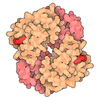
A: Zinc finger protein DPF3
B: Histone H3.3
C: Zinc finger protein DPF3
D: Histone H3.3
E: Zinc finger protein DPF3
F: Histone H3.3
G: Zinc finger protein DPF3
H: Histone H3.3
hetero molecules


Theoretical massNumber of molelcules
Total (without water)63,37824
Polymers62,3318
Non-polymers1,04716
Water2,612145
1
A: Zinc finger protein DPF3
B: Histone H3.3
C: Zinc finger protein DPF3
D: Histone H3.3
hetero molecules


Theoretical massNumber of molelcules
Total (without water)31,68912
Polymers31,1664
Non-polymers5238
Water724
TypeNameSymmetry operationNumber
identity operation1_555x,y,z1
Buried area6190 Å2
ΔGint-39 kcal/mol
Surface area14890 Å2
MethodPISA
2
E: Zinc finger protein DPF3
F: Histone H3.3
G: Zinc finger protein DPF3
H: Histone H3.3
hetero molecules


Theoretical massNumber of molelcules
Total (without water)31,68912
Polymers31,1664
Non-polymers5238
Water724
TypeNameSymmetry operationNumber
identity operation1_555x,y,z1
Buried area6030 Å2
ΔGint-24 kcal/mol
Surface area15150 Å2
MethodPISA
Unit cell
Length a, b, c (Å)70.088, 84.253, 111.123
Angle α, β, γ (deg.)90.00, 90.00, 90.00
Int Tables number19
Space group name H-MP212121

-
Components

#1: Protein
Zinc finger protein DPF3 / BRG1-associated factor 45C / BAF45C / Zinc finger protein cer-d4


Mass: 12810.580 Da / Num. of mol.: 4
Source method: isolated from a genetically manipulated source
Source: (gene. exp.) Homo sapiens (human) / Gene: DPF3, BAF45C, CERD4 / Production host: Escherichia coli (E. coli) / References: UniProt: Q92784
#2: Protein/peptide
Histone H3.3


Mass: 2772.234 Da / Num. of mol.: 4
Source method: isolated from a genetically manipulated source
Source: (gene. exp.) Homo sapiens (human) / Gene: H3-3A, H3.3A, H3F3, H3F3A, PP781, H3-3B, H3.3B, H3F3B / Production host: Homo sapiens (human) / References: UniProt: P84243
#3: Chemical
ChemComp-ZN / ZINC ION


Mass: 65.409 Da / Num. of mol.: 16 / Source method: obtained synthetically / Formula: Zn / Feature type: SUBJECT OF INVESTIGATION
#4: Water ChemComp-HOH / water


Mass: 18.015 Da / Num. of mol.: 145 / Source method: isolated from a natural source / Formula: H2O
Has ligand of interestY
Has protein modificationY

-
Experimental details

-
Experiment

ExperimentMethod: X-RAY DIFFRACTION / Number of used crystals: 1

-
Sample preparation

CrystalDensity Matthews: 2.63 Å3/Da / Density % sol: 53.22 %
Crystal growTemperature: 277.15 K / Method: vapor diffusion, sitting drop / Details: 4 M Sodium Formate, pH 7.0

-
Data collection

DiffractionMean temperature: 100 K / Serial crystal experiment: N
Diffraction sourceSource: SYNCHROTRON / Site: SSRF / Beamline: BL17U / Wavelength: 0.97918 Å
DetectorType: DECTRIS PILATUS3 X 6M / Detector: PIXEL / Date: May 4, 2018
RadiationProtocol: SINGLE WAVELENGTH / Monochromatic (M) / Laue (L): M / Scattering type: x-ray
Radiation wavelengthWavelength: 0.97918 Å / Relative weight: 1
ReflectionResolution: 2.69→50 Å / Num. obs: 18737 / % possible obs: 99.7 % / Redundancy: 6.7 % / CC1/2: 0.996 / CC star: 0.999 / Rmerge(I) obs: 0.155 / Rpim(I) all: 0.064 / Rrim(I) all: 0.168 / Χ2: 0.881 / Net I/σ(I): 5
Reflection shell

Diffraction-ID: 1

Resolution (Å)Redundancy (%)Rmerge(I) obsNum. unique obsCC1/2CC starRpim(I) allRrim(I) allΧ2% possible all
2.7-2.756.80.6749200.8610.9620.2760.730.47999.7
2.75-2.86.70.6119230.8750.9660.2510.6620.50999.9
2.8-2.856.60.5369100.8940.9720.2230.5820.5199.6
2.85-2.916.50.4369230.9330.9820.1830.4740.59399.4
2.91-2.976.30.439180.9330.9820.1830.4690.568100
2.97-3.045.50.3469210.9540.9880.1610.3830.59299.7
3.04-3.125.50.2989080.9590.990.1370.3290.62999.7
3.12-3.270.2769410.9740.9930.1110.2980.65599.7
3.2-3.37.30.2589040.9740.9930.1010.2780.75899.9
3.3-3.47.40.2149340.9850.9960.0830.230.81599.9
3.4-3.527.20.2229300.9830.9960.0890.241.16299.9
3.52-3.667.30.1559430.9850.9960.0620.1670.989100
3.66-3.837.20.159260.9910.9980.060.1621.16499.9
3.83-4.0370.1339330.9840.9960.0540.1441.353100
4.03-4.297.10.19380.9960.9990.040.1081.125100
4.29-4.6270.0919460.9950.9990.0370.0991.07999.9
4.62-5.086.70.0829550.9970.9990.0330.0881.0499.9
5.08-5.815.90.0899530.9970.9990.0390.0970.86498.8
5.81-7.326.30.0779720.9960.9990.0330.0840.9499.5
7.32-506.30.05810390.99810.0260.0641.52299.1

-
Processing

Software
NameVersionClassification
PHENIX(1.20.1_4487: ???)refinement
SCALEPACKdata scaling
DENZOdata reduction
MOLREPphasing
PDB_EXTRACTdata extraction
RefinementMethod to determine structure: MOLECULAR REPLACEMENT / Resolution: 2.69→36.11 Å / SU ML: 0.32 / Cross valid method: THROUGHOUT / σ(F): 2.01 / Phase error: 22.09 / Stereochemistry target values: ML
RfactorNum. reflection% reflection
Rfree0.23 1318 7.06 %
Rwork0.181 --
obs0.1844 18674 99.26 %
Solvent computationShrinkage radii: 0.9 Å / VDW probe radii: 1.1 Å / Solvent model: FLAT BULK SOLVENT MODEL
Refinement stepCycle: LAST / Resolution: 2.69→36.11 Å
ProteinNucleic acidLigandSolventTotal
Num. atoms4270 0 16 145 4431
Refine LS restraints
Refine-IDTypeDev idealNumber
X-RAY DIFFRACTIONf_bond_d0.0034358
X-RAY DIFFRACTIONf_angle_d0.5565882
X-RAY DIFFRACTIONf_dihedral_angle_d14.3651634
X-RAY DIFFRACTIONf_chiral_restr0.039625
X-RAY DIFFRACTIONf_plane_restr0.004775
LS refinement shell
Resolution (Å)Rfactor RfreeNum. reflection RfreeRfactor RworkNum. reflection RworkRefine-ID% reflection obs (%)
2.69-2.80.29961450.24591824X-RAY DIFFRACTION96
2.8-2.930.32361610.2271889X-RAY DIFFRACTION100
2.93-3.080.28091430.22241885X-RAY DIFFRACTION100
3.08-3.270.27391590.22061911X-RAY DIFFRACTION100
3.28-3.530.25581210.20091946X-RAY DIFFRACTION100
3.53-3.880.20651400.16821952X-RAY DIFFRACTION100
3.88-4.440.18891590.14911929X-RAY DIFFRACTION100
4.44-5.590.21231380.14611969X-RAY DIFFRACTION100
5.59-36.110.18161520.15912051X-RAY DIFFRACTION99

+
About Yorodumi

-
News

-
Feb 9, 2022. New format data for meta-information of EMDB entries

New format data for meta-information of EMDB entries

  • Version 3 of the EMDB header file is now the official format.
  • The previous official version 1.9 will be removed from the archive.

Related info.:EMDB header

External links:wwPDB to switch to version 3 of the EMDB data model

-
Aug 12, 2020. Covid-19 info

Covid-19 info

URL: https://pdbj.org/emnavi/covid19.php

New page: Covid-19 featured information page in EM Navigator.

Related info.:Covid-19 info / Mar 5, 2020. Novel coronavirus structure data

+
Mar 5, 2020. Novel coronavirus structure data

Novel coronavirus structure data

Related info.:Yorodumi Speices / Aug 12, 2020. Covid-19 info

External links:COVID-19 featured content - PDBj / Molecule of the Month (242):Coronavirus Proteases

+
Jan 31, 2019. EMDB accession codes are about to change! (news from PDBe EMDB page)

EMDB accession codes are about to change! (news from PDBe EMDB page)

  • The allocation of 4 digits for EMDB accession codes will soon come to an end. Whilst these codes will remain in use, new EMDB accession codes will include an additional digit and will expand incrementally as the available range of codes is exhausted. The current 4-digit format prefixed with “EMD-” (i.e. EMD-XXXX) will advance to a 5-digit format (i.e. EMD-XXXXX), and so on. It is currently estimated that the 4-digit codes will be depleted around Spring 2019, at which point the 5-digit format will come into force.
  • The EM Navigator/Yorodumi systems omit the EMD- prefix.

Related info.:Q: What is EMD? / ID/Accession-code notation in Yorodumi/EM Navigator

External links:EMDB Accession Codes are Changing Soon! / Contact to PDBj

+
Jul 12, 2017. Major update of PDB

Major update of PDB

  • wwPDB released updated PDB data conforming to the new PDBx/mmCIF dictionary.
  • This is a major update changing the version number from 4 to 5, and with Remediation, in which all the entries are updated.
  • In this update, many items about electron microscopy experimental information are reorganized (e.g. em_software).
  • Now, EM Navigator and Yorodumi are based on the updated data.

External links:wwPDB Remediation / Enriched Model Files Conforming to OneDep Data Standards Now Available in the PDB FTP Archive

-
Yorodumi

Thousand views of thousand structures

  • Yorodumi is a browser for structure data from EMDB, PDB, SASBDB, etc.
  • This page is also the successor to EM Navigator detail page, and also detail information page/front-end page for Omokage search.
  • The word "yorodu" (or yorozu) is an old Japanese word meaning "ten thousand". "mi" (miru) is to see.

Related info.:EMDB / PDB / SASBDB / Comparison of 3 databanks / Yorodumi Search / Aug 31, 2016. New EM Navigator & Yorodumi / Yorodumi Papers / Jmol/JSmol / Function and homology information / Changes in new EM Navigator and Yorodumi

Read more