 Movie
Movie Controller

[English] 日本語
 Yorodumi
- PDB-9uol: Cryo-EM structure of pyrene-modified TIP60 double mutant (G12C/S5... -
+ Open data

- Basic information
| Entry | Database: PDB / ID: 9uol | |||||||||||||||||||||||||||
|---|---|---|---|---|---|---|---|---|---|---|---|---|---|---|---|---|---|---|---|---|---|---|---|---|---|---|---|---|
| Title | Cryo-EM structure of pyrene-modified TIP60 double mutant (G12C/S50C) with addition of Nile Red | |||||||||||||||||||||||||||
 Components Components | TIP60 double mutant (G12C/S50C) | |||||||||||||||||||||||||||
 Keywords Keywords | DE NOVO PROTEIN / Artificial designed protein complex / Fusion protein / Protein nanocage / Protein nanoparticle / Pyrene modification | |||||||||||||||||||||||||||
| Function / homology | :  Function and homology information Function and homology information | |||||||||||||||||||||||||||
| Biological species | synthetic construct (others) | |||||||||||||||||||||||||||
| Method | ELECTRON MICROSCOPY / single particle reconstruction / cryo EM / Resolution: 3.8 Å | |||||||||||||||||||||||||||
 Authors Authors | Yamashita, M. / Kawakami, N. / Arai, R. / Ikeda, A. / Moriya, T. / Senda, T. / Miyamoto, K. | |||||||||||||||||||||||||||
| Funding support |  Japan, 8items Japan, 8items
| |||||||||||||||||||||||||||
 Citation Citation | Journal: Biomater Sci / Year: 2025 Title: misteINK: a protein nanocage-based ink with reversible, stimuli-responsive color shifts. Authors: Maika Yamashita / Norifumi Kawakami / Ryoichi Arai / Akihito Ikeda / Toshio Moriya / Toshiya Senda / Kenji Miyamoto / Abstract: Dyes exhibiting polarity-dependent color changes, known as solvatochromism, have great potential for creating sensors, smart materials, and responsive coatings. However, full-range color shifts ...Dyes exhibiting polarity-dependent color changes, known as solvatochromism, have great potential for creating sensors, smart materials, and responsive coatings. However, full-range color shifts require a technique to disperse dyes across a wide range of solvent polarities, which remains a persistent challenge. For example, hydrophobic dyes often aggregate in water, preventing effective color shifts. Although surfactants can assist in dye dispersion, they can also prevent solvent molecules from accessing the dye. To address this, we used a 60-mer protein nanocage, TIP60, with a densely pyrene-modified interior surface. The modification did not induce protein denaturation, as monitored by small-angle X-ray scattering, and greatly increased the aqueous solubility of a hydrophobic solvatochromic dye, Nile Red (NR), while preserving its fluorescence. The NR-loaded solution appeared blue, reflecting the polar environment surrounding NR. Cryogenic electron microscopy suggested that the pyrenes interacted with each other to form a binding site for NR. This interaction also contributed to thermostability of TIP60 (65 °C to 86 °C) and stability against sodium dodecyl sulfate, as observed by electrophoresis experiments. When brushed onto plain copy paper, the NR-loaded nanocage appeared bluish-purple and shifted reversibly to purplish red upon heating, returning on cooling-presumably nanocage dissociation and reassembly. The color change was also sensitive to humidity. We term this material "misteINK", a protein-based ink with reversible temperature- and humidity-dependent color changes. These findings demonstrate that a single-step interior modification enables the rational design of protein materials for tuning dye photophysics, providing a powerful strategy for designing protein-based functional materials. #1: Journal: Chempluschem / Year: 2023 Title: Hydrophobization of a TIP60 Protein Nanocage for the Encapsulation of Hydrophobic Compounds. Authors: Maika Yamashita / Norifumi Kawakami / Kenji Miyamoto / Abstract: Encapsulation of hydrophobic molecules in protein-based nanocages is a promising approach for dispersing these molecules in water. Here, we report a chemical modification approach to produce a ...Encapsulation of hydrophobic molecules in protein-based nanocages is a promising approach for dispersing these molecules in water. Here, we report a chemical modification approach to produce a protein nanocage with a hydrophobic interior surface based on our previously developed nanocage, TIP60. The large pores of TIP60 act as tunnels for small molecules, allowing modification of the interior surface by hydrophobic compounds without nanocage disassembly. We used four different hydrophobic compounds for modification. The largest modification group tested, pyrene, resulted in a modified TIP60 that could encapsulate aromatic photosensitizer zinc phthalocyanine (ZnPC) more efficiently than the other modification compounds. The encapsulated ZnPC generated singlet oxygen upon light activation in the aqueous phase, whereas ZnPC alone formed inert aggregates under the same experimental conditions. Given that chemical modification allows a wider diversity of modifications than mutagenesis, this approach could be used to develop more suitable nanocages for encapsulating hydrophobic molecules of interest. #2: Journal: Chem Commun (Camb) / Year: 2021Title: Icosahedral 60-meric porous structure of designed supramolecular protein nanoparticle TIP60. Authors: Junya Obata / Norifumi Kawakami / Akihisa Tsutsumi / Erika Nasu / Kenji Miyamoto / Masahide Kikkawa / Ryoichi Arai / Abstract: Supramolecular protein nanoparticles and nanocages have potential in a broad range of applications. Recently, we developed a uniform supramolecular protein nanoparticle, TIP60, symmmetrically self- ...Supramolecular protein nanoparticles and nanocages have potential in a broad range of applications. Recently, we developed a uniform supramolecular protein nanoparticle, TIP60, symmmetrically self-assembled from fusion proteins of a pentameric Sm-like protein and a dimeric MyoX-coil domain. Herein, we report the icosahedral 60-meric structure of TIP60 solved using single-particle cryo-electron microscopy. Interestingly, the structure revealed 20 regular-triangle-like pores on the surface. TIP60 and its mutants have many modifiable sites on their exterior and interior surfaces. The TIP60 architecture will be useful in the development of biomedical and biochemical nanoparticles/nanocages for future applications. #3: Journal: Angew Chem Int Ed Engl / Year: 2018 Title: Design of Hollow Protein Nanoparticles with Modifiable Interior and Exterior Surfaces. Authors: Norifumi Kawakami / Hiroki Kondo / Yuki Matsuzawa / Kaoru Hayasaka / Erika Nasu / Kenji Sasahara / Ryoichi Arai / Kenji Miyamoto / Abstract: Protein-based nanoparticles hold promise for a broad range of applications. Here, we report the production of a uniform anionic hollow protein nanoparticle, designated TIP60, which spontaneously ...Protein-based nanoparticles hold promise for a broad range of applications. Here, we report the production of a uniform anionic hollow protein nanoparticle, designated TIP60, which spontaneously assembles from a designed fusion protein subunit based on the geometric features of polyhedra. We show that TIP60 tolerates mutation and both its interior and exterior surfaces can be chemically modified. Moreover, TIP60 forms larger structures upon the addition of a cationic protein. Therefore, TIP60 can be used as a modifiable nano-building block for further molecular assembly. | |||||||||||||||||||||||||||
| History |
|
- Structure visualization
| Structure viewer | Molecule: MolmilJmol/JSmol |
|---|
- Downloads & links
-Download
| PDBx/mmCIF format | 9uol.cif.gz | 1.6 MB | Display | PDBx/mmCIF format |
|---|---|---|---|---|
| PDB format | pdb9uol.ent.gz | Display | PDB format | |
| PDBx/mmJSON format | 9uol.json.gz | Tree view | PDBx/mmJSON format | |
| Others |  Other downloads Other downloads |
-Validation report
| Arichive directory | https://data.pdbj.org/pub/pdb/validation_reports/uo/9uolftp://data.pdbj.org/pub/pdb/validation_reports/uo/9uol | HTTPS FTP |
|---|
-Related structure data
| Related structure data |  64381MC M: map data used to model this data C: citing same article ( |
|---|---|
| Similar structure data |
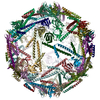
-Links
 PDBj
PDBj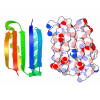
- Assembly
| Deposited unit | 
|
|---|---|
| 1 |
|
-Components
| #1: Protein | Mass: 17856.383 Da / Num. of mol.: 60 / Mutation: G12C, S50C Source method: isolated from a genetically manipulated source Source: (gene. exp.) synthetic construct (others) / Plasmid: pACYC-Duet 1 / Production host:   Escherichia coli BL21(DE3) (bacteria) Escherichia coli BL21(DE3) (bacteria)#2: Chemical | ChemComp-A1L9F / Mass: 297.307 Da / Num. of mol.: 120 / Source method: obtained synthetically / Formula: C20H11NO2 / Feature type: SUBJECT OF INVESTIGATION Has ligand of interest | Y | Has protein modification | Y | |
|---|
-Experimental details
-Experiment
| Experiment | Method: ELECTRON MICROSCOPY |
|---|---|
| EM experiment | Aggregation state: PARTICLE / 3D reconstruction method: single particle reconstruction |
- Sample preparation
| Component | Name: Pyrene-modified TIP60 double mutant (G12C/S50C) with addition of Nile Red Type: COMPLEX Details: Pyrene-modified TIP60 (Truncated Icosahedral Protein composed of 60-mer fusion proteins) double mutant (G12C/S50C) with addition of Nile Red Entity ID: #1 / Source: RECOMBINANT | |||||||||||||||
|---|---|---|---|---|---|---|---|---|---|---|---|---|---|---|---|---|
| Molecular weight | Value: 1.108 MDa / Experimental value: YES | |||||||||||||||
| Source (natural) | Organism: synthetic construct (others) | |||||||||||||||
| Source (recombinant) | Organism: Escherichia coli BL21(DE3) (bacteria) / Plasmid: pACYCDuet-1 | |||||||||||||||
| Buffer solution | pH: 7.4 / Details: 20 mM Tris-HCl, 1 mM EDTA | |||||||||||||||
| Buffer component |
| |||||||||||||||
| Specimen | Conc.: 12.4 mg/ml / Embedding applied: NO / Shadowing applied: NO / Staining applied: NO / Vitrification applied: YES | |||||||||||||||
| Specimen support | Details: PIB-10 (Vacuum Device Inc.) was used for glow discharge. Grid material: COPPER / Grid mesh size: 300 divisions/in. / Grid type: Quantifoil R1.2/1.3 | |||||||||||||||
| Vitrification | Instrument: FEI VITROBOT MARK IV / Cryogen name: ETHANE / Humidity: 100 % / Chamber temperature: 291 K / Details: Blotting time was 5 seconds (blot force 15) |
- Electron microscopy imaging
| Experimental equipment | 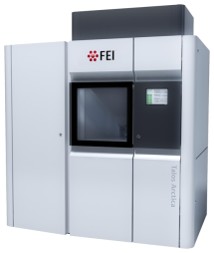 Model: Talos Arctica / Image courtesy: FEI Company |
|---|---|
| Microscopy | Model: FEI TALOS ARCTICA |
| Electron gun | Electron source:  FIELD EMISSION GUN / Accelerating voltage: 200 kV / Illumination mode: FLOOD BEAM FIELD EMISSION GUN / Accelerating voltage: 200 kV / Illumination mode: FLOOD BEAM |
| Electron lens | Mode: BRIGHT FIELD / Nominal magnification: 92000 X / Nominal defocus max: 2500 nm / Nominal defocus min: 1000 nm / Cs: 2.7 mm / C2 aperture diameter: 50 µm |
| Specimen holder | Cryogen: NITROGEN / Specimen holder model: FEI TITAN KRIOS AUTOGRID HOLDER / Temperature (max): 100 K / Temperature (min): 77 K |
| Image recording | Average exposure time: 6.02 sec. / Electron dose: 50 e/Å2 / Detector mode: COUNTING / Film or detector model: FEI FALCON IV (4k x 4k) / Num. of grids imaged: 1 / Num. of real images: 2110 |
| Image scans | Width: 4096 / Height: 4096 |
- Processing
| EM software |
| ||||||||||||||||||||||||||||||||||||||||
|---|---|---|---|---|---|---|---|---|---|---|---|---|---|---|---|---|---|---|---|---|---|---|---|---|---|---|---|---|---|---|---|---|---|---|---|---|---|---|---|---|---|
| CTF correction | Type: PHASE FLIPPING AND AMPLITUDE CORRECTION | ||||||||||||||||||||||||||||||||||||||||
| Particle selection | Num. of particles selected: 235783 / Details: Topaz auto-picking | ||||||||||||||||||||||||||||||||||||||||
| Symmetry | Point symmetry: I (icosahedral) | ||||||||||||||||||||||||||||||||||||||||
| 3D reconstruction | Resolution: 3.8 Å / Resolution method: FSC 0.143 CUT-OFF / Num. of particles: 22050 / Algorithm: FOURIER SPACE / Num. of class averages: 1 / Symmetry type: POINT | ||||||||||||||||||||||||||||||||||||||||
| Atomic model building | Protocol: OTHER / Space: REAL / Target criteria: Correlation coefficient | ||||||||||||||||||||||||||||||||||||||||
| Atomic model building | PDB-ID: 7EQ9 Accession code: 7EQ9 / Source name: PDB / Type: experimental model | ||||||||||||||||||||||||||||||||||||||||
| Refinement | Cross valid method: NONE Stereochemistry target values: GeoStd + Monomer Library + CDL v1.2 | ||||||||||||||||||||||||||||||||||||||||
| Displacement parameters | Biso mean: 182.97 Å2 | ||||||||||||||||||||||||||||||||||||||||
| Refine LS restraints |
|
