 Movie
Movie Controller


+ Open data

- Basic information
| Entry | Database: PDB / ID: 9uo4 | |||||||||||||||||||||
|---|---|---|---|---|---|---|---|---|---|---|---|---|---|---|---|---|---|---|---|---|---|---|
| Title | Cryo-EM structure of the chimeric human IgM-Fc hexamer | |||||||||||||||||||||
 Components Components | Immunoglobulin heavy constant mu | |||||||||||||||||||||
 Keywords Keywords | IMMUNE SYSTEM / Complex / polymeric antibody | |||||||||||||||||||||
| Function / homology |  Function and homology information Function and homology informationhexameric IgM immunoglobulin complex / IgM B cell receptor complex / pentameric IgM immunoglobulin complex / IgM immunoglobulin complex / pre-B cell allelic exclusion / CD22 mediated BCR regulation / antigen binding / B cell receptor signaling pathway / Antigen activates B Cell Receptor (BCR) leading to generation of second messengers / Cell surface interactions at the vascular wall ...hexameric IgM immunoglobulin complex / IgM B cell receptor complex / pentameric IgM immunoglobulin complex / IgM immunoglobulin complex / pre-B cell allelic exclusion / CD22 mediated BCR regulation / antigen binding / B cell receptor signaling pathway / Antigen activates B Cell Receptor (BCR) leading to generation of second messengers / Cell surface interactions at the vascular wall / adaptive immune response / innate immune response / blood microparticle / defense response to Gram-negative bacterium / antibacterial humoral response / Potential therapeutics for SARS / cell surface / extracellular exosome / extracellular region / plasma membrane Similarity search - Function | |||||||||||||||||||||
| Biological species |  Homo sapiens (human) Homo sapiens (human) | |||||||||||||||||||||
| Method | ELECTRON MICROSCOPY / single particle reconstruction / cryo EM / Resolution: 3.29 Å | |||||||||||||||||||||
 Authors Authors | Ji, C. / Zhang, R. / Xiao, J. | |||||||||||||||||||||
| Funding support |  China, 1items China, 1items
| |||||||||||||||||||||
 Citation Citation | Journal: Sci Adv / Year: 2025 Title: IgX informs engineering strategies of IgM and IgG hexamers. Authors: Ruixue Zhang / Chenggong Ji / Shuhan Li / Ningning Li / Ning Gao / Junyu Xiao / Abstract: Polymeric immunoglobulins are essential components of the immune system in jawed vertebrates. While mammalian immunoglobulin M (IgM) typically forms a pentamer linked by the joining chain (J-chain), ...Polymeric immunoglobulins are essential components of the immune system in jawed vertebrates. While mammalian immunoglobulin M (IgM) typically forms a pentamer linked by the joining chain (J-chain), IgX can assemble into a J-chain-independent polymer. Here, we present the cryo-electron microscopy (cryo-EM) structure of IgX, revealing its hexameric configuration. By incorporating the IgX tailpiece into human IgM, we achieved efficient IgM hexamer formation. Truncating IgM's natural tailpiece to a range of 11 to 16 residues also substantially enhanced hexamerization efficiency. Furthermore, introducing a shortened IgM tailpiece to IgG resulted in effective IgG hexamer formation. We further show that the engineered IgM and IgG hexamers targeting CD20 demonstrated robust complement-dependent cytotoxicity (CDC) against several B lymphoma cells. In addition, the IgG-Fc hexamer functioned as a decoy, attenuating CDC in cell cultures. These findings deepen our understanding of polymeric immunoglobulin evolution and introduce innovative strategies for the development of IgM- and IgG-based biologics. | |||||||||||||||||||||
| History |
|
- Structure visualization
| Structure viewer | Molecule: MolmilJmol/JSmol |
|---|
- Downloads & links
-Download
| PDBx/mmCIF format | 9uo4.cif.gz | 510.3 KB | Display | PDBx/mmCIF format |
|---|---|---|---|---|
| PDB format | pdb9uo4.ent.gz | 412.1 KB | Display | PDB format |
| PDBx/mmJSON format | 9uo4.json.gz | Tree view | PDBx/mmJSON format | |
| Others |  Other downloads Other downloads |
-Validation report
| Arichive directory | https://data.pdbj.org/pub/pdb/validation_reports/uo/9uo4ftp://data.pdbj.org/pub/pdb/validation_reports/uo/9uo4 | HTTPS FTP |
|---|
-Related structure data
| Related structure data |  64372MC  9uo3C  9uo5C  9uo6C M: map data used to model this data C: citing same article ( |
|---|---|
| Similar structure data |


-Links
 PDBj
PDBj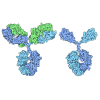
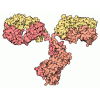

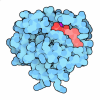


- Assembly
| Deposited unit | 
|
|---|---|
| 1 |
|
-Components
| #1: Protein | Mass: 41102.953 Da / Num. of mol.: 12 Source method: isolated from a genetically manipulated source Source: (gene. exp.) Homo sapiens (human) / Gene: IGHM / Production host: Homo sapiens (human) / References: UniProt: P01871Has protein modification | Y | |
|---|
-Experimental details
-Experiment
| Experiment | Method: ELECTRON MICROSCOPY |
|---|---|
| EM experiment | Aggregation state: PARTICLE / 3D reconstruction method: single particle reconstruction |
- Sample preparation
| Component | Name: The hexamer of human chimeric IgM-Fc / Type: COMPLEX / Entity ID: all / Source: RECOMBINANT |
|---|---|
| Source (natural) | Organism: Homo sapiens (human) |
| Source (recombinant) | Organism: Homo sapiens (human) |
| Buffer solution | pH: 7.4 |
| Specimen | Embedding applied: NO / Shadowing applied: NO / Staining applied: NO / Vitrification applied: YES |
| Vitrification | Cryogen name: ETHANE |
- Electron microscopy imaging
| Experimental equipment | 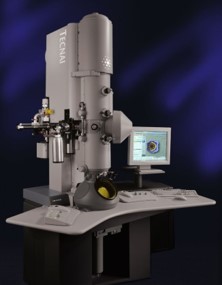 Model: Tecnai Polara / Image courtesy: FEI Company |
|---|---|
| Microscopy | Model: FEI POLARA 300 |
| Electron gun | Electron source:  FIELD EMISSION GUN / Accelerating voltage: 300 kV / Illumination mode: FLOOD BEAM FIELD EMISSION GUN / Accelerating voltage: 300 kV / Illumination mode: FLOOD BEAM |
| Electron lens | Mode: BRIGHT FIELD / Nominal defocus max: 1400 nm / Nominal defocus min: 1000 nm |
| Image recording | Electron dose: 60 e/Å2 / Film or detector model: GATAN K3 (6k x 4k) |
- Processing
| EM software | Name: PHENIX / Version: 1.20.1_4487 / Category: model refinement | ||||||||||||||||||||||||
|---|---|---|---|---|---|---|---|---|---|---|---|---|---|---|---|---|---|---|---|---|---|---|---|---|---|
| CTF correction | Type: NONE | ||||||||||||||||||||||||
| 3D reconstruction | Resolution: 3.29 Å / Resolution method: FSC 0.143 CUT-OFF / Num. of particles: 1099811 / Symmetry type: POINT | ||||||||||||||||||||||||
| Refinement | Highest resolution: 3.29 Å Stereochemistry target values: REAL-SPACE (WEIGHTED MAP SUM AT ATOM CENTERS) | ||||||||||||||||||||||||
| Refine LS restraints |
|
