 Movie
Movie Controller

[English] 日本語
 Yorodumi
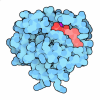
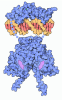
- PDB-9tu0: Crystal structure of human ERK1 in complex with the KIM1 motif of... -
+ Open data

- Basic information
| Entry | Database: PDB / ID: 9tu0 | ||||||
|---|---|---|---|---|---|---|---|
| Title | Crystal structure of human ERK1 in complex with the KIM1 motif of the T. gondii protein GRA24 | ||||||
 Components Components |
| ||||||
 Keywords Keywords | TRANSFERASE / phosphoryl transfer / kinase / MAPK / GRA24 / toxoplasma | ||||||
| Function / homology |  Function and homology information Function and homology informationnegative regulation of cholesterol efflux / negative regulation of T cell mediated immune response to tumor cell / RAF-independent MAPK1/3 activation / Suppression of apoptosis / Gastrin-CREB signalling pathway via PKC and MAPK / Signaling by Activin / interleukin-34-mediated signaling pathway / caveolin-mediated endocytosis / Signaling by NODAL / RSK activation ...negative regulation of cholesterol efflux / negative regulation of T cell mediated immune response to tumor cell / RAF-independent MAPK1/3 activation / Suppression of apoptosis / Gastrin-CREB signalling pathway via PKC and MAPK / Signaling by Activin / interleukin-34-mediated signaling pathway / caveolin-mediated endocytosis / Signaling by NODAL / RSK activation / Signaling by MAP2K mutants / ERKs are inactivated / phosphorylation / response to epidermal growth factor / Regulation of the apoptosome activity / Golgi Cisternae Pericentriolar Stack Reorganization / positive regulation of macrophage proliferation / Signaling by LTK in cancer / regulation of Golgi inheritance / peptidyl-tyrosine autophosphorylation / interleukin-1-mediated signaling pathway / positive regulation of cyclase activity / Negative feedback regulation of MAPK pathway / regulation of early endosome to late endosome transport / regulation of stress-activated MAPK cascade / IFNG signaling activates MAPKs / positive regulation of neuroinflammatory response / Frs2-mediated activation / Activation of the AP-1 family of transcription factors / MAPK3 (ERK1) activation / ERBB2-ERBB3 signaling pathway / ERK/MAPK targets / RUNX2 regulates osteoblast differentiation / positive regulation of macrophage chemotaxis / regulation of cytoskeleton organization / pseudopodium / MAP kinase activity / positive regulation of telomere maintenance / ERK1 and ERK2 cascade / BMP signaling pathway / Advanced glycosylation endproduct receptor signaling / mitogen-activated protein kinase / Regulation of HSF1-mediated heat shock response / Estrogen-dependent nuclear events downstream of ESR-membrane signaling / RHO GTPases Activate NADPH Oxidases / stress-activated MAPK cascade / Signal attenuation / Growth hormone receptor signaling / RHO GTPases Activate WASPs and WAVEs / Schwann cell development / phosphatase binding / ciliary tip / myelination / insulin-like growth factor receptor signaling pathway / NPAS4 regulates expression of target genes / signal transduction in response to DNA damage / sensory perception of pain / phosphotyrosine residue binding / Nuclear events stimulated by ALK signaling in cancer / Transcriptional and post-translational regulation of MITF-M expression and activity / ESR-mediated signaling / NCAM signaling for neurite out-growth / negative regulation of TORC1 signaling / RNA Polymerase I Promoter Opening / cellular response to amino acid starvation / Regulation of PTEN gene transcription / Signal transduction by L1 / FCGR3A-mediated phagocytosis / FCERI mediated MAPK activation / Negative regulation of FGFR3 signaling / Negative regulation of FGFR2 signaling / Negative regulation of FGFR4 signaling / Downregulation of SMAD2/3:SMAD4 transcriptional activity / Negative regulation of FGFR1 signaling / SMAD2/SMAD3:SMAD4 heterotrimer regulates transcription / Signaling by high-kinase activity BRAF mutants / Spry regulation of FGF signaling / MAP2K and MAPK activation / Regulation of actin dynamics for phagocytic cup formation / Negative Regulation of CDH1 Gene Transcription / Oncogene Induced Senescence / caveola / modulation of chemical synaptic transmission / cellular response to mechanical stimulus / insulin receptor signaling pathway / ISG15 antiviral mechanism / epidermal growth factor receptor signaling pathway / Interferon gamma signaling / Signaling by RAF1 mutants / Signaling by moderate kinase activity BRAF mutants / Paradoxical activation of RAF signaling by kinase inactive BRAF / Signaling downstream of RAS mutants / MAPK cascade / Negative regulation of MAPK pathway / Signaling by BRAF and RAF1 fusions / late endosome / nuclear envelope / PI5P, PP2A and IER3 Regulate PI3K/AKT Signaling / Thrombin signalling through proteinase activated receptors (PARs) / RAF/MAP kinase cascade Similarity search - Function | ||||||
| Biological species |  Homo sapiens (human) Homo sapiens (human)  Toxoplasma gondii (eukaryote) Toxoplasma gondii (eukaryote) | ||||||
| Method |  X-RAY DIFFRACTION / SYNCHROTRON / MOLECULAR REPLACEMENT / Resolution: 2.17 Å X-RAY DIFFRACTION / SYNCHROTRON / MOLECULAR REPLACEMENT / Resolution: 2.17 Å | ||||||
 Authors Authors | Juyoux, P. / von Velsen, J. / Bowler, M.W. | ||||||
| Funding support | 1items
| ||||||
 Citation Citation | Journal: bioRxiv / Year: 2026 Title: Molecular basis of mitogen-activated protein kinase ERK2 activation by its upstream kinase MEK1. Authors: Jill von Velsen / Pauline Juyoux / Nicola Piasentin / Hayden Fisher / Karine Lapouge / Oscar Vadas / Francesco Luigi Gervasio / Matthew W Bowler /     Abstract: The RAS-RAF-MEK-ERK mitogen-activated protein kinase (MAPK) pathway relays extracellular signals into a cellular response and its dysregulation leads to many pathologies, particularly cancer. Here, ...The RAS-RAF-MEK-ERK mitogen-activated protein kinase (MAPK) pathway relays extracellular signals into a cellular response and its dysregulation leads to many pathologies, particularly cancer. Here, we determined cryo-EM structures of the MAP2K MEK1 activating its substrate MAPK ERK2, the final event in the cascade. We define the molecular details of specificity and phosphoryl transfer to the tyrosine of the ERK2 activation loop and examine the mechanism of substrate recognition using solution techniques and molecular dynamics. Binding of the substrate MAPK leads to release of the MAP2K catalytic machinery, explaining the mechanism of many disease-causing mutations, and ERK2 release is not required for nucleotide exchange, suggesting a processive mechanism. Our data advance the understanding of MAPK signalling and provide a starting point for drug development. | ||||||
| History |
|
- Structure visualization
| Structure viewer | Molecule: MolmilJmol/JSmol |
|---|
- Downloads & links
-Download
| PDBx/mmCIF format | 9tu0.cif.gz | 202.1 KB | Display | PDBx/mmCIF format |
|---|---|---|---|---|
| PDB format | pdb9tu0.ent.gz | 128.3 KB | Display | PDB format |
| PDBx/mmJSON format | 9tu0.json.gz | Tree view | PDBx/mmJSON format | |
| Others |  Other downloads Other downloads |
-Validation report
| Arichive directory | https://data.pdbj.org/pub/pdb/validation_reports/tu/9tu0ftp://data.pdbj.org/pub/pdb/validation_reports/tu/9tu0 | HTTPS FTP |
|---|
-Related structure data
| Related structure data |  9tygC  9tyhC  9tyiC C: citing same article ( |
|---|---|
| Similar structure data | |
| Experimental dataset #1 | Data reference: 10.15151/esrf-dc-2310714581 / Data set type: diffraction image data |


-Links
 PDBj
PDBj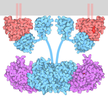

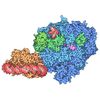
- Assembly
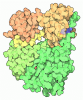
| Deposited unit | 
| ||||||||||||
|---|---|---|---|---|---|---|---|---|---|---|---|---|---|
| 1 |
| ||||||||||||
| Unit cell |
|
-Components
| #1: Protein | Mass: 43270.465 Da / Num. of mol.: 1 Source method: isolated from a genetically manipulated source Source: (gene. exp.) Homo sapiens (human) / Gene: MAPK3, ERK1, PRKM3Production host:   Escherichia coli 'BL21-Gold(DE3)pLysS AG' (bacteria) Escherichia coli 'BL21-Gold(DE3)pLysS AG' (bacteria)References: UniProt: P27361, mitogen-activated protein kinase | ||||||
|---|---|---|---|---|---|---|---|
| #2: Protein | Mass: 57402.145 Da / Num. of mol.: 1 / Source method: obtained synthetically / Source: (synth.) Toxoplasma gondii (eukaryote) / References: UniProt: B6KJB6 | ||||||
| #3: Chemical |  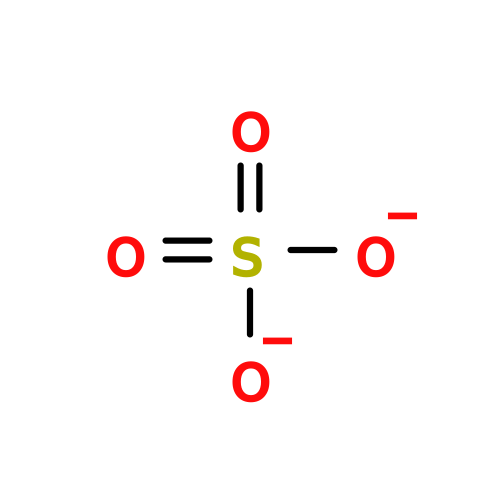 Mass: 96.063 Da / Num. of mol.: 3 / Source method: obtained synthetically / Formula: SO4 Mass: 96.063 Da / Num. of mol.: 3 / Source method: obtained synthetically / Formula: SO4#4: Water | ChemComp-HOH / |  Mass: 18.015 Da / Num. of mol.: 70 / Source method: isolated from a natural source / Formula: H2O Mass: 18.015 Da / Num. of mol.: 70 / Source method: isolated from a natural source / Formula: H2OHas ligand of interest | N | Has protein modification | Y | |
-Experimental details
-Experiment
| Experiment | Method: X-RAY DIFFRACTION / Number of used crystals: 1 |
|---|
- Sample preparation
| Crystal | Density Matthews: 2.33 Å3/Da / Density % sol: 47.34 % / Description: crystal volume: 0.107 x 0.079 x 0.101 mm3 |
|---|---|
| Crystal grow | Temperature: 277 K / Method: vapor diffusion, sitting drop / pH: 7 Details: 0.1 M MES pH 7, 10% dioxane and 1.8 M ammonium sulphate |
-Data collection
| Diffraction | Mean temperature: 100 K / Serial crystal experiment: N |
|---|---|
| Diffraction source | Source: SYNCHROTRON / Site: ESRF / Beamline: MASSIF-1 / Wavelength: 0.966 Å |
| Detector | Type: DECTRIS PILATUS3 2M / Detector: PIXEL / Date: Oct 6, 2018 / Details: Be CRL |
| Radiation | Monochromator: C110 / Protocol: SINGLE WAVELENGTH / Monochromatic (M) / Laue (L): M / Scattering type: x-ray |
| Radiation wavelength | Wavelength: 0.966 Å / Relative weight: 1 |
| Reflection | Resolution: 2.17→64.7 Å / Num. obs: 609516 / % possible obs: 91.6 % / Redundancy: 34 % / Biso Wilson estimate: 42.43 Å2 / CC1/2: 0.999 / Rmerge(I) obs: 0.183 / Rpim(I) all: 0.032 / Rrim(I) all: 0.186 / Net I/σ(I): 18.5 |
| Reflection shell | Resolution: 2.17→2.38 Å / Redundancy: 36.1 % / Rmerge(I) obs: 2.649 / Mean I/σ(I) obs: 1.9 / Num. unique obs: 32486 / CC1/2: 0.919 / Rpim(I) all: 0.442 / Rrim(I) all: 2.687 / % possible all: 49 |
- Processing
| Software |
| |||||||||||||||||||||||||||||||||||||||||||||||||
|---|---|---|---|---|---|---|---|---|---|---|---|---|---|---|---|---|---|---|---|---|---|---|---|---|---|---|---|---|---|---|---|---|---|---|---|---|---|---|---|---|---|---|---|---|---|---|---|---|---|---|
| Refinement | Method to determine structure: MOLECULAR REPLACEMENT / Resolution: 2.17→19.93 Å / SU ML: 0.2878 / Cross valid method: FREE R-VALUE / σ(F): 1.34 / Phase error: 33.398 Stereochemistry target values: GeoStd + Monomer Library + CDL v1.2
| |||||||||||||||||||||||||||||||||||||||||||||||||
| Solvent computation | Shrinkage radii: 0.9 Å / VDW probe radii: 1.1 Å / Solvent model: FLAT BULK SOLVENT MODEL | |||||||||||||||||||||||||||||||||||||||||||||||||
| Displacement parameters | Biso mean: 57.22 Å2 | |||||||||||||||||||||||||||||||||||||||||||||||||
| Refinement step | Cycle: LAST / Resolution: 2.17→19.93 Å
| |||||||||||||||||||||||||||||||||||||||||||||||||
| Refine LS restraints |
| |||||||||||||||||||||||||||||||||||||||||||||||||
| LS refinement shell |
| |||||||||||||||||||||||||||||||||||||||||||||||||
| Refinement TLS params. | Method: refined / Origin x: 10.8602585356 Å / Origin y: 16.8996154895 Å / Origin z: -15.1108364711 Å
| |||||||||||||||||||||||||||||||||||||||||||||||||
| Refinement TLS group | Selection details: all |
