 Movie
Movie Controller

[English] 日本語
 Yorodumi
- PDB-9tgo: Cryo-EM structure of Z22 mAb in complex with left-handed Z-DNA (d... -
+ Open data

- Basic information
| Entry | Database: PDB / ID: 9tgo | |||||||||||||||||||||
|---|---|---|---|---|---|---|---|---|---|---|---|---|---|---|---|---|---|---|---|---|---|---|
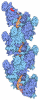
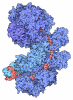
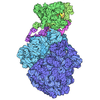
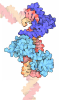
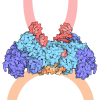
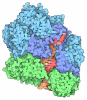
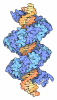
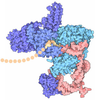
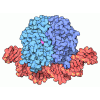
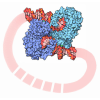
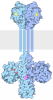
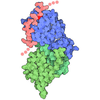
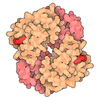
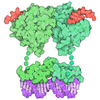
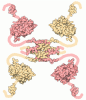
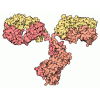
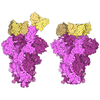
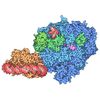
| Title | Cryo-EM structure of Z22 mAb in complex with left-handed Z-DNA (dimer of trimer) | |||||||||||||||||||||
 Components Components |
| |||||||||||||||||||||
 Keywords Keywords | DNA BINDING PROTEIN / Z-DNA / monoclonal antibody / antibody avidity / left-handed geometry | |||||||||||||||||||||
| Function / homology | DNA / DNA (> 10) Function and homology information Function and homology information | |||||||||||||||||||||
| Biological species |   Mus musculus (house mouse) Mus musculus (house mouse) Homo sapiens (human) Homo sapiens (human) | |||||||||||||||||||||
| Method | ELECTRON MICROSCOPY / single particle reconstruction / cryo EM / Resolution: 2.8 Å | |||||||||||||||||||||
 Authors Authors | Chin, D.H.R. / Luo, Y.B. / Luo, D. | |||||||||||||||||||||
| Funding support |  Singapore, 1items Singapore, 1items
| |||||||||||||||||||||
 Citation Citation | Journal: bioRxiv / Year: 2025 Title: Cryo-EM structures of anti Z-DNA antibodies in complex with antigen reveal distinct recognition modes of a left-handed geometry. Authors: Danielle Chin / Yongbo Luo / Yiteng Lau / Nivedita Dutta / Zengyting He / Chaoran Yin / Riley M Williams / Siddharth Balachandran / Quentin Vicens / Peter Dröge / Dahai Luo Abstract: Double-stranded nucleic acids can undergo transitions from canonical B/A-forms to alternate left-handed Z-DNA/Z-RNA (Z-NAs). Z-NAs are implicated in processes such as neuroinflammation in Alzheimer's ...Double-stranded nucleic acids can undergo transitions from canonical B/A-forms to alternate left-handed Z-DNA/Z-RNA (Z-NAs). Z-NAs are implicated in processes such as neuroinflammation in Alzheimer's disease, Lupus Erythematosus, microbial biofilms, and type I interferon-mediated human pathologies. Since endogenous Z-NA sensors like the Zα domain can induce B-to-Z transitions, monoclonal antibodies (mAbs) Z-D11 and Z22 have been regarded as conformation-specific tools to confirm Z-NA , although high-resolution structural information is missing. Here, we employed single-particle cryo-electron microscopy to solve structures of Z-D11 and Z22 bound to synthetic d(CG) 12mer Z-DNA duplex. Both mAbs form filamentous trimers around the Z-DNA axis, further stabilized by Fab-Fab interactions. The mAbs achieve specificity through extensive contacts to both Z-form backbone strands and the exposed guanine/cytosine bases in the major groove. This mode of recognition is dictated by shape complementarity rather than sequence specificity, sensing the alternating syn/anti backbone torsions and the phosphate zig-zag geometry unique to Z-DNA. Our data also suggest that these mAbs are not inducing B-to-Z transitions under normal physiological conditions. Finally, comparison to other double-stranded NA-binding mAbs defines a similar structural logic adapted to different helical geometry recognition patterns, thus providing a framework for engineering highly specific nucleic acid probes. | |||||||||||||||||||||
| History |
|
- Structure visualization
| Structure viewer | Molecule: MolmilJmol/JSmol |
|---|
- Downloads & links
-Download
| PDBx/mmCIF format | 9tgo.cif.gz | 295.9 KB | Display | PDBx/mmCIF format |
|---|---|---|---|---|
| PDB format | pdb9tgo.ent.gz | 235.8 KB | Display | PDB format |
| PDBx/mmJSON format | 9tgo.json.gz | Tree view | PDBx/mmJSON format | |
| Others |  Other downloads Other downloads |
-Validation report
| Arichive directory | https://data.pdbj.org/pub/pdb/validation_reports/tg/9tgoftp://data.pdbj.org/pub/pdb/validation_reports/tg/9tgo | HTTPS FTP |
|---|
-Related structure data
| Related structure data |  55906MC  9tgnC  9tgwC M: map data used to model this data C: citing same article ( |
|---|---|
| Similar structure data |


-Links
 PDBj
PDBj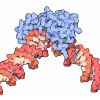
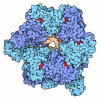
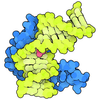
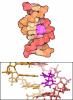

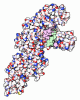
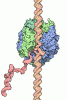
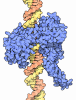
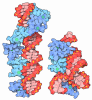

- Assembly
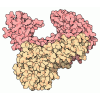
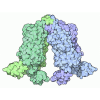
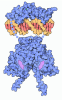
| Deposited unit | 
|
|---|---|
| 1 |
|
-Components
| #1: Antibody | Mass: 13627.357 Da / Num. of mol.: 6 Source method: isolated from a genetically manipulated source Details: Heavy chain of Z22 / Source: (gene. exp.) Mus musculus (house mouse) / Cell line (production host): hybridoma Z22 / Production host: Homo sapiens (human)#2: Antibody | Mass: 11662.902 Da / Num. of mol.: 6 Source method: isolated from a genetically manipulated source Details: Light chain of Z22 / Source: (gene. exp.) Mus musculus (house mouse) / Cell line (production host): hybridoma Z22 / Production host: Homo sapiens (human)#3: DNA chain | Mass: 3665.368 Da / Num. of mol.: 4 / Source method: obtained synthetically / Details: DNA chemically synthesised from IDT / Source: (synth.) Homo sapiens (human)#4: Chemical | ChemComp-MG /   Mass: 24.305 Da / Num. of mol.: 15 / Source method: obtained synthetically / Formula: Mg Mass: 24.305 Da / Num. of mol.: 15 / Source method: obtained synthetically / Formula: Mg#5: Water | ChemComp-HOH / |  Mass: 18.015 Da / Num. of mol.: 32 / Source method: isolated from a natural source / Formula: H2O Mass: 18.015 Da / Num. of mol.: 32 / Source method: isolated from a natural source / Formula: H2OHas ligand of interest | N | Has protein modification | Y | |
|---|
-Experimental details
-Experiment
| Experiment | Method: ELECTRON MICROSCOPY |
|---|---|
| EM experiment | Aggregation state: PARTICLE / 3D reconstruction method: single particle reconstruction |
- Sample preparation
| Component | Name: Dimer of trimer complex of Z22 antibody with left-handed Z-DNA Type: COMPLEX Details: Full length antibody arranged as a dimer of trimer around the Z-DNA Entity ID: #1-#3 / Source: RECOMBINANT | ||||||||||||||||
|---|---|---|---|---|---|---|---|---|---|---|---|---|---|---|---|---|---|
| Molecular weight | Value: 0.9 MDa / Experimental value: NO | ||||||||||||||||
| Source (natural) | Organism: Mus musculus (house mouse) | ||||||||||||||||
| Source (recombinant) | Organism: Homo sapiens (human) | ||||||||||||||||
| Buffer solution | pH: 7.2 Details: High salt buffer for complex preparation: 20mM HEPES pH 7.2, 2.5M NaCl, 0.7mM MgCl2 Buffer above is for analytical SEC. | ||||||||||||||||
| Buffer component |
| ||||||||||||||||
| Specimen | Conc.: 1.1 mg/ml / Embedding applied: NO / Shadowing applied: NO / Staining applied: NO / Vitrification applied: YES | ||||||||||||||||
| Specimen support | Grid material: GOLD / Grid mesh size: 300 divisions/in. / Grid type: Quantifoil R1.2/1.3 | ||||||||||||||||
| Vitrification | Instrument: FEI VITROBOT MARK IV / Cryogen name: ETHANE / Humidity: 100 % / Chamber temperature: 277 K |
- Electron microscopy imaging
| Experimental equipment |  Model: Titan Krios / Image courtesy: FEI Company |
|---|---|
| Microscopy | Model: TFS KRIOS |
| Electron gun | Electron source:  FIELD EMISSION GUN / Accelerating voltage: 300 kV / Illumination mode: FLOOD BEAM FIELD EMISSION GUN / Accelerating voltage: 300 kV / Illumination mode: FLOOD BEAM |
| Electron lens | Mode: BRIGHT FIELD / Nominal magnification: 165000 X / Nominal defocus max: 2230 nm / Nominal defocus min: 500 nm / Cs: 2.7 mm |
| Specimen holder | Cryogen: NITROGEN / Specimen holder model: FEI TITAN KRIOS AUTOGRID HOLDER |
| Image recording | Electron dose: 50 e/Å2 / Film or detector model: FEI FALCON IV (4k x 4k) / Num. of real images: 4660 |
- Processing
| EM software |
| ||||||||||||||||||||||||
|---|---|---|---|---|---|---|---|---|---|---|---|---|---|---|---|---|---|---|---|---|---|---|---|---|---|
| CTF correction | Type: PHASE FLIPPING AND AMPLITUDE CORRECTION | ||||||||||||||||||||||||
| 3D reconstruction | Resolution: 2.8 Å / Resolution method: FSC 0.143 CUT-OFF / Num. of particles: 59879 / Symmetry type: POINT | ||||||||||||||||||||||||
| Refinement | Highest resolution: 2.8 Å Stereochemistry target values: REAL-SPACE (WEIGHTED MAP SUM AT ATOM CENTERS) | ||||||||||||||||||||||||
| Refine LS restraints |
|
