 Movie
Movie Controller

[English] 日本語
 Yorodumi
- PDB-9t6l: Cryo-EM structure of the human LENG8-PCID2-DSS1 complex bound to ... -
+ Open data

- Basic information
| Entry | Database: PDB / ID: 9t6l | |||||||||||||||||||||||||||
|---|---|---|---|---|---|---|---|---|---|---|---|---|---|---|---|---|---|---|---|---|---|---|---|---|---|---|---|---|
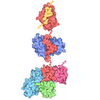
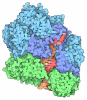
| Title | Cryo-EM structure of the human LENG8-PCID2-DSS1 complex bound to UAP56 and RRP1B | |||||||||||||||||||||||||||
 Components Components |
| |||||||||||||||||||||||||||
 Keywords Keywords | NUCLEAR PROTEIN / RNA metabolism / RNA decay / splicing quality control | |||||||||||||||||||||||||||
| Function / homology |  Function and homology information Function and homology informationnegative regulation of lymphoid progenitor cell differentiation / granular component / transcription export complex / U6 snRNP / transcription export complex 2 / post-transcriptional tethering of RNA polymerase II gene DNA at nuclear periphery / negative regulation of GTPase activity / nuclear pore nuclear basket / spleen development / Impaired BRCA2 translocation to the nucleus ...negative regulation of lymphoid progenitor cell differentiation / granular component / transcription export complex / U6 snRNP / transcription export complex 2 / post-transcriptional tethering of RNA polymerase II gene DNA at nuclear periphery / negative regulation of GTPase activity / nuclear pore nuclear basket / spleen development / Impaired BRCA2 translocation to the nucleus / Impaired BRCA2 binding to SEM1 (DSS1) / ATP-dependent activity, acting on RNA / mRNA 3'-end processing / ATP-dependent protein binding / integrator complex / U4 snRNP / host-mediated activation of viral transcription / RNA export from nucleus / U4 snRNA binding / Transport of Mature mRNA derived from an Intron-Containing Transcript / proteasome regulatory particle, lid subcomplex / RNA Polymerase II Transcription Termination / positive regulation of B cell differentiation / poly(A)+ mRNA export from nucleus / Regulation of ornithine decarboxylase (ODC) / preribosome, small subunit precursor / Proteasome assembly / cellular response to type I interferon / Cross-presentation of soluble exogenous antigens (endosomes) / Somitogenesis / negative regulation of gene expression, epigenetic / Homologous DNA Pairing and Strand Exchange / Defective homologous recombination repair (HRR) due to BRCA1 loss of function / Defective HDR through Homologous Recombination Repair (HRR) due to PALB2 loss of BRCA1 binding function / Defective HDR through Homologous Recombination Repair (HRR) due to PALB2 loss of BRCA2/RAD51/RAD51C binding function / Resolution of D-loop Structures through Synthesis-Dependent Strand Annealing (SDSA) / regulation of RNA splicing / Resolution of D-loop Structures through Holliday Junction Intermediates / spliceosomal complex assembly / Impaired BRCA2 binding to RAD51 / Presynaptic phase of homologous DNA pairing and strand exchange / U6 snRNA binding / RHOBTB2 GTPase cycle / proteasome assembly / mRNA export from nucleus / proteasome complex / spliceosomal complex / heterochromatin / mRNA Splicing - Major Pathway / RNA splicing / regulation of proteasomal protein catabolic process / Regulation of activated PAK-2p34 by proteasome mediated degradation / cellular response to virus / ubiquitin binding / Autodegradation of Cdh1 by Cdh1:APC/C / proteasomal protein catabolic process / APC/C:Cdc20 mediated degradation of Securin / Asymmetric localization of PCP proteins / Ubiquitin-dependent degradation of Cyclin D / SCF-beta-TrCP mediated degradation of Emi1 / NIK-->noncanonical NF-kB signaling / AUF1 (hnRNP D0) binds and destabilizes mRNA / TNFR2 non-canonical NF-kB pathway / mRNA splicing, via spliceosome / Assembly of the pre-replicative complex / Vpu mediated degradation of CD4 / Cdc20:Phospho-APC/C mediated degradation of Cyclin A / euchromatin / Dectin-1 mediated noncanonical NF-kB signaling / Degradation of DVL / Degradation of AXIN / Degradation of CRY and PER proteins / Hh mutants are degraded by ERAD / transcription elongation by RNA polymerase II / Activation of NF-kappaB in B cells / G2/M Checkpoints / Degradation of GLI1 by the proteasome / Hedgehog ligand biogenesis / Autodegradation of the E3 ubiquitin ligase COP1 / Regulation of RUNX3 expression and activity / Defective CFTR causes cystic fibrosis / GSK3B and BTRC:CUL1-mediated-degradation of NFE2L2 / Negative regulation of NOTCH4 signaling / AMPK-induced ERAD and lysosome mediated degradation of PD-L1(CD274) / Hedgehog 'on' state / APC/C:Cdh1 mediated degradation of Cdc20 and other APC/C:Cdh1 targeted proteins in late mitosis/early G1 / Vif-mediated degradation of APOBEC3G / FBXL7 down-regulates AURKA during mitotic entry and in early mitosis / Degradation of GLI2 by the proteasome / GLI3 is processed to GLI3R by the proteasome / MAPK6/MAPK4 signaling / GSK3B-mediated proteasomal degradation of PD-L1(CD274) / Degradation of CDH1 / Degradation of beta-catenin by the destruction complex / Oxygen-dependent proline hydroxylation of Hypoxia-inducible Factor Alpha / CDK-mediated phosphorylation and removal of Cdc6 / HDR through Homologous Recombination (HRR) / ABC-family protein mediated transport / CLEC7A (Dectin-1) signaling / SCF(Skp2)-mediated degradation of p27/p21 Similarity search - Function | |||||||||||||||||||||||||||
| Biological species |  Homo sapiens (human) Homo sapiens (human) | |||||||||||||||||||||||||||
| Method | ELECTRON MICROSCOPY / single particle reconstruction / cryo EM / Resolution: 2.9 Å | |||||||||||||||||||||||||||
 Authors Authors | Abbas, D.K. / Bonneau, F. / Basquin, J. / Conti, E. / Schussler, S. / Wilkinson, M.E. | |||||||||||||||||||||||||||
| Funding support | European Union,  Germany, Germany,  Denmark, 3items Denmark, 3items
| |||||||||||||||||||||||||||
 Citation Citation | Journal: Genes Dev / Year: 2026 Title: Evolutionarily conserved spliceosome-exosome pathway in nuclear mRNA surveillance. Authors: Daniel K Abbas / Fabien Bonneau / Max E Wilkinson / Steffen Schüssler / Jérôme Basquin / Elena Conti /  Abstract: Intron-containing mRNAs are cotranscriptionally spliced and assembled into messenger ribonucleoprotein (mRNP) particles, a process monitored by surveillance pathways. Here, we combined biochemical ...Intron-containing mRNAs are cotranscriptionally spliced and assembled into messenger ribonucleoprotein (mRNP) particles, a process monitored by surveillance pathways. Here, we combined biochemical and structural approaches to elucidate the mechanisms by which mRNPs are sorted between two opposing fates: nuclear degradation and cytoplasmic export. While the human GANP-PCID2 complex is known to connect mRNPs to nuclear export, our data indicate that the LENG8-PCID2 complex operates as an mRNP decay connector, coupling nuclear mRNPs to the RNA-degrading exosome via the PAXT adaptor complex. Both recognize the mRNP component UAP56, but LENG8-PCID2 uniquely associates with early splicing factors through a direct interaction with U1A and RRP1B. Similarly, the Thp3-Csn12 ortholog in budding yeast couples the early splicing factors Mud2-Bbp with the nuclear exosome. The spliceosome-exosome mRNP decay pathway we uncovered reveals molecular principles that remain strikingly conserved across evolution, despite the fundamental differences in splicing and decay between humans and budding yeast. | |||||||||||||||||||||||||||
| History |
|
- Structure visualization
| Structure viewer | Molecule: MolmilJmol/JSmol |
|---|
- Downloads & links
-Download
| PDBx/mmCIF format | 9t6l.cif.gz | 158.7 KB | Display | PDBx/mmCIF format |
|---|---|---|---|---|
| PDB format | pdb9t6l.ent.gz | 114.7 KB | Display | PDB format |
| PDBx/mmJSON format | 9t6l.json.gz | Tree view | PDBx/mmJSON format | |
| Others |  Other downloads Other downloads |
-Validation report
| Arichive directory | https://data.pdbj.org/pub/pdb/validation_reports/t6/9t6lftp://data.pdbj.org/pub/pdb/validation_reports/t6/9t6l | HTTPS FTP |
|---|
-Related structure data
| Related structure data |  55617MC  9t6nC M: map data used to model this data C: citing same article ( |
|---|---|
| Similar structure data |

-Links
 PDBj
PDBj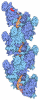

- Assembly
| Deposited unit | 
|
|---|---|
| 1 |
|
-Components
| #1: Protein | Mass: 49412.582 Da / Num. of mol.: 1 Source method: isolated from a genetically manipulated source Source: (gene. exp.) Homo sapiens (human) / Gene: DDX39B, BAT1, UAP56 / Production host:   Escherichia coli (E. coli) / References: UniProt: Q13838, RNA helicase Escherichia coli (E. coli) / References: UniProt: Q13838, RNA helicase |
|---|---|
| #2: Protein | Mass: 30940.674 Da / Num. of mol.: 1 Source method: isolated from a genetically manipulated source Details: Chains C and F are part of the same fusion protein (LENG8(550-800)-GS-RRP1B(742-758). Chain C is LENG8(550-800)., Chains C and F are part of the same fusion protein (LENG8(550-800)-GS- ...Details: Chains C and F are part of the same fusion protein (LENG8(550-800)-GS-RRP1B(742-758). Chain C is LENG8(550-800)., Chains C and F are part of the same fusion protein (LENG8(550-800)-GS-RRP1B(742-758). Chain F is RRP1B(742-758).,Chains C and F are part of the same fusion protein (LENG8(550-800)-GS-RRP1B(742-758). Chain C is LENG8(550-800)., Chains C and F are part of the same fusion protein (LENG8(550-800)-GS-RRP1B(742-758). Chain F is RRP1B(742-758). Source: (gene. exp.) Homo sapiens (human) / Gene: LENG8, KIAA1932, RRP1B, KIAA0179 / Production host: Escherichia coli (E. coli) / References: UniProt: Q96PV6, UniProt: Q14684 |
| #3: Protein | Mass: 46371.211 Da / Num. of mol.: 1 Source method: isolated from a genetically manipulated source Source: (gene. exp.) Homo sapiens (human) / Gene: PCID2, HT004 / Production host: Escherichia coli (E. coli) / References: UniProt: Q5JVF3 |
| #4: Protein | Mass: 8284.611 Da / Num. of mol.: 1 Source method: isolated from a genetically manipulated source Source: (gene. exp.) Homo sapiens (human) / Gene: SEM1, C7orf76, DSS1, SHFDG1, SHFM1 / Production host: Escherichia coli (E. coli) / References: UniProt: P60896 |
| Has protein modification | Y |
-Experimental details
-Experiment
| Experiment | Method: ELECTRON MICROSCOPY |
|---|---|
| EM experiment | Aggregation state: PARTICLE / 3D reconstruction method: single particle reconstruction |
- Sample preparation
| Component | Name: Cryo-EM structure of the human LENG8-PCID2-DSS1 complex bound to UAP56 and RRP1B Type: COMPLEX / Entity ID: #1, #3-#4 / Source: RECOMBINANT |
|---|---|
| Source (natural) | Organism: Homo sapiens (human) |
| Source (recombinant) | Organism: Escherichia coli (E. coli) |
| Buffer solution | pH: 7.5 |
| Specimen | Embedding applied: NO / Shadowing applied: NO / Staining applied: NO / Vitrification applied: YES |
| Vitrification | Instrument: FEI VITROBOT MARK IV / Cryogen name: ETHANE-PROPANE / Humidity: 95 % / Chamber temperature: 277 K |
- Electron microscopy imaging
| Experimental equipment |  Model: Titan Krios / Image courtesy: FEI Company |
|---|---|
| Microscopy | Model: TFS KRIOS |
| Electron gun | Electron source:  FIELD EMISSION GUN / Accelerating voltage: 300 kV / Illumination mode: FLOOD BEAM FIELD EMISSION GUN / Accelerating voltage: 300 kV / Illumination mode: FLOOD BEAM |
| Electron lens | Mode: BRIGHT FIELD / Nominal magnification: 105000 X / Nominal defocus max: 2000 nm / Nominal defocus min: 500 nm |
| Image recording | Electron dose: 61.8 e/Å2 / Film or detector model: GATAN K3 BIOQUANTUM (6k x 4k) / Num. of real images: 28229 |
| EM imaging optics | Energyfilter name: GIF Bioquantum / Energyfilter slit width: 10 eV |
- Processing
| EM software |
| ||||||||||||||||||||||||||||||||||||||||
|---|---|---|---|---|---|---|---|---|---|---|---|---|---|---|---|---|---|---|---|---|---|---|---|---|---|---|---|---|---|---|---|---|---|---|---|---|---|---|---|---|---|
| CTF correction | Type: PHASE FLIPPING AND AMPLITUDE CORRECTION | ||||||||||||||||||||||||||||||||||||||||
| 3D reconstruction | Resolution: 2.9 Å / Resolution method: FSC 0.143 CUT-OFF / Num. of particles: 892731 / Symmetry type: POINT | ||||||||||||||||||||||||||||||||||||||||
| Atomic model building | Source name: AlphaFold / Type: in silico model | ||||||||||||||||||||||||||||||||||||||||
| Refinement | Highest resolution: 2.9 Å / Cross valid method: NONE Stereochemistry target values: REAL-SPACE (WEIGHTED MAP SUM AT ATOM CENTERS) | ||||||||||||||||||||||||||||||||||||||||
| Refine LS restraints |
|
