 Movie
Movie Controller

[English] 日本語
 Yorodumi
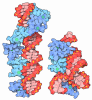
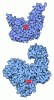
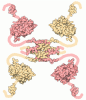
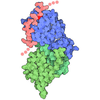
- PDB-9sw0: XRCC3-RAD51C-RAD51D-XRCC2 (XRCC3 complex) capping a RAD51 filamen... -
+ Open data

- Basic information
| Entry | Database: PDB / ID: 9sw0 | ||||||||||||||||||||||||
|---|---|---|---|---|---|---|---|---|---|---|---|---|---|---|---|---|---|---|---|---|---|---|---|---|---|
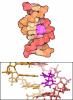
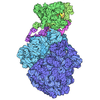
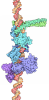
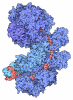
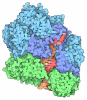
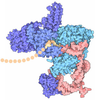
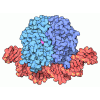
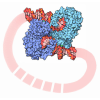
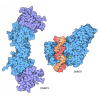
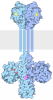
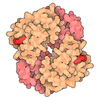
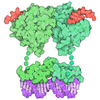
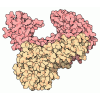
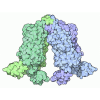
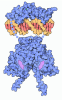
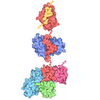
| Title | XRCC3-RAD51C-RAD51D-XRCC2 (XRCC3 complex) capping a RAD51 filament on a D-loop intermediate | ||||||||||||||||||||||||
 Components Components |
| ||||||||||||||||||||||||
 Keywords Keywords | DNA BINDING PROTEIN / complex / tumor suppresor | ||||||||||||||||||||||||
| Function / homology |  Function and homology information Function and homology informationtelomeric loop disassembly / double-strand break repair via synthesis-dependent strand annealing / telomere maintenance via telomere trimming / resolution of mitotic recombination intermediates / Rad51C-XRCC3 complex / Rad51B-Rad51C-Rad51D-XRCC2 complex / meiotic DNA recombinase assembly / presynaptic intermediate filament cytoskeleton / response to glucoside / crossover junction DNA endonuclease activity ...telomeric loop disassembly / double-strand break repair via synthesis-dependent strand annealing / telomere maintenance via telomere trimming / resolution of mitotic recombination intermediates / Rad51C-XRCC3 complex / Rad51B-Rad51C-Rad51D-XRCC2 complex / meiotic DNA recombinase assembly / presynaptic intermediate filament cytoskeleton / response to glucoside / crossover junction DNA endonuclease activity / mitotic recombination-dependent replication fork processing / chromosome organization involved in meiotic cell cycle / cellular response to cisplatin / telomere maintenance via telomere lengthening / DNA recombinase assembly / double-strand break repair involved in meiotic recombination / cellular response to camptothecin / t-circle formation / DNA strand invasion / mitotic recombination / lateral element / DNA strand exchange activity / gamma-tubulin binding / Impaired BRCA2 binding to PALB2 / positive regulation of mitotic cell cycle spindle assembly checkpoint / telomere maintenance via recombination / reciprocal meiotic recombination / single-stranded DNA helicase activity / centrosome cycle / regulation of centrosome duplication / sister chromatid cohesion / response to X-ray / regulation of double-strand break repair via homologous recombination / ATP-dependent DNA damage sensor activity / HDR through Single Strand Annealing (SSA) / regulation of DNA damage checkpoint / Homologous DNA Pairing and Strand Exchange / Defective homologous recombination repair (HRR) due to BRCA1 loss of function / Defective HDR through Homologous Recombination Repair (HRR) due to PALB2 loss of BRCA1 binding function / Defective HDR through Homologous Recombination Repair (HRR) due to PALB2 loss of BRCA2/RAD51/RAD51C binding function / Resolution of D-loop Structures through Synthesis-Dependent Strand Annealing (SDSA) / nuclear chromosome / Resolution of D-loop Structures through Holliday Junction Intermediates / Transcriptional Regulation by E2F6 / microtubule organizing center / nuclear replication fork / Impaired BRCA2 binding to RAD51 / Presynaptic phase of homologous DNA pairing and strand exchange / ATP-dependent activity, acting on DNA / interstrand cross-link repair / positive regulation of G2/M transition of mitotic cell cycle / condensed chromosome / DNA polymerase binding / supramolecular fiber organization / replication fork / telomere maintenance / replication fork processing / cellular response to ionizing radiation / condensed nuclear chromosome / TP53 Regulates Transcription of DNA Repair Genes / cellular response to gamma radiation / meiotic cell cycle / protein-DNA complex / double-strand break repair via homologous recombination / PML body / response to toxic substance / Meiotic recombination / Hydrolases; Acting on acid anhydrides; Acting on acid anhydrides to facilitate cellular and subcellular movement / HDR through Homologous Recombination (HRR) / mitotic cell cycle / site of double-strand break / single-stranded DNA binding / Factors involved in megakaryocyte development and platelet production / double-stranded DNA binding / DNA recombination / chromosome, telomeric region / response to xenobiotic stimulus / mitochondrial matrix / hydrolase activity / DNA repair / centrosome / chromatin binding / DNA damage response / nucleolus / chromatin / perinuclear region of cytoplasm / enzyme binding / protein-containing complex / mitochondrion / DNA binding / nucleoplasm / ATP binding / identical protein binding / nucleus / cytosol / cytoplasm Similarity search - Function | ||||||||||||||||||||||||
| Biological species |  Homo sapiens (human) Homo sapiens (human)synthetic construct (others) | ||||||||||||||||||||||||
| Method | ELECTRON MICROSCOPY / single particle reconstruction / cryo EM / Resolution: 3 Å | ||||||||||||||||||||||||
 Authors Authors | Greenhough, L.A. / West, S.C. | ||||||||||||||||||||||||
| Funding support |  United Kingdom, 4items United Kingdom, 4items
| ||||||||||||||||||||||||
 Citation Citation | Journal: Science / Year: 2026 Title: Cryo-electron microscopic visualization of RAD51 filament assembly and end-capping by XRCC3-RAD51C-RAD51D-XRCC2. Authors: Luke A Greenhough / Lorenzo Galanti / Chih-Chao Liang / Simon J Boulton / Stephen C West / Abstract: Homologous recombination repairs DNA double-strand breaks and protects stalled replication forks, but how the five RAD51 paralogs contribute to these processes remains unclear. Mutations in the RAD51 ...Homologous recombination repairs DNA double-strand breaks and protects stalled replication forks, but how the five RAD51 paralogs contribute to these processes remains unclear. Mutations in the RAD51 paralogs are linked to heritable breast and ovarian cancers and the cancer-prone disease Fanconi anemia. In this work, we show that the RAD51 paralogs assemble into two distinct heterotetrameric complexes, RAD51B-RAD51C-RAD51D-XRCC2 (RAD51B complex) and XRCC3-RAD51C-RAD51D-XRCC2 (XRCC3 complex). The RAD51B complex promotes dynamic adenosine triphosphate hydrolysis-dependent assembly of RAD51 filaments, whereas the XRCC3 complex stably caps the 5' termini of RAD51 filaments to promote homologous pairing, as visualized by cryo-electron microscopy. Highly conserved across evolution, the XRCC3 complex reveals insights into RAD51 filament formation and capping during DNA repair and replication fork stabilization. | ||||||||||||||||||||||||
| History |
|
- Structure visualization
| Structure viewer | Molecule: MolmilJmol/JSmol |
|---|
- Downloads & links
-Download
| PDBx/mmCIF format | 9sw0.cif.gz | 712.3 KB | Display | PDBx/mmCIF format |
|---|---|---|---|---|
| PDB format | pdb9sw0.ent.gz | 575 KB | Display | PDB format |
| PDBx/mmJSON format | 9sw0.json.gz | Tree view | PDBx/mmJSON format | |
| Others |  Other downloads Other downloads |
-Validation report
| Arichive directory | https://data.pdbj.org/pub/pdb/validation_reports/sw/9sw0ftp://data.pdbj.org/pub/pdb/validation_reports/sw/9sw0 | HTTPS FTP |
|---|
-Related structure data
| Related structure data |  55292MC  9svxC  9svyC M: map data used to model this data C: citing same article ( |
|---|---|
| Similar structure data |


-Links
 PDBj
PDBj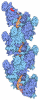

- Assembly
| Deposited unit | 
|
|---|---|
| 1 |
|
-Components
-DNA repair protein ... , 5 types, 11 molecules BFGEHIJKACD
| #1: Protein | Mass: 35084.254 Da / Num. of mol.: 1 Source method: isolated from a genetically manipulated source Source: (gene. exp.) Homo sapiens (human) / Gene: RAD51D, RAD51L3 / Production host:   Spodoptera frugiperda (fall armyworm) / References: UniProt: O75771 Spodoptera frugiperda (fall armyworm) / References: UniProt: O75771 | ||||||
|---|---|---|---|---|---|---|---|
| #2: Protein | Mass: 37009.125 Da / Num. of mol.: 7 Source method: isolated from a genetically manipulated source Source: (gene. exp.) Homo sapiens (human) / Gene: RAD51, RAD51A, RECA / Production host:   Escherichia coli (E. coli) / References: UniProt: Q06609 Escherichia coli (E. coli) / References: UniProt: Q06609#6: Protein | | Mass: 31995.525 Da / Num. of mol.: 1 Source method: isolated from a genetically manipulated source Source: (gene. exp.) Homo sapiens (human) / Gene: XRCC2 / Production host: Spodoptera frugiperda (fall armyworm) / References: UniProt: O43543#7: Protein | | Mass: 42244.609 Da / Num. of mol.: 1 Source method: isolated from a genetically manipulated source Source: (gene. exp.) Homo sapiens (human) / Gene: RAD51C, RAD51L2 / Production host: Spodoptera frugiperda (fall armyworm) / References: UniProt: O43502#8: Protein | | Mass: 37899.781 Da / Num. of mol.: 1 Source method: isolated from a genetically manipulated source Source: (gene. exp.) Homo sapiens (human) / Gene: XRCC3 / Production host: Spodoptera frugiperda (fall armyworm) / References: UniProt: O43542 |
-DNA chain , 3 types, 3 molecules MNO
| #3: DNA chain | Mass: 9460.064 Da / Num. of mol.: 1 / Source method: obtained synthetically / Source: (synth.) synthetic construct (others) |
|---|---|
| #4: DNA chain | Mass: 18211.734 Da / Num. of mol.: 1 / Source method: obtained synthetically / Source: (synth.) synthetic construct (others) |
| #5: DNA chain | Mass: 17969.551 Da / Num. of mol.: 1 / Source method: obtained synthetically / Source: (synth.) synthetic construct (others) |
-Non-polymers , 4 types, 24 molecules 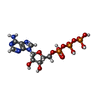


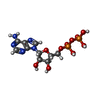
| #9: Chemical | ChemComp-ATP / 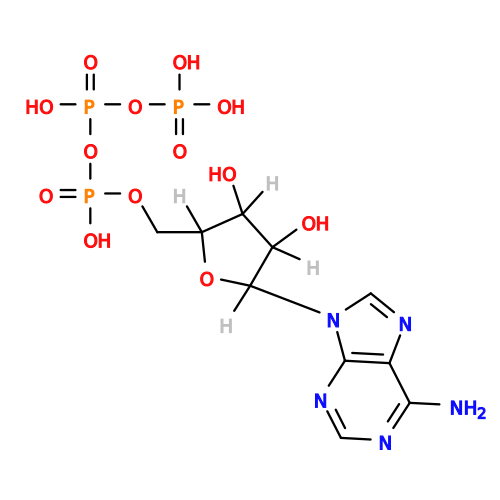 Mass: 507.181 Da / Num. of mol.: 8 / Source method: obtained synthetically / Formula: C10H16N5O13P3 / Feature type: SUBJECT OF INVESTIGATION / Comment: ATP, energy-carrying molecule*YM Mass: 507.181 Da / Num. of mol.: 8 / Source method: obtained synthetically / Formula: C10H16N5O13P3 / Feature type: SUBJECT OF INVESTIGATION / Comment: ATP, energy-carrying molecule*YM#10: Chemical | ChemComp-CA /  Mass: 40.078 Da / Num. of mol.: 7 / Source method: obtained synthetically / Formula: Ca / Feature type: SUBJECT OF INVESTIGATION Mass: 40.078 Da / Num. of mol.: 7 / Source method: obtained synthetically / Formula: Ca / Feature type: SUBJECT OF INVESTIGATION#11: Chemical | ChemComp-MG /  Mass: 24.305 Da / Num. of mol.: 8 / Source method: obtained synthetically / Formula: Mg / Feature type: SUBJECT OF INVESTIGATION Mass: 24.305 Da / Num. of mol.: 8 / Source method: obtained synthetically / Formula: Mg / Feature type: SUBJECT OF INVESTIGATION#12: Chemical | ChemComp-ADP / | 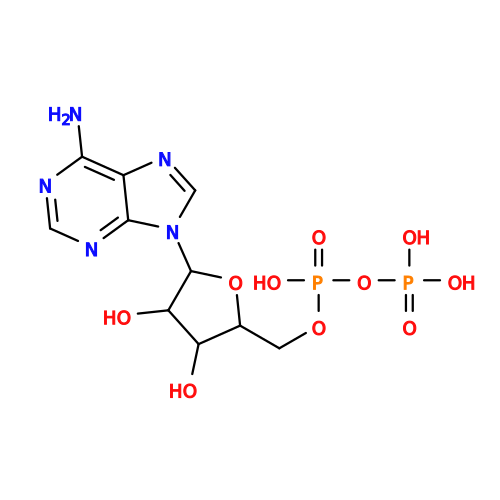 Mass: 427.201 Da / Num. of mol.: 1 / Source method: obtained synthetically / Formula: C10H15N5O10P2 / Feature type: SUBJECT OF INVESTIGATION / Comment: ADP, energy-carrying molecule*YM Mass: 427.201 Da / Num. of mol.: 1 / Source method: obtained synthetically / Formula: C10H15N5O10P2 / Feature type: SUBJECT OF INVESTIGATION / Comment: ADP, energy-carrying molecule*YM |
|---|
-Details
| Has ligand of interest | Y |
|---|---|
| Has protein modification | N |
-Experimental details
-Experiment
| Experiment | Method: ELECTRON MICROSCOPY |
|---|---|
| EM experiment | Aggregation state: PARTICLE / 3D reconstruction method: single particle reconstruction |
- Sample preparation
| Component | Name: XRCC3-RAD51C-RAD51D-XRCC2 (XRCC3 complex) capping a RAD51 filament on a D-loop intermediate Type: COMPLEX / Entity ID: #1-#8 / Source: RECOMBINANT | |||||||||||||||||||||||||||||||||||
|---|---|---|---|---|---|---|---|---|---|---|---|---|---|---|---|---|---|---|---|---|---|---|---|---|---|---|---|---|---|---|---|---|---|---|---|---|
| Molecular weight | Experimental value: NO | |||||||||||||||||||||||||||||||||||
| Source (natural) | Organism: Homo sapiens (human) | |||||||||||||||||||||||||||||||||||
| Source (recombinant) | Organism: Spodoptera frugiperda (fall armyworm) / Strain: Sf9 | |||||||||||||||||||||||||||||||||||
| Buffer solution | pH: 7.5 Details: 25 mM HEPES-NaOH pH 7.5, 100 mM NaCl, 2.5 mM MgCl2, 2.5 mM CaCl2, 1 mM ATP, 0.25 mM TCEP | |||||||||||||||||||||||||||||||||||
| Buffer component |
| |||||||||||||||||||||||||||||||||||
| Specimen | Embedding applied: NO / Shadowing applied: NO / Staining applied: NO / Vitrification applied: YES | |||||||||||||||||||||||||||||||||||
| Vitrification | Instrument: FEI VITROBOT MARK IV / Cryogen name: ETHANE / Humidity: 95 % / Chamber temperature: 277 K |
- Electron microscopy imaging
| Experimental equipment |  Model: Titan Krios / Image courtesy: FEI Company |
|---|---|
| Microscopy | Model: TFS KRIOS |
| Electron gun | Electron source:  FIELD EMISSION GUN / Accelerating voltage: 300 kV / Illumination mode: SPOT SCAN FIELD EMISSION GUN / Accelerating voltage: 300 kV / Illumination mode: SPOT SCAN |
| Electron lens | Mode: BRIGHT FIELD / Nominal magnification: 130000 X / Nominal defocus max: 2300 nm / Nominal defocus min: 800 nm |
| Specimen holder | Cryogen: NITROGEN / Specimen holder model: FEI TITAN KRIOS AUTOGRID HOLDER |
| Image recording | Electron dose: 48.4 e/Å2 / Film or detector model: FEI FALCON IV (4k x 4k) |
- Processing
| EM software |
| ||||||||||||||||||||||||
|---|---|---|---|---|---|---|---|---|---|---|---|---|---|---|---|---|---|---|---|---|---|---|---|---|---|
| CTF correction | Type: PHASE FLIPPING ONLY | ||||||||||||||||||||||||
| Particle selection | Num. of particles selected: 35223698 | ||||||||||||||||||||||||
| 3D reconstruction | Resolution: 3 Å / Resolution method: FSC 0.143 CUT-OFF / Num. of particles: 29848 / Symmetry type: POINT | ||||||||||||||||||||||||
| Refinement | Highest resolution: 3 Å / Cross valid method: NONE Stereochemistry target values: REAL-SPACE (WEIGHTED MAP SUM AT ATOM CENTERS) | ||||||||||||||||||||||||
| Refine LS restraints |
|
