 Movie
Movie Controller


+ Open data

- Basic information
| Entry | Database: PDB / ID: 9svk | ||||||||||||
|---|---|---|---|---|---|---|---|---|---|---|---|---|---|
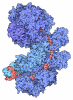
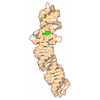
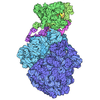
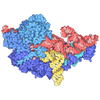
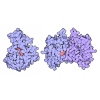
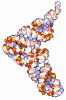
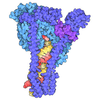
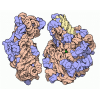
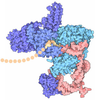
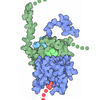
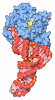
| Title | cryo-EM structure of LwHicAB-crRNA | ||||||||||||
 Components Components |
| ||||||||||||
 Keywords Keywords | IMMUNE SYSTEM / toxin-antitoxin / CRISPR RNA binding / prokaryotic immunity | ||||||||||||
| Function / homology | HicA mRNA interferase family / HicA superfamily / HicA toxin of bacterial toxin-antitoxin, / TTHA1013/TTHA0281-like / mRNA binding / RNA / RNA (> 10) / Toxin-antitoxin system, toxin component, HicA family / Toxin-antitoxin system, antitoxin component, HicB family Function and homology information Function and homology information | ||||||||||||
| Biological species |  Leptotrichia wadei F0279 (bacteria) Leptotrichia wadei F0279 (bacteria) | ||||||||||||
| Method | ELECTRON MICROSCOPY / single particle reconstruction / cryo EM / Resolution: 3.4 Å | ||||||||||||
 Authors Authors | Liang, L. / Jiyun, C. / Xueyan, L. | ||||||||||||
| Funding support |  United Kingdom, European Union, 3items United Kingdom, European Union, 3items
| ||||||||||||
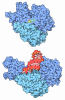
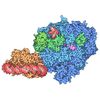
 Citation Citation | Journal: Nat Commun / Year: 2026 Title: Potential role of a CRISPR-Cas-activated toxin-antitoxin system in bacterial immunity. Authors: Jiyun Chen / Linglong Huang / Hong Chen / Xueyan Li / Xiaofeng Lin / Chenmin Guo / Xi Liu / Guowei Fu / Ying Chen / Liang Liu /  Abstract: CRISPR-Cas and toxin-antitoxin systems can serve as antiviral defense mechanisms in prokaryotes. In typical toxin-antitoxin systems, toxin activation can limit phage propagation by inducing growth ...CRISPR-Cas and toxin-antitoxin systems can serve as antiviral defense mechanisms in prokaryotes. In typical toxin-antitoxin systems, toxin activation can limit phage propagation by inducing growth arrest or reduced cellular fitness, while the antitoxin neutralizes toxin activity. Here, we study potential functional synergy between a CRISPR-Cas13a system and a type II toxin-antitoxin module (HicAB) from a Leptotrichia bacterium, when heterologously expressed in E. coli, as well as in biochemical and structural analyses. We show that the antitoxin HicB exhibits toxic properties, and Cas13a directly activates HicB, triggering growth inhibition and conferring protection against bacteriophages. Structural analyses reveal that Cas13a binding promotes the spatial proximity of HicB tetramers, likely enabling its activation. The toxin HicA competitively binds to HicB, thereby inhibiting Cas13a-mediated HicB activation. Importantly, both CRISPR RNA and HicB independently suppress HicA toxicity. Structural evidence indicates that CRISPR RNA forms a hetero-tetradecameric complex with HicAB, occluding HicA's active site and neutralizing its toxic function. Thus, our findings indicate functional synergy between distinct bacterial immune strategies. | ||||||||||||
| History |
|
- Structure visualization
| Structure viewer | Molecule: MolmilJmol/JSmol |
|---|
- Downloads & links
-Download
| PDBx/mmCIF format | 9svk.cif.gz | 300.2 KB | Display | PDBx/mmCIF format |
|---|---|---|---|---|
| PDB format | pdb9svk.ent.gz | 241.8 KB | Display | PDB format |
| PDBx/mmJSON format | 9svk.json.gz | Tree view | PDBx/mmJSON format | |
| Others |  Other downloads Other downloads |
-Validation report
| Arichive directory | https://data.pdbj.org/pub/pdb/validation_reports/sv/9svkftp://data.pdbj.org/pub/pdb/validation_reports/sv/9svk | HTTPS FTP |
|---|
-Related structure data
| Related structure data |  55261MC M: map data used to model this data C: citing same article ( |
|---|---|
| Similar structure data |
-Links
 PDBj
PDBj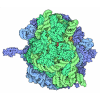
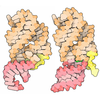
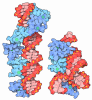
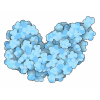
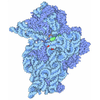
- Assembly
| Deposited unit | 
|
|---|---|
| 1 |
|
-Components
| #1: Protein | Mass: 15867.150 Da / Num. of mol.: 8 Source method: isolated from a genetically manipulated source Source: (gene. exp.) Leptotrichia wadei F0279 (bacteria) / Gene: HMPREF9015_01859 / Production host:  Escherichia coli (E. coli) / References: UniProt: U2RCH0 Escherichia coli (E. coli) / References: UniProt: U2RCH0#2: Protein | Mass: 7239.685 Da / Num. of mol.: 4 Source method: isolated from a genetically manipulated source Source: (gene. exp.) Leptotrichia wadei F0279 (bacteria) / Gene: HMPREF9015_01860 / Production host: Escherichia coli (E. coli) / References: UniProt: U2R460#3: RNA chain | Mass: 18564.164 Da / Num. of mol.: 2 Source method: isolated from a genetically manipulated source Source: (gene. exp.) Leptotrichia wadei F0279 (bacteria) / Production host:   Escherichia phage T7 (virus) Escherichia phage T7 (virus)Has protein modification | N | |
|---|
-Experimental details
-Experiment
| Experiment | Method: ELECTRON MICROSCOPY |
|---|---|
| EM experiment | Aggregation state: 3D ARRAY / 3D reconstruction method: single particle reconstruction |
- Sample preparation
| Component | Name: LwHicAB-crRNA / Type: COMPLEX / Entity ID: all / Source: RECOMBINANT | ||||||||||||||||||||
|---|---|---|---|---|---|---|---|---|---|---|---|---|---|---|---|---|---|---|---|---|---|
| Source (natural) | Organism: Leptotrichia wadei F0279 (bacteria) | ||||||||||||||||||||
| Source (recombinant) | Organism: Escherichia coli (E. coli) | ||||||||||||||||||||
| Buffer solution | pH: 7.5 | ||||||||||||||||||||
| Buffer component |
| ||||||||||||||||||||
| Specimen | Conc.: 3.8 mg/ml / Embedding applied: NO / Shadowing applied: NO / Staining applied: NO / Vitrification applied: YES | ||||||||||||||||||||
| Specimen support | Grid material: GOLD / Grid mesh size: 300 divisions/in. / Grid type: UltrAuFoil R1.2/1.3 | ||||||||||||||||||||
| Vitrification | Instrument: FEI VITROBOT MARK II / Cryogen name: ETHANE / Humidity: 100 % / Chamber temperature: 277 K |
- Electron microscopy imaging
| Experimental equipment |  Model: Titan Krios / Image courtesy: FEI Company |
|---|---|
| Microscopy | Model: TFS KRIOS |
| Electron gun | Electron source:  FIELD EMISSION GUN / Accelerating voltage: 300 kV / Illumination mode: FLOOD BEAM FIELD EMISSION GUN / Accelerating voltage: 300 kV / Illumination mode: FLOOD BEAM |
| Electron lens | Mode: BRIGHT FIELD / Nominal magnification: 120000 X / Nominal defocus max: 2800 nm / Nominal defocus min: 1200 nm / Cs: 2.7 mm / C2 aperture diameter: 50 µm |
| Image recording | Electron dose: 63 e/Å2 / Film or detector model: TFS FALCON 4i (4k x 4k) |
- Processing
| EM software |
| ||||||||||||||||||||||||
|---|---|---|---|---|---|---|---|---|---|---|---|---|---|---|---|---|---|---|---|---|---|---|---|---|---|
| CTF correction | Type: NONE | ||||||||||||||||||||||||
| 3D reconstruction | Resolution: 3.4 Å / Resolution method: FSC 0.143 CUT-OFF / Num. of particles: 1184599 / Symmetry type: POINT | ||||||||||||||||||||||||
| Atomic model building | Protocol: AB INITIO MODEL | ||||||||||||||||||||||||
| Refine LS restraints |
|
