 Movie
Movie Controller

[English] 日本語
 Yorodumi
- PDB-9rwr: Ancestral Fibrobacteres-Chlorobi-Bacteroidetes Group Chaperonin (... -
+ Open data

- Basic information
| Entry | Database: PDB / ID: 9rwr | |||||||||||||||||||||||||||
|---|---|---|---|---|---|---|---|---|---|---|---|---|---|---|---|---|---|---|---|---|---|---|---|---|---|---|---|---|
| Title | Ancestral Fibrobacteres-Chlorobi-Bacteroidetes Group Chaperonin (AFCB) Double-Ring in Open Conformation | |||||||||||||||||||||||||||
 Components Components | Ancestral Fibrobacteres-Chlorobi-Bacteroidetes Group Chaperonin (AFCB) | |||||||||||||||||||||||||||
 Keywords Keywords | CHAPERONE / Chaperonins / Ancestors / Evolution / Cryoelectron Microscopy | |||||||||||||||||||||||||||
| Biological species | synthetic construct (others) | |||||||||||||||||||||||||||
| Method | ELECTRON MICROSCOPY / single particle reconstruction / cryo EM / Resolution: 3.45 Å | |||||||||||||||||||||||||||
 Authors Authors | Cuellar, J. / Gutierrez-Seijo, J. / Severino, R. | |||||||||||||||||||||||||||
| Funding support |  Spain, 3items Spain, 3items
| |||||||||||||||||||||||||||
 Citation Citation | Journal: Mol Biol Evol / Year: 2025 Title: Ancestral Chaperonins Provide the First Structural Glimpse into Early Multimeric Protein Evolution. Authors: Rita Severino / Jorge Cuéllar / Jorge Gutiérrez-Seijo / Moisés Maestro-López / Luis Sánchez-Pulido / César Santiago / Mercedes Moreno-Paz / José María Valpuesta / Víctor Parro / Abstract: Chaperonins are essential protein-folding machines, classified into three structural and phylogenetic groups: Group I (bacterial GroEL), Group II (archaeal thermosome and eukaryotic CCT), and Group ...Chaperonins are essential protein-folding machines, classified into three structural and phylogenetic groups: Group I (bacterial GroEL), Group II (archaeal thermosome and eukaryotic CCT), and Group III (bacterial thermosome-like). Using ancestral sequence reconstruction (ASR) and protein resurrection, we inferred and experimentally characterized the last common ancestors of these groups (ancestral chaperonins ACI, ACII, and ACIII). The resurrected proteins exhibited ATPase activity (except ACII) and protected client proteins from heat-induced inactivation. Structural analyses by electron microscopy and Cryo-EM revealed that ACI forms single 7-mer rings, whereas ACII adopts a mixed population of single/double 8-mer rings, representing the first experimental observation of intermediate oligomeric states. ACII also features a unique cochaperonin-independent closure mechanism, distinct from modern Group I and II chaperonins. Together, these findings provide the experimental structural reconstruction of the most ancient and complex multimeric proteins so far, uncover novel intermediate states in chaperonin evolution, and offer a direct empirical framework for studying the emergence of multimeric complexity in early cellular life. | |||||||||||||||||||||||||||
| History |
|
- Structure visualization
| Structure viewer | Molecule:  MolmilJmol/JSmol MolmilJmol/JSmol |
|---|
- Downloads & links
-Download
| PDBx/mmCIF format | 9rwr.cif.gz | 2.5 MB | Display | PDBx/mmCIF format |
|---|---|---|---|---|
| PDB format | pdb9rwr.ent.gz | Display | PDB format | |
| PDBx/mmJSON format | 9rwr.json.gz | Tree view | PDBx/mmJSON format | |
| Others |  Other downloads Other downloads |
-Validation report
| Arichive directory | https://data.pdbj.org/pub/pdb/validation_reports/rw/9rwrftp://data.pdbj.org/pub/pdb/validation_reports/rw/9rwr | HTTPS FTP |
|---|
-Related structure data
| Related structure data |  54341MC  9rwpC  9rwqC M: map data used to model this data C: citing same article ( |
|---|


-Links
 PDBj
PDBj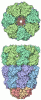
- Assembly
| Deposited unit | 
|
|---|---|
| 1 |
|
-Components
| #1: Protein | Mass: 56053.145 Da / Num. of mol.: 14 Source method: isolated from a genetically manipulated source Source: (gene. exp.) synthetic construct (others) / Production host:   Escherichia coli BL21(DE3) (bacteria) Escherichia coli BL21(DE3) (bacteria)Has protein modification | N | |
|---|
-Experimental details
-Experiment
| Experiment | Method: ELECTRON MICROSCOPY |
|---|---|
| EM experiment | Aggregation state: PARTICLE / 3D reconstruction method: single particle reconstruction |
- Sample preparation
| Component | Name: Ancestral Fibrobacteres-Chlorobi-Bacteroidetes Group Chaperonin (AFCB) Type: COMPLEX / Entity ID: all / Source: RECOMBINANT |
|---|---|
| Molecular weight | Value: 0.802 MDa / Experimental value: NO |
| Source (natural) | Organism: synthetic construct (others) |
| Source (recombinant) | Organism: Escherichia coli BL21(DE3) (bacteria) |
| Buffer solution | pH: 7.4 |
| Specimen | Embedding applied: NO / Shadowing applied: NO / Staining applied: NO / Vitrification applied: YES |
| Specimen support | Grid material: COPPER/RHODIUM / Grid mesh size: 300 divisions/in. / Grid type: Quantifoil R2/2 |
| Vitrification | Cryogen name: ETHANE |
- Electron microscopy imaging
| Experimental equipment | 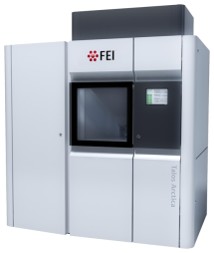 Model: Talos Arctica / Image courtesy: FEI Company |
|---|---|
| Microscopy | Model: FEI TALOS ARCTICA |
| Electron gun | Electron source:  FIELD EMISSION GUN / Accelerating voltage: 200 kV / Illumination mode: FLOOD BEAM FIELD EMISSION GUN / Accelerating voltage: 200 kV / Illumination mode: FLOOD BEAM |
| Electron lens | Mode: BRIGHT FIELD / Nominal magnification: 120000 X / Nominal defocus max: 2200 nm / Nominal defocus min: 800 nm |
| Image recording | Electron dose: 43 e/Å2 / Detector mode: COUNTING / Film or detector model: FEI FALCON III (4k x 4k) / Num. of grids imaged: 1 |
- Processing
| EM software |
| ||||||||||||||||||||||||||||||||||||||||||||
|---|---|---|---|---|---|---|---|---|---|---|---|---|---|---|---|---|---|---|---|---|---|---|---|---|---|---|---|---|---|---|---|---|---|---|---|---|---|---|---|---|---|---|---|---|---|
| CTF correction | Type: PHASE FLIPPING AND AMPLITUDE CORRECTION | ||||||||||||||||||||||||||||||||||||||||||||
| Particle selection | Num. of particles selected: 245876 | ||||||||||||||||||||||||||||||||||||||||||||
| Symmetry | Point symmetry: C1 (asymmetric) | ||||||||||||||||||||||||||||||||||||||||||||
| 3D reconstruction | Resolution: 3.45 Å / Resolution method: FSC 0.143 CUT-OFF / Num. of particles: 44531 / Symmetry type: POINT | ||||||||||||||||||||||||||||||||||||||||||||
| Atomic model building | Protocol: AB INITIO MODEL | ||||||||||||||||||||||||||||||||||||||||||||
| Atomic model building | Source name: AlphaFold / Type: in silico model |
