 Movie
Movie Controller


+ Open data

- Basic information
| Entry | Database: PDB / ID: 9rb3 | ||||||||||||||||||||||||
|---|---|---|---|---|---|---|---|---|---|---|---|---|---|---|---|---|---|---|---|---|---|---|---|---|---|
| Title | A53T alpha-synuclein fibril - Type 1 | ||||||||||||||||||||||||
 Components Components | Alpha-synuclein | ||||||||||||||||||||||||
 Keywords Keywords | PROTEIN FIBRIL / alpha-synuclein / fibril / A53T mutant | ||||||||||||||||||||||||
| Function / homology |  Function and homology information Function and homology informationnegative regulation of mitochondrial electron transport, NADH to ubiquinone / response to desipramine / negative regulation of dopamine uptake involved in synaptic transmission / negative regulation of norepinephrine uptake / positive regulation of SNARE complex assembly / positive regulation of hydrogen peroxide catabolic process / supramolecular fiber / negative regulation of chaperone-mediated autophagy / regulation of synaptic vesicle recycling / regulation of reactive oxygen species biosynthetic process ...negative regulation of mitochondrial electron transport, NADH to ubiquinone / response to desipramine / negative regulation of dopamine uptake involved in synaptic transmission / negative regulation of norepinephrine uptake / positive regulation of SNARE complex assembly / positive regulation of hydrogen peroxide catabolic process / supramolecular fiber / negative regulation of chaperone-mediated autophagy / regulation of synaptic vesicle recycling / regulation of reactive oxygen species biosynthetic process / positive regulation of protein localization to cell periphery / negative regulation of exocytosis / dopamine biosynthetic process / dopamine uptake involved in synaptic transmission / negative regulation of dopamine metabolic process / response to iron(II) ion / negative regulation of platelet-derived growth factor receptor signaling pathway / SNARE complex assembly / negative regulation of microtubule polymerization / negative regulation of thrombin-activated receptor signaling pathway / synaptic vesicle priming / Lewy body / synaptic vesicle transport / regulation of norepinephrine uptake / synaptic vesicle exocytosis / transporter regulator activity / protein kinase inhibitor activity / positive regulation of inositol phosphate biosynthetic process / positive regulation of receptor recycling / cuprous ion binding / positive regulation of exocytosis / nuclear outer membrane / dynein complex binding / synaptic transmission, dopaminergic / regulation of dopamine secretion / positive regulation of endocytosis / response to magnesium ion / negative regulation of serotonin uptake / kinesin binding / cysteine-type endopeptidase inhibitor activity / regulation of presynapse assembly / synaptic vesicle endocytosis / alpha-tubulin binding / beta-tubulin binding / phospholipase binding / behavioral response to cocaine / cellular response to fibroblast growth factor stimulus / supramolecular fiber organization / response to type II interferon / cellular response to epinephrine stimulus / inclusion body / response to interleukin-1 / Hsp70 protein binding / axon terminus / cellular response to copper ion / positive regulation of release of sequestered calcium ion into cytosol / enzyme inhibitor activity / glutathione metabolic process / SNARE binding / protein tetramerization / regulation of microtubule cytoskeleton organization / phosphoprotein binding / receptor internalization / protein destabilization / microglial cell activation / tubulin binding / ferrous iron binding / protein sequestering activity / phospholipid binding / synapse organization / PKR-mediated signaling / tau protein binding / enzyme activator activity / positive regulation of inflammatory response / actin cytoskeleton / terminal bouton / synaptic vesicle membrane / negative regulation of neuron apoptotic process / histone binding / actin binding / response to lipopolysaccharide / growth cone / cellular response to oxidative stress / cell cortex / oxidoreductase activity / microtubule binding / amyloid fibril formation / mitochondrial outer membrane / lysosome / transcription cis-regulatory region binding / mitochondrial inner membrane / positive regulation of apoptotic process / ribosome / mitochondrial matrix / Amyloid fiber formation / copper ion binding / protein domain specific binding / axon / lipid binding / neuronal cell body Similarity search - Function | ||||||||||||||||||||||||
| Biological species |  Homo sapiens (human) Homo sapiens (human) | ||||||||||||||||||||||||
| Method | ELECTRON MICROSCOPY / helical reconstruction / cryo EM / Resolution: 3.4 Å | ||||||||||||||||||||||||
 Authors Authors | So, R.W.L. / Frieg, B. / Schroeder, G.F. / Watts, J.C. | ||||||||||||||||||||||||
| Funding support |  Canada, Canada,  Germany, 2items Germany, 2items
| ||||||||||||||||||||||||
 Citation Citation | Journal: Neuron / Year: 2026 Title: Stochastic misfolding drives the emergence of distinct α-synuclein strains. Authors: Raphaella W L So / Benedikt Frieg / José D Camino / Christopher Situ / Mark N Metri / Nicholas R G Silver / Le Yao Li / Alison Mao / Erica Stuart / Gunnar F Schröder / Joel C Watts / Abstract: α-Synuclein conformational strains provide a potential explanation for the clinical and pathological differences among synucleinopathies such as Parkinson's disease and multiple system atrophy. ...α-Synuclein conformational strains provide a potential explanation for the clinical and pathological differences among synucleinopathies such as Parkinson's disease and multiple system atrophy. However, how distinct α-synuclein strains arise remains unknown. Here, we observed conformational heterogeneity between individual preparations of α-synuclein pre-formed fibrils (PFFs) generated by polymerizing wild-type or A53T-mutant human α-synuclein under identical conditions. Moreover, we found that α-synuclein aggregates formed spontaneously in the brains of a transgenic synucleinopathy mouse model are conformationally diverse. Propagation of stochastically formed PFF- and brain-derived α-synuclein strains in mice initiated several distinct synucleinopathies. The conformational diversity of α-synuclein aggregates across PFF preparations and between individual mice demonstrates that α-synuclein can spontaneously form multiple self-propagating strains within an identical environment. This suggests that stochastic misfolding into distinct aggregate structures drives the emergence of α-synuclein strains and reveals that the intrinsic variability of common synucleinopathy research tools must be considered when designing and interpreting experiments. | ||||||||||||||||||||||||
| History |
|
- Structure visualization
| Structure viewer | Molecule: MolmilJmol/JSmol |
|---|
- Downloads & links
-Download
| PDBx/mmCIF format | 9rb3.cif.gz | 133.4 KB | Display | PDBx/mmCIF format |
|---|---|---|---|---|
| PDB format | pdb9rb3.ent.gz | 98.9 KB | Display | PDB format |
| PDBx/mmJSON format | 9rb3.json.gz | Tree view | PDBx/mmJSON format | |
| Others |  Other downloads Other downloads |
-Validation report
| Arichive directory | https://data.pdbj.org/pub/pdb/validation_reports/rb/9rb3ftp://data.pdbj.org/pub/pdb/validation_reports/rb/9rb3 | HTTPS FTP |
|---|
-Related structure data
| Related structure data |  53884MC  9rb6C  9rb7C  9rb8C  9rb9C  9rbaC  9rbbC M: map data used to model this data C: citing same article ( |
|---|---|
| Similar structure data |


-Links
 PDBj
PDBj- Assembly
| Deposited unit | 
| ||||||||||||||||||||||||||||||||||||||||||||||||||||||||||||||||||||||||||||||||||||||||||||||||||||||||||
|---|---|---|---|---|---|---|---|---|---|---|---|---|---|---|---|---|---|---|---|---|---|---|---|---|---|---|---|---|---|---|---|---|---|---|---|---|---|---|---|---|---|---|---|---|---|---|---|---|---|---|---|---|---|---|---|---|---|---|---|---|---|---|---|---|---|---|---|---|---|---|---|---|---|---|---|---|---|---|---|---|---|---|---|---|---|---|---|---|---|---|---|---|---|---|---|---|---|---|---|---|---|---|---|---|---|---|---|
| 1 |
| ||||||||||||||||||||||||||||||||||||||||||||||||||||||||||||||||||||||||||||||||||||||||||||||||||||||||||
| Noncrystallographic symmetry (NCS) | NCS domain:
NCS domain segments: Component-ID: 1 / Ens-ID: ens_1 / Beg auth comp-ID: GLY / Beg label comp-ID: GLY / End auth comp-ID: ASP / End label comp-ID: ASP / Auth seq-ID: 14 - 98 / Label seq-ID: 14 - 98
NCS oper:
|
-Components
| #1: Protein | Mass: 14506.136 Da / Num. of mol.: 10 Source method: isolated from a genetically manipulated source Source: (gene. exp.) Homo sapiens (human) / Gene: SNCA, NACP, PARK1 / Production host:   Escherichia coli BL21(DE3) (bacteria) / References: UniProt: P37840 Escherichia coli BL21(DE3) (bacteria) / References: UniProt: P37840Has protein modification | N | |
|---|
-Experimental details
-Experiment
| Experiment | Method: ELECTRON MICROSCOPY |
|---|---|
| EM experiment | Aggregation state: FILAMENT / 3D reconstruction method: helical reconstruction |
- Sample preparation
| Component | Name: A53T alpha-synuclein fibril - Type 1 / Type: COMPLEX / Entity ID: all / Source: RECOMBINANT |
|---|---|
| Molecular weight | Experimental value: NO |
| Source (natural) | Organism: Homo sapiens (human) |
| Source (recombinant) | Organism: Escherichia coli BL21(DE3) (bacteria) |
| Buffer solution | pH: 7.4 |
| Specimen | Embedding applied: NO / Shadowing applied: NO / Staining applied: NO / Vitrification applied: YES |
| Vitrification | Cryogen name: ETHANE |
- Electron microscopy imaging
| Experimental equipment | 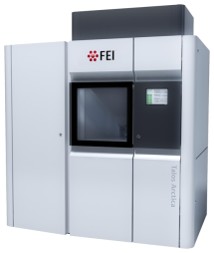 Model: Talos Arctica / Image courtesy: FEI Company |
|---|---|
| Microscopy | Model: FEI TALOS ARCTICA |
| Electron gun | Electron source:  FIELD EMISSION GUN / Accelerating voltage: 200 kV / Illumination mode: FLOOD BEAM FIELD EMISSION GUN / Accelerating voltage: 200 kV / Illumination mode: FLOOD BEAM |
| Electron lens | Mode: BRIGHT FIELD / Nominal defocus max: 2500 nm / Nominal defocus min: 500 nm |
| Image recording | Electron dose: 30 e/Å2 / Film or detector model: GATAN K3 BIOQUANTUM (6k x 4k) |
- Processing
| CTF correction | Type: NONE | ||||||||||||||||||||||||||||||||||||||||||||||||||||||||||||||||||||||
|---|---|---|---|---|---|---|---|---|---|---|---|---|---|---|---|---|---|---|---|---|---|---|---|---|---|---|---|---|---|---|---|---|---|---|---|---|---|---|---|---|---|---|---|---|---|---|---|---|---|---|---|---|---|---|---|---|---|---|---|---|---|---|---|---|---|---|---|---|---|---|---|
| Helical symmerty | Angular rotation/subunit: 179.79 ° / Axial rise/subunit: 2.49 Å / Axial symmetry: C1 | ||||||||||||||||||||||||||||||||||||||||||||||||||||||||||||||||||||||
| 3D reconstruction | Resolution: 3.4 Å / Resolution method: FSC 0.143 CUT-OFF / Num. of particles: 37465 / Symmetry type: HELICAL | ||||||||||||||||||||||||||||||||||||||||||||||||||||||||||||||||||||||
| Refinement | Cross valid method: NONE Stereochemistry target values: GeoStd + Monomer Library + CDL v1.2 | ||||||||||||||||||||||||||||||||||||||||||||||||||||||||||||||||||||||
| Displacement parameters | Biso mean: 89.73 Å2 | ||||||||||||||||||||||||||||||||||||||||||||||||||||||||||||||||||||||
| Refine LS restraints |
| ||||||||||||||||||||||||||||||||||||||||||||||||||||||||||||||||||||||
| Refine LS restraints NCS |
|
