 Movie
Movie Controller


+ Open data

- Basic information
| Entry | Database: PDB / ID: 9r0s | ||||||
|---|---|---|---|---|---|---|---|
| Title | human FAM118B pentameric filament | ||||||
 Components Components | Protein FAM118B | ||||||
 Keywords Keywords | IMMUNE SYSTEM / filament / enzyme / NAD / nucleus / innate immunity / sirtuin | ||||||
| Function / homology | Protein FAM118 / SIR2-like domain / Cajal body / identical protein binding / Protein FAM118B Function and homology information Function and homology information | ||||||
| Biological species |  Homo sapiens (human) Homo sapiens (human) | ||||||
| Method | ELECTRON MICROSCOPY / single particle reconstruction / cryo EM / Resolution: 5 Å | ||||||
 Authors Authors | Baretic, D. / Missoury, S. / Patel, K. / Coste, F. / Delarue, M. / Suskiewicz, J.M. / Ahel, I. | ||||||
| Funding support |  United Kingdom, 1items United Kingdom, 1items
| ||||||
 Citation Citation | Journal: Nat Struct Mol Biol / Year: 2025 Title: Filament formation and NAD processing by noncanonical human FAM118 sirtuins. Authors: Domagoj Baretić / Sophia Missoury / Karishma Patel / Maximilien Martinez / Franck Coste / Kang Zhu / Rebecca Smith / Anna Georgina Kopasz / Yang Lu / Nicolas Bigot / Catherine Chapuis / ...Authors: Domagoj Baretić / Sophia Missoury / Karishma Patel / Maximilien Martinez / Franck Coste / Kang Zhu / Rebecca Smith / Anna Georgina Kopasz / Yang Lu / Nicolas Bigot / Catherine Chapuis / Romane Riou / Nina Đukić / Stéphane Goffinont / Valentin Pressoir / Sara Patačko / Gyula Timinszky / Marc Delarue / Bertrand Castaing / Dragana Ahel / Andreja Mikoč / Sébastien Huet / Ivan Ahel / Marcin J Suskiewicz /    Abstract: Sirtuins are an ancient family of enzymes with diverse nicotinamide adenine dinucleotide (NAD)-dependent activities. Here we identify family with sequence similarity 118 member B (FAM118B) and ...Sirtuins are an ancient family of enzymes with diverse nicotinamide adenine dinucleotide (NAD)-dependent activities. Here we identify family with sequence similarity 118 member B (FAM118B) and FAM118A-two understudied vertebrate proteins-as vertebrate-specific sirtuins with similarities to bacterial antiphage sirtuins. We show that human FAM118B forms head-to-tail filaments both in vitro and in living human cells, a feature that appears to be conserved in both FAM118B and its paralog FAM118A across vertebrates. While human FAM118B and FAM118A have individually very weak NAD-processing activity in vitro, their interaction leads to markedly increased activity, suggesting a tightly regulated system. The overexpression of wild-type human FAM118B and FAM118A leads to strongly decreased NAD levels in human cells, an effect that is abolished in catalytically dead or filament-deficient mutants. Our study highlights filament formation and NAD processing as conserved mechanisms among immunity-associated sirtuins across evolution. | ||||||
| History |
|
- Structure visualization
| Structure viewer | Molecule: MolmilJmol/JSmol |
|---|
- Downloads & links
-Download
| PDBx/mmCIF format | 9r0s.cif.gz | 506.8 KB | Display | PDBx/mmCIF format |
|---|---|---|---|---|
| PDB format | pdb9r0s.ent.gz | 425.3 KB | Display | PDB format |
| PDBx/mmJSON format | 9r0s.json.gz | Tree view | PDBx/mmJSON format | |
| Others |  Other downloads Other downloads |
-Validation report
| Summary document | 9r0s_validation.pdf.gz | 1.3 MB | Display | wwPDB validaton report |
|---|---|---|---|---|
| Full document | 9r0s_full_validation.pdf.gz | 1.3 MB | Display | |
| Data in XML | 9r0s_validation.xml.gz | 62.5 KB | Display | |
| Data in CIF | 9r0s_validation.cif.gz | 94.2 KB | Display | |
| Arichive directory | https://data.pdbj.org/pub/pdb/validation_reports/r0/9r0sftp://data.pdbj.org/pub/pdb/validation_reports/r0/9r0s | HTTPS FTP |
-Related structure data
| Related structure data |  53488MC  9r0pC  9r3eC M: map data used to model this data C: citing same article ( |
|---|---|
| Similar structure data |


-Links
 PDBj
PDBj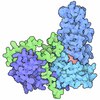
- Assembly
| Deposited unit | 
|
|---|---|
| 1 |
|
-Components
| #1: Protein | Mass: 41724.402 Da / Num. of mol.: 5 Source method: isolated from a genetically manipulated source Details: 6xHis-tag with additional residue before and after the tag: MGSSHHHHHHSSGLVPRGSH Source: (gene. exp.) Homo sapiens (human) / Gene: FAM118B / Production host:   Escherichia coli (E. coli) / References: UniProt: Q9BPY3 Escherichia coli (E. coli) / References: UniProt: Q9BPY3Has protein modification | N | |
|---|
-Experimental details
-Experiment
| Experiment | Method: ELECTRON MICROSCOPY |
|---|---|
| EM experiment | Aggregation state: FILAMENT / 3D reconstruction method: single particle reconstruction |
- Sample preparation
| Component | Name: homopolymer/filament of human FAM118B / Type: COMPLEX / Details: filament purified from E. coli / Entity ID: all / Source: RECOMBINANT | |||||||||||||||||||||||||
|---|---|---|---|---|---|---|---|---|---|---|---|---|---|---|---|---|---|---|---|---|---|---|---|---|---|---|
| Molecular weight | Experimental value: NO | |||||||||||||||||||||||||
| Source (natural) | Organism: Homo sapiens (human) | |||||||||||||||||||||||||
| Source (recombinant) | Organism: Escherichia coli (E. coli) | |||||||||||||||||||||||||
| Buffer solution | pH: 7.5 Details: 20 mM HEPES pH 7.5, 150 mM NaCl, 0.5 mM TCEP and 12.5 m Tris pH 7.5, 150 mM NaCl, 0.5 mM TCEP, the sample was originally in the Hepes buffer and prior to vitrification it was diluted in the ...Details: 20 mM HEPES pH 7.5, 150 mM NaCl, 0.5 mM TCEP and 12.5 m Tris pH 7.5, 150 mM NaCl, 0.5 mM TCEP, the sample was originally in the Hepes buffer and prior to vitrification it was diluted in the Tris buffer in 1:3 volume ratio, respectively to a final concentration of protein at 0.1 mg/mL (3.5 uM) | |||||||||||||||||||||||||
| Buffer component |
| |||||||||||||||||||||||||
| Specimen | Conc.: 0.1 mg/ml / Embedding applied: NO / Shadowing applied: NO / Staining applied: NO / Vitrification applied: YES Details: the sample was purified in the form of filaments of various sizes ranging from about 3 to 10 units | |||||||||||||||||||||||||
| Specimen support | Grid material: COPPER / Grid mesh size: 300 divisions/in. / Grid type: Quantifoil R1.2/1.3 | |||||||||||||||||||||||||
| Vitrification | Instrument: LEICA EM GP / Cryogen name: ETHANE / Humidity: 100 % / Chamber temperature: 291.15 K Details: A 3.5 uL of sample was applied to the holey carbon side of the grid. Without an additional incubation time, the grid was back blotted once for 1.5 s and plunge frozen in liquid ethane. |
- Electron microscopy imaging
| Experimental equipment |  Model: Titan Krios / Image courtesy: FEI Company |
|---|---|
| Microscopy | Model: TFS KRIOS |
| Electron gun | Electron source:  FIELD EMISSION GUN / Accelerating voltage: 300 kV / Illumination mode: FLOOD BEAM FIELD EMISSION GUN / Accelerating voltage: 300 kV / Illumination mode: FLOOD BEAM |
| Electron lens | Mode: BRIGHT FIELD / Nominal defocus max: 2600 nm / Nominal defocus min: 1600 nm / Cs: 2.7 mm / C2 aperture diameter: 50 µm / Alignment procedure: BASIC |
| Specimen holder | Cryogen: NITROGEN / Specimen holder model: FEI TITAN KRIOS AUTOGRID HOLDER |
| Image recording | Electron dose: 43.7 e/Å2 / Film or detector model: GATAN K3 (6k x 4k) / Num. of grids imaged: 1 / Num. of real images: 11630 / Details: Grid ID 6-1-db251124 |
| EM imaging optics | Details: Gatan K3 direct electron detector with energy filter was used Energyfilter slit width: 20 eV |
- Processing
| EM software |
| ||||||||||||||||||||||||||||||||||||||||||||||||||
|---|---|---|---|---|---|---|---|---|---|---|---|---|---|---|---|---|---|---|---|---|---|---|---|---|---|---|---|---|---|---|---|---|---|---|---|---|---|---|---|---|---|---|---|---|---|---|---|---|---|---|---|
| CTF correction | Type: PHASE FLIPPING AND AMPLITUDE CORRECTION | ||||||||||||||||||||||||||||||||||||||||||||||||||
| Particle selection | Num. of particles selected: 1958302 | ||||||||||||||||||||||||||||||||||||||||||||||||||
| 3D reconstruction | Resolution: 5 Å / Resolution method: FSC 0.143 CUT-OFF / Num. of particles: 111156 / Algorithm: FOURIER SPACE / Num. of class averages: 1 / Symmetry type: POINT | ||||||||||||||||||||||||||||||||||||||||||||||||||
| Atomic model building | Protocol: FLEXIBLE FIT / Space: REAL Details: Molecular dynamics flexible fitting was used in ISOLDE/Chimerax | ||||||||||||||||||||||||||||||||||||||||||||||||||
| Atomic model building | Accession code: Q9BPY3F1 / Chain residue range: 28-326 / Source name: AlphaFold / Type: in silico model |
