 Movie
Movie Controller


+ Open data

- Basic information
| Entry | Database: PDB / ID: 9qy3 | ||||||||||||||||||||||||||||||
|---|---|---|---|---|---|---|---|---|---|---|---|---|---|---|---|---|---|---|---|---|---|---|---|---|---|---|---|---|---|---|---|
| Title | Structure of the Plum Pox Virus (PPV) | ||||||||||||||||||||||||||||||
 Components Components |
| ||||||||||||||||||||||||||||||
 Keywords Keywords | VIRUS / Potyvirus / Plum Pox Virus / PPV | ||||||||||||||||||||||||||||||
| Function / homology | Potyvirus coat protein / Potyvirus coat protein / viral capsid / RNA / RNA (> 10) / RNA (> 100) / Genome polyprotein Function and homology information Function and homology information | ||||||||||||||||||||||||||||||
| Biological species |  Plum pox virus Plum pox virus | ||||||||||||||||||||||||||||||
| Method | ELECTRON MICROSCOPY / helical reconstruction / cryo EM / Resolution: 2.9 Å | ||||||||||||||||||||||||||||||
 Authors Authors | Bonnet, D.M.V. / Chaves-Sanjuan, A. | ||||||||||||||||||||||||||||||
| Funding support |  Italy, 1items Italy, 1items
| ||||||||||||||||||||||||||||||
 Citation Citation | Journal: Arch Virol / Year: 2025 Title: Structural characterization of plum pox virus by cryo-electron microscopy. Authors: Diane Marie Valérie Jeanne Bonnet / Antonio Chaves-Sanjuan / Nicoletta Contaldo / Angelo De Stradis / Rosanna Caliandro / Angelantonio Minafra / Filippo Geuna / Abstract: Plum pox virus (PPV), a significant member of the genus Potyvirus, represents a global agricultural challenge, causing significant economic losses and threatening fruit farming due to its easy ...Plum pox virus (PPV), a significant member of the genus Potyvirus, represents a global agricultural challenge, causing significant economic losses and threatening fruit farming due to its easy transmission to most Prunus species. Here, we present the high-resolution structural characterization of PPV using cryo-electron microscopy (cryo-EM). The reconstructed structure at 2.9 Å reveals a filamentous virion with a helical assembly formed by the coat protein (CP), which encapsidates a single-stranded RNA (ssRNA) genome. The structure of the CP core shows remarkable conservation with other potyviruses, with an RNA binding site and inter-subunit interactions mediated in part by the N-terminal arm, which is confirmed here to have a disordered structure. Mass spectrometry analysis identified numerous post-translational modifications, mostly phosphorylation, primarily in the flexible N-terminal region. In silico predictions revealed intrinsically disordered regions, which is compatible with the amyloidogenic properties of the CP. These results provide new insights into the architecture and assembly of PPV, offering a basis for future studies and, possibly, antiviral strategies. | ||||||||||||||||||||||||||||||
| History |
|
- Structure visualization
| Structure viewer | Molecule: MolmilJmol/JSmol |
|---|
- Downloads & links
-Download
| PDBx/mmCIF format | 9qy3.cif.gz | 1.6 MB | Display | PDBx/mmCIF format |
|---|---|---|---|---|
| PDB format | pdb9qy3.ent.gz | 1.4 MB | Display | PDB format |
| PDBx/mmJSON format | 9qy3.json.gz | Tree view | PDBx/mmJSON format | |
| Others |  Other downloads Other downloads |
-Validation report
| Arichive directory | https://data.pdbj.org/pub/pdb/validation_reports/qy/9qy3ftp://data.pdbj.org/pub/pdb/validation_reports/qy/9qy3 | HTTPS FTP |
|---|
-Related structure data
| Related structure data |  53450MC M: map data used to model this data C: citing same article ( |
|---|---|
| Similar structure data |
-Links
 PDBj
PDBj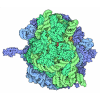
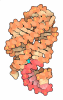
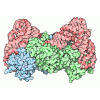
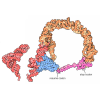
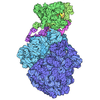
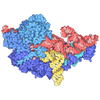
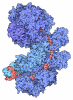
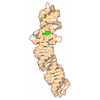
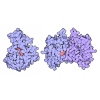
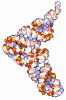
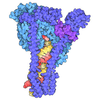
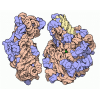
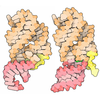
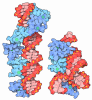
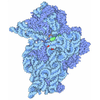
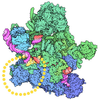
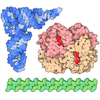
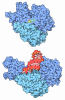
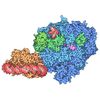
- Assembly
| Deposited unit | 
|
|---|---|
| 1 |
|
-Components
| #1: Protein | Mass: 36551.996 Da / Num. of mol.: 45 Source method: isolated from a genetically manipulated source Details: Coat Protein (CP) / Source: (gene. exp.) Plum pox virus / Production host: Plum pox virus / References: UniProt: B6C7W4#2: RNA chain | | Mass: 191003.562 Da / Num. of mol.: 1 Source method: isolated from a genetically manipulated source Source: (gene. exp.) Plum pox virus / Production host: Plum pox virusHas protein modification | N | |
|---|
-Experimental details
-Experiment
| Experiment | Method: ELECTRON MICROSCOPY |
|---|---|
| EM experiment | Aggregation state: FILAMENT / 3D reconstruction method: helical reconstruction |
- Sample preparation
| Component | Name: Plum pox virus / Type: VIRUS / Entity ID: all / Source: NATURAL |
|---|---|
| Source (natural) | Organism: Plum pox virus |
| Details of virus | Empty: NO / Enveloped: NO / Isolate: OTHER / Type: VIRION |
| Virus shell | Name: CP |
| Buffer solution | pH: 7 |
| Specimen | Embedding applied: NO / Shadowing applied: NO / Staining applied: NO / Vitrification applied: YES |
| Specimen support | Grid material: COPPER / Grid mesh size: 300 divisions/in. / Grid type: Quantifoil R1.2/1.3 |
| Vitrification | Instrument: FEI VITROBOT MARK IV / Cryogen name: ETHANE / Humidity: 100 % |
- Electron microscopy imaging
| Experimental equipment | 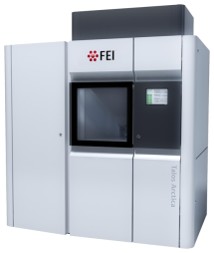 Model: Talos Arctica / Image courtesy: FEI Company |
|---|---|
| Microscopy | Model: FEI TALOS ARCTICA |
| Electron gun | Electron source:  FIELD EMISSION GUN / Accelerating voltage: 200 kV / Illumination mode: FLOOD BEAM FIELD EMISSION GUN / Accelerating voltage: 200 kV / Illumination mode: FLOOD BEAM |
| Electron lens | Mode: BRIGHT FIELD / Nominal magnification: 120000 X / Nominal defocus max: 2300 nm / Nominal defocus min: 500 nm / Alignment procedure: COMA FREE |
| Specimen holder | Cryogen: NITROGEN / Specimen holder model: FEI TITAN KRIOS AUTOGRID HOLDER |
| Image recording | Electron dose: 40 e/Å2 / Detector mode: COUNTING / Film or detector model: FEI FALCON III (4k x 4k) / Num. of grids imaged: 1 / Num. of real images: 2508 |
- Processing
| EM software |
| ||||||||||||||||||||||||||||||||
|---|---|---|---|---|---|---|---|---|---|---|---|---|---|---|---|---|---|---|---|---|---|---|---|---|---|---|---|---|---|---|---|---|---|
| CTF correction | Type: PHASE FLIPPING ONLY | ||||||||||||||||||||||||||||||||
| Helical symmerty | Angular rotation/subunit: -40.89 ° / Axial rise/subunit: 4.08 Å / Axial symmetry: C1 | ||||||||||||||||||||||||||||||||
| Particle selection | Num. of particles selected: 406769 | ||||||||||||||||||||||||||||||||
| 3D reconstruction | Resolution: 2.9 Å / Resolution method: FSC 0.143 CUT-OFF / Num. of particles: 406769 / Symmetry type: HELICAL | ||||||||||||||||||||||||||||||||
| Atomic model building | Protocol: AB INITIO MODEL / Space: REAL | ||||||||||||||||||||||||||||||||
| Refinement | Highest resolution: 2.9 Å Stereochemistry target values: REAL-SPACE (WEIGHTED MAP SUM AT ATOM CENTERS) | ||||||||||||||||||||||||||||||||
| Refine LS restraints |
|
