 Movie
Movie Controller


+ Open data

- Basic information
| Entry | Database: PDB / ID: 9quq | |||||||||||||||||||||
|---|---|---|---|---|---|---|---|---|---|---|---|---|---|---|---|---|---|---|---|---|---|---|
| Title | cryo-EM structure of TolQR conformation2 in SMA nanodiscs | |||||||||||||||||||||
 Components Components |
| |||||||||||||||||||||
 Keywords Keywords | MEMBRANE PROTEIN / Molecular motor Multi-pass membrane protein Accumulates at cell constriction sites. | |||||||||||||||||||||
| Function / homology |  Function and homology information Function and homology informationcellular response to bacteriocin / regulation of membrane invagination / cell septum assembly / bacteriocin transport / toxin transmembrane transporter activity / protein import / virion binding / cell envelope / cell division site / transmembrane transporter activity ...cellular response to bacteriocin / regulation of membrane invagination / cell septum assembly / bacteriocin transport / toxin transmembrane transporter activity / protein import / virion binding / cell envelope / cell division site / transmembrane transporter activity / disordered domain specific binding / protein transport / protein domain specific binding / cell division / symbiont entry into host cell / membrane / plasma membrane Similarity search - Function | |||||||||||||||||||||
| Biological species |   Escherichia coli str. K-12 substr. MG1655 (bacteria) Escherichia coli str. K-12 substr. MG1655 (bacteria) | |||||||||||||||||||||
| Method | ELECTRON MICROSCOPY / single particle reconstruction / cryo EM / Resolution: 3.28 Å | |||||||||||||||||||||
 Authors Authors | Luo, Y. / Shen, C. | |||||||||||||||||||||
| Funding support |  China, 1items China, 1items
| |||||||||||||||||||||
 Citation Citation | Journal: Cell Discov / Year: 2025 Title: Deciphering the molecular mechanism of the bacterial division motor TolQRA. Authors: Chongrong Shen / Teng Xie / Yongbo Luo / Fangyuan Zhao / Xin Wang / Zhibo Zhang / Jie Pang / Jierou Zhang / Xintan Dong / Shenghai Chang / Bi-Sen Ding / Binwu Ying / Wei Chi / Zhaoming Su / ...Authors: Chongrong Shen / Teng Xie / Yongbo Luo / Fangyuan Zhao / Xin Wang / Zhibo Zhang / Jie Pang / Jierou Zhang / Xintan Dong / Shenghai Chang / Bi-Sen Ding / Binwu Ying / Wei Chi / Zhaoming Su / Ruhong Zhou / Xiaodi Tang / Haohao Dong /  Abstract: The Tol-Pal system is essential for maintaining outer membrane (OM) stability during cell division in Gram-negative bacteria. The inner membrane complex TolQRA harnesses proton motive force (PMF) to ...The Tol-Pal system is essential for maintaining outer membrane (OM) stability during cell division in Gram-negative bacteria. The inner membrane complex TolQRA harnesses proton motive force (PMF) to establish transient interactions within the periplasm, thereby coordinating cell envelope remodeling and facilitating OM invagination at division sites. However, the precise mechanism remains unclear. Here, we present cryo-electron microscopy structures of Escherichia coli TolQRA in multiple conformational states at 2.92-3.52 Å resolution, revealing rotary dynamics within the complex. Computational simulations reveal a proton-conductive channel comprising the putative proton-accepting residue Asp23 and the conserved polar residues Thr145 and Thr178, with monitored inter-residue distances providing support for a proton-driven rotary mechanism. Site-directed mutagenesis combined with functional assays validates the AlphaFold-predicted structure of the periplasmic domains of TolR and TolA, and further pinpoints critical residues required for complex function. Together, these findings advance our understanding of TolQRA-mediated proton transduction and offer new avenues for antibiotic drug development. | |||||||||||||||||||||
| History |
|
- Structure visualization
| Structure viewer | Molecule: MolmilJmol/JSmol |
|---|
- Downloads & links
-Download
| PDBx/mmCIF format | 9quq.cif.gz | 239.9 KB | Display | PDBx/mmCIF format |
|---|---|---|---|---|
| PDB format | pdb9quq.ent.gz | 188.6 KB | Display | PDB format |
| PDBx/mmJSON format | 9quq.json.gz | Tree view | PDBx/mmJSON format | |
| Others |  Other downloads Other downloads |
-Validation report
| Arichive directory | https://data.pdbj.org/pub/pdb/validation_reports/qu/9quqftp://data.pdbj.org/pub/pdb/validation_reports/qu/9quq | HTTPS FTP |
|---|
-Related structure data
| Related structure data |  53380MC  9o40C  9qvdC M: map data used to model this data C: citing same article ( |
|---|---|
| Similar structure data |


-Links
 PDBj
PDBj- Assembly
| Deposited unit | 
|
|---|---|
| 1 |
|
-Components
| #1: Protein | Mass: 43232.699 Da / Num. of mol.: 1 Source method: isolated from a genetically manipulated source Source: (gene. exp.) Escherichia coli str. K-12 substr. MG1655 (bacteria)Gene: tolA, cim, excC, lky, b0739, JW0729 / Production host: Escherichia coli BL21(DE3) (bacteria) / References: UniProt: P19934 | ||||
|---|---|---|---|---|---|
| #2: Protein | Mass: 25623.662 Da / Num. of mol.: 5 Source method: isolated from a genetically manipulated source Source: (gene. exp.) Escherichia coli str. K-12 substr. MG1655 (bacteria)Gene: tolQ, fii, b0737, JW0727 / Production host: Escherichia coli BL21(DE3) (bacteria) / References: UniProt: P0ABU9#3: Protein | Mass: 15398.884 Da / Num. of mol.: 2 Source method: isolated from a genetically manipulated source Source: (gene. exp.) Escherichia coli str. K-12 substr. MG1655 (bacteria)Gene: tolR, b0738, JW0728 / Production host: Escherichia coli BL21(DE3) (bacteria) / References: UniProt: P0ABV6Has protein modification | N | |
-Experimental details
-Experiment
| Experiment | Method: ELECTRON MICROSCOPY |
|---|---|
| EM experiment | Aggregation state: PARTICLE / 3D reconstruction method: single particle reconstruction |
- Sample preparation
| Component | Name: cryo-EM structure of TolQR conformation2 in SMA nanodiscs Type: COMPLEX / Entity ID: #2-#3, #1 / Source: RECOMBINANT |
|---|---|
| Source (natural) | Organism: Escherichia coli str. K-12 substr. MG1655 (bacteria) |
| Source (recombinant) | Organism: Escherichia coli BL21(DE3) (bacteria) |
| Buffer solution | pH: 7.8 |
| Specimen | Embedding applied: NO / Shadowing applied: NO / Staining applied: NO / Vitrification applied: YES |
| Specimen support | Grid material: COPPER / Grid mesh size: 300 divisions/in. / Grid type: Quantifoil R1.2/1.3 |
| Vitrification | Cryogen name: ETHANE |
- Electron microscopy imaging
| Experimental equipment | 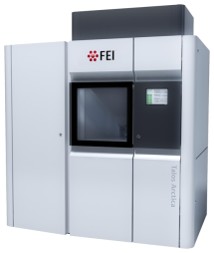 Model: Talos Arctica / Image courtesy: FEI Company |
|---|---|
| Microscopy | Model: FEI TALOS ARCTICA |
| Electron gun | Electron source:  FIELD EMISSION GUN / Accelerating voltage: 300 kV / Illumination mode: FLOOD BEAM FIELD EMISSION GUN / Accelerating voltage: 300 kV / Illumination mode: FLOOD BEAM |
| Electron lens | Mode: BRIGHT FIELD / Nominal defocus max: 2555 nm / Nominal defocus min: 647 nm |
| Image recording | Electron dose: 45.7 e/Å2 / Detector mode: COUNTING / Film or detector model: GATAN K2 QUANTUM (4k x 4k) |
- Processing
| CTF correction | Type: PHASE FLIPPING AND AMPLITUDE CORRECTION | ||||||||||||||||||||||||
|---|---|---|---|---|---|---|---|---|---|---|---|---|---|---|---|---|---|---|---|---|---|---|---|---|---|
| 3D reconstruction | Resolution: 3.28 Å / Resolution method: FSC 0.143 CUT-OFF / Num. of particles: 228227 / Symmetry type: POINT | ||||||||||||||||||||||||
| Refinement | Highest resolution: 3.28 Å Stereochemistry target values: REAL-SPACE (WEIGHTED MAP SUM AT ATOM CENTERS) | ||||||||||||||||||||||||
| Refine LS restraints |
|
