 Movie
Movie Controller


+ Open data

- Basic information
| Entry | Database: PDB / ID: 9qtu | ||||||||||||||||||
|---|---|---|---|---|---|---|---|---|---|---|---|---|---|---|---|---|---|---|---|
| Title | human PAN2-PAN3 deadenylase complex in the apo state | ||||||||||||||||||
 Components Components |
| ||||||||||||||||||
 Keywords Keywords | RNA BINDING PROTEIN / complex / mammalian / deadenylase / mRNA poly(A) tail / RNA processing / mRNA | ||||||||||||||||||
| Function / homology |  Function and homology information Function and homology informationPAN complex / positive regulation of cytoplasmic mRNA processing body assembly / poly(A)-specific ribonuclease / poly(A)-specific ribonuclease activity / nuclear-transcribed mRNA poly(A) tail shortening / Deadenylation of mRNA / poly(A) binding / P-body / mRNA processing / 3'-5'-RNA exonuclease activity ...PAN complex / positive regulation of cytoplasmic mRNA processing body assembly / poly(A)-specific ribonuclease / poly(A)-specific ribonuclease activity / nuclear-transcribed mRNA poly(A) tail shortening / Deadenylation of mRNA / poly(A) binding / P-body / mRNA processing / 3'-5'-RNA exonuclease activity / nucleic acid binding / protein kinase activity / zinc ion binding / ATP binding / metal ion binding / nucleus / cytosol Similarity search - Function | ||||||||||||||||||
| Biological species |  Homo sapiens (human) Homo sapiens (human) | ||||||||||||||||||
| Method | ELECTRON MICROSCOPY / single particle reconstruction / cryo EM / Resolution: 4.6 Å | ||||||||||||||||||
 Authors Authors | Albrecht, J.C. / Reitinger, T. / Basquin, J. / Schuessler, S. / Schaefer, I.B. / Conti, E. | ||||||||||||||||||
| Funding support | European Union,  Germany, Germany,  Denmark, 5items Denmark, 5items
| ||||||||||||||||||
 Citation Citation | Journal: Cell Rep / Year: 2025 Title: Mechanisms governing poly(A)-tail-length specificity of the human PAN2-PAN3 deadenylase complex. Authors: Jana C Albrecht / Timo Reitinger / Jérôme Basquin / Steffen Schüssler / Margot Riggi / Ingmar B Schäfer / Elena Conti / Abstract: The lifespan of most eukaryotic mRNAs is modulated by the gradual shortening of the poly(A) tail and removal of the associated poly(A)-binding protein. The human PAN2-PAN3 complex catalyzes initial ...The lifespan of most eukaryotic mRNAs is modulated by the gradual shortening of the poly(A) tail and removal of the associated poly(A)-binding protein. The human PAN2-PAN3 complex catalyzes initial deadenylation by shortening long poly(A) tails associated with PABPC1. Both PAN2-PAN3 and PABPC1 are evolutionarily conserved from fungi to humans. How the human complex has adapted to recognize and act on longer poly(A) tails characteristic of mammalian mRNAs remains unclear. Here, we report a method to obtain homo-polymeric poly(A) RNAs up to 240 nt, mimicking the synthesis length of poly(A) tails in mammals. We recapitulate human deadenylation properties in vitro, with PAN2-PAN3 showing greater activity on long poly(A)-PABPC1 ribonucleoprotein substrates. Single-particle cryo-electron microscopy (cryo-EM) analyses of PAN2-PAN3 bound to poly(A)-PABPC1 ribonucleoproteins uncover a longer substrate-binding path in the case of the human deadenylase compared to fungi. Altogether, these data provide a rationale for the co-evolution of deadenylase properties and poly(A) tail lengths. | ||||||||||||||||||
| History |
|
- Structure visualization
| Structure viewer | Molecule: MolmilJmol/JSmol |
|---|
- Downloads & links
-Download
| PDBx/mmCIF format | 9qtu.cif.gz | 279.9 KB | Display | PDBx/mmCIF format |
|---|---|---|---|---|
| PDB format | pdb9qtu.ent.gz | 204.7 KB | Display | PDB format |
| PDBx/mmJSON format | 9qtu.json.gz | Tree view | PDBx/mmJSON format | |
| Others |  Other downloads Other downloads |
-Validation report
| Arichive directory | https://data.pdbj.org/pub/pdb/validation_reports/qt/9qtuftp://data.pdbj.org/pub/pdb/validation_reports/qt/9qtu | HTTPS FTP |
|---|
-Related structure data
| Related structure data |  53362MC M: map data used to model this data C: citing same article ( |
|---|---|
| Similar structure data |


-Links
 PDBj
PDBj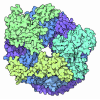
- Assembly
| Deposited unit | 
|
|---|---|
| 1 |
|
-Components
| #1: Protein | Mass: 92526.539 Da / Num. of mol.: 2 Source method: isolated from a genetically manipulated source Source: (gene. exp.) Homo sapiens (human) / Gene: PAN3 / Plasmid: PB-T / Cell line (production host): HEK293-T / Production host: Homo sapiens (human) / References: UniProt: Q58A45#2: Protein | | Mass: 135523.094 Da / Num. of mol.: 1 Source method: isolated from a genetically manipulated source Source: (gene. exp.) Homo sapiens (human) / Gene: PAN2, KIAA0710, USP52 / Plasmid: PB-T / Cell line (production host): HEK293-T / Production host: Homo sapiens (human) / References: UniProt: Q504Q3, poly(A)-specific ribonucleaseHas protein modification | N | |
|---|
-Experimental details
-Experiment
| Experiment | Method: ELECTRON MICROSCOPY |
|---|---|
| EM experiment | Aggregation state: PARTICLE / 3D reconstruction method: single particle reconstruction |
- Sample preparation
| Component | Name: heterotrimeric PAN2-PAN3 mRNA deadenylase complex composed of the regulatory PAN3 homodimer bound to the catalytic PAN2 Type: COMPLEX / Entity ID: all / Source: RECOMBINANT |
|---|---|
| Molecular weight | Experimental value: NO |
| Source (natural) | Organism: Homo sapiens (human) |
| Source (recombinant) | Organism: Homo sapiens (human) / Strain: HEK293-T |
| Buffer solution | pH: 7.5 |
| Specimen | Conc.: 0.12 mg/ml / Embedding applied: NO / Shadowing applied: NO / Staining applied: NO / Vitrification applied: YES |
| Specimen support | Grid material: COPPER / Grid mesh size: 200 divisions/in. / Grid type: Quantifoil R2/1 |
| Vitrification | Instrument: FEI VITROBOT MARK IV / Cryogen name: ETHANE-PROPANE / Humidity: 95 % / Chamber temperature: 277 K |
- Electron microscopy imaging
| Experimental equipment |  Model: Titan Krios / Image courtesy: FEI Company |
|---|---|
| Microscopy | Model: TFS KRIOS |
| Electron gun | Electron source:  FIELD EMISSION GUN / Accelerating voltage: 300 kV / Illumination mode: FLOOD BEAM FIELD EMISSION GUN / Accelerating voltage: 300 kV / Illumination mode: FLOOD BEAM |
| Electron lens | Mode: BRIGHT FIELD / Nominal defocus max: 2800 nm / Nominal defocus min: 500 nm / Cs: 2.62 mm / C2 aperture diameter: 100 µm / Alignment procedure: COMA FREE |
| Specimen holder | Cryogen: NITROGEN |
| Image recording | Average exposure time: 3.5 sec. / Electron dose: 70 e/Å2 / Film or detector model: GATAN K3 BIOQUANTUM (6k x 4k) / Num. of grids imaged: 1 |
- Processing
| EM software |
| ||||||||||||||||||||||||||||||||||||||||
|---|---|---|---|---|---|---|---|---|---|---|---|---|---|---|---|---|---|---|---|---|---|---|---|---|---|---|---|---|---|---|---|---|---|---|---|---|---|---|---|---|---|
| CTF correction | Type: PHASE FLIPPING AND AMPLITUDE CORRECTION | ||||||||||||||||||||||||||||||||||||||||
| 3D reconstruction | Resolution: 4.6 Å / Resolution method: FSC 0.143 CUT-OFF / Num. of particles: 34171 / Num. of class averages: 1 / Symmetry type: POINT | ||||||||||||||||||||||||||||||||||||||||
| Atomic model building | Protocol: RIGID BODY FIT | ||||||||||||||||||||||||||||||||||||||||
| Atomic model building | Source name: AlphaFold / Type: in silico model | ||||||||||||||||||||||||||||||||||||||||
| Refine LS restraints |
|
