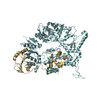
Movie
Movie Controller


+ Open data

- Basic information
| Entry | Database: PDB / ID: 9qec | ||||||||||||||||||||||||
|---|---|---|---|---|---|---|---|---|---|---|---|---|---|---|---|---|---|---|---|---|---|---|---|---|---|
| Title | Cryo-EM structure of the XPF-ERCC1-XPA complex | ||||||||||||||||||||||||
 Components Components |
| ||||||||||||||||||||||||
 Keywords Keywords | HYDROLASE / DNA repair / endonuclease / multiprotein complex | ||||||||||||||||||||||||
| Function / homology |  Function and homology information Function and homology informationpositive regulation of t-circle formation / telomeric DNA-containing double minutes formation / ERCC4-ERCC1 complex / negative regulation of protection from non-homologous end joining at telomere / nucleotide-excision repair factor 1 complex / nucleotide-excision repair involved in interstrand cross-link repair / nucleotide-excision repair, DNA damage recognition / nucleotide-excision repair complex / negative regulation of telomere maintenance / single-stranded DNA endonuclease activity ...positive regulation of t-circle formation / telomeric DNA-containing double minutes formation / ERCC4-ERCC1 complex / negative regulation of protection from non-homologous end joining at telomere / nucleotide-excision repair factor 1 complex / nucleotide-excision repair involved in interstrand cross-link repair / nucleotide-excision repair, DNA damage recognition / nucleotide-excision repair complex / negative regulation of telomere maintenance / single-stranded DNA endonuclease activity / resolution of meiotic recombination intermediates / UV protection / t-circle formation / mitotic recombination / negative regulation of telomere maintenance via telomere lengthening / UV-damage excision repair / HDR through Single Strand Annealing (SSA) / response to UV / TFIID-class transcription factor complex binding / protein localization to nucleus / telomere maintenance / DNA endonuclease activity / promoter-specific chromatin binding / Fanconi Anemia Pathway / nucleotide-excision repair / base-excision repair / double-strand break repair via homologous recombination / double-strand break repair via nonhomologous end joining / Dual Incision in GG-NER / Formation of TC-NER Pre-Incision Complex / Formation of Incision Complex in GG-NER / sequence-specific double-stranded DNA binding / cellular response to UV / Dual incision in TC-NER / single-stranded DNA binding / response to oxidative stress / damaged DNA binding / Hydrolases; Acting on ester bonds / nuclear body / protein-macromolecule adaptor activity / chromosome, telomeric region / protein domain specific binding / DNA repair / protein homodimerization activity / nucleoplasm / zinc ion binding / identical protein binding / nucleus / cytoplasm Similarity search - Function | ||||||||||||||||||||||||
| Biological species |  Homo sapiens (human) Homo sapiens (human) | ||||||||||||||||||||||||
| Method | ELECTRON MICROSCOPY / single particle reconstruction / cryo EM / Resolution: 2.9 Å | ||||||||||||||||||||||||
 Authors Authors | Feng, J. / Cronin, N.B. / Greber, B.J. | ||||||||||||||||||||||||
| Funding support |  United Kingdom, 1items United Kingdom, 1items
| ||||||||||||||||||||||||
 Citation Citation | Journal: Nat Commun / Year: 2025 Title: Molecular basis of XPF-ERCC1 targeting to SLX4-dependent DNA repair pathways. Authors: Junjie Feng / Peter R Martin / Szymon Kowalski / Maxime Lecot / Nora B Cronin / Teige Matthews-Palmer / Wojciech Niedzwiedz / Basil J Greber /   Abstract: The preservation and faithful propagation of genetic information is essential for all life forms and depends on cellular pathways that enable replication, recombination, and repair of DNA. The ...The preservation and faithful propagation of genetic information is essential for all life forms and depends on cellular pathways that enable replication, recombination, and repair of DNA. The multifunctional XPF-ERCC1 DNA endonuclease complex acts in several DNA repair pathways and interacts with numerous partner proteins and large DNA repair assemblies, including the nucleotide excision repair machinery and the SMX tri-endonuclease complex. Here, we report structures of XPF-ERCC1 in complex with the DNA repair factors SLX4 and SLX4IP, thereby identifying key residues responsible for direct interactions with XPF-ERCC1. When introduced into human cells, point mutations in these interfaces impair the interactions between XPF-ERCC1 and SLX4 or SLX4IP, and disruption of the XPF-SLX4IP interface leads to cis-platin sensitivity. Furthermore, our data reveal the structure of the human XPF-ERCC1-SLX4IP-SLX4 complex with DNA bound at its active site, and they complete the structural characterisation of molecular interactions required to assemble the SMX complex. | ||||||||||||||||||||||||
| History |
|
- Structure visualization
| Structure viewer | Molecule: MolmilJmol/JSmol |
|---|
- Downloads & links
-Download
| PDBx/mmCIF format | 9qec.cif.gz | 214.6 KB | Display | PDBx/mmCIF format |
|---|---|---|---|---|
| PDB format | pdb9qec.ent.gz | 160.3 KB | Display | PDB format |
| PDBx/mmJSON format | 9qec.json.gz | Tree view | PDBx/mmJSON format | |
| Others |  Other downloads Other downloads |
-Validation report
| Arichive directory | https://data.pdbj.org/pub/pdb/validation_reports/qe/9qecftp://data.pdbj.org/pub/pdb/validation_reports/qe/9qec | HTTPS FTP |
|---|
-Related structure data
| Related structure data |  53054MC  9qedC  9qeeC M: map data used to model this data C: citing same article ( |
|---|---|
| Similar structure data |


-Links
 PDBj
PDBj
- Assembly
| Deposited unit | 
|
|---|---|
| 1 |
|
-Components
| #1: Protein | Mass: 106894.539 Da / Num. of mol.: 1 Source method: isolated from a genetically manipulated source Source: (gene. exp.) Homo sapiens (human) / Gene: ERCC4, ERCC11, XPF / Cell line (production host): Sf9 / Production host:   Spodoptera frugiperda (fall armyworm) Spodoptera frugiperda (fall armyworm)References: UniProt: Q92889, Hydrolases; Acting on ester bonds |
|---|---|
| #2: Protein | Mass: 32598.301 Da / Num. of mol.: 1 Source method: isolated from a genetically manipulated source Source: (gene. exp.) Homo sapiens (human) / Gene: ERCC1 / Cell line (production host): Sf9 / Production host: Spodoptera frugiperda (fall armyworm) / References: UniProt: P07992 |
| #3: Protein | Mass: 31422.053 Da / Num. of mol.: 1 Source method: isolated from a genetically manipulated source Source: (gene. exp.) Homo sapiens (human) / Gene: XPA, XPAC / Cell line (production host): Sf9 / Production host: Spodoptera frugiperda (fall armyworm) / References: UniProt: P23025 |
| Has protein modification | N |
-Experimental details
-Experiment
| Experiment | Method: ELECTRON MICROSCOPY |
|---|---|
| EM experiment | Aggregation state: PARTICLE / 3D reconstruction method: single particle reconstruction |
- Sample preparation
| Component | Name: XPF-ERCC1-XPA complex / Type: COMPLEX / Entity ID: all / Source: RECOMBINANT | |||||||||||||||||||||||||
|---|---|---|---|---|---|---|---|---|---|---|---|---|---|---|---|---|---|---|---|---|---|---|---|---|---|---|
| Molecular weight | Value: 0.17 MDa / Experimental value: NO | |||||||||||||||||||||||||
| Source (natural) | Organism: Homo sapiens (human) | |||||||||||||||||||||||||
| Source (recombinant) | Organism: Spodoptera frugiperda (fall armyworm) | |||||||||||||||||||||||||
| Buffer solution | pH: 7.9 | |||||||||||||||||||||||||
| Buffer component |
| |||||||||||||||||||||||||
| Specimen | Conc.: 0.2 mg/ml / Embedding applied: NO / Shadowing applied: NO / Staining applied: NO / Vitrification applied: YES | |||||||||||||||||||||||||
| Specimen support | Grid material: GOLD / Grid mesh size: 300 divisions/in. / Grid type: UltrAuFoil R1.2/1.3 | |||||||||||||||||||||||||
| Vitrification | Instrument: FEI VITROBOT MARK IV / Cryogen name: ETHANE / Humidity: 100 % / Chamber temperature: 4 K |
- Electron microscopy imaging
| Experimental equipment |  Model: Titan Krios / Image courtesy: FEI Company |
|---|---|
| Microscopy | Model: TFS KRIOS |
| Electron gun | Electron source:  FIELD EMISSION GUN / Accelerating voltage: 300 kV / Illumination mode: FLOOD BEAM FIELD EMISSION GUN / Accelerating voltage: 300 kV / Illumination mode: FLOOD BEAM |
| Electron lens | Mode: BRIGHT FIELD / Nominal magnification: 165000 X / Nominal defocus max: 2500 nm / Nominal defocus min: 400 nm / Cs: 2.7 mm / C2 aperture diameter: 50 µm / Alignment procedure: COMA FREE |
| Specimen holder | Cryogen: NITROGEN / Specimen holder model: FEI TITAN KRIOS AUTOGRID HOLDER |
| Image recording | Electron dose: 60 e/Å2 / Film or detector model: GATAN K3 BIOQUANTUM (6k x 4k) / Num. of real images: 12629 |
| EM imaging optics | Energyfilter name: GIF Bioquantum / Energyfilter slit width: 20 eV |
- Processing
| EM software |
| ||||||||||||||||||||||||||||||||||||||||||||||||
|---|---|---|---|---|---|---|---|---|---|---|---|---|---|---|---|---|---|---|---|---|---|---|---|---|---|---|---|---|---|---|---|---|---|---|---|---|---|---|---|---|---|---|---|---|---|---|---|---|---|
| CTF correction | Type: PHASE FLIPPING AND AMPLITUDE CORRECTION | ||||||||||||||||||||||||||||||||||||||||||||||||
| Symmetry | Point symmetry: C1 (asymmetric) | ||||||||||||||||||||||||||||||||||||||||||||||||
| 3D reconstruction | Resolution: 2.9 Å / Resolution method: FSC 0.143 CUT-OFF / Num. of particles: 73737 / Algorithm: FOURIER SPACE / Symmetry type: POINT | ||||||||||||||||||||||||||||||||||||||||||||||||
| Atomic model building | Protocol: RIGID BODY FIT / Space: REAL | ||||||||||||||||||||||||||||||||||||||||||||||||
| Atomic model building | PDB-ID: 6SXA Accession code: 6SXA / Source name: PDB / Type: experimental model | ||||||||||||||||||||||||||||||||||||||||||||||||
| Refinement | Highest resolution: 2.9 Å Stereochemistry target values: REAL-SPACE (WEIGHTED MAP SUM AT ATOM CENTERS) | ||||||||||||||||||||||||||||||||||||||||||||||||
| Refine LS restraints |
|