Journal: Nat Commun / Year: 2026 Title: L-type pyocins inhibit the BAM complex to kill without cell entry. Authors: Fabian Munder / Matthew D Johnson / Imogen Samuels / Laura McCaughey / Oleksii Zdorevskyi / Chunxiao Wang / Ashleigh Kropp / Lauren Zavan / Erin P Price / Derek S Sarovich / Swati Varshney / ...Authors: Fabian Munder / Matthew D Johnson / Imogen Samuels / Laura McCaughey / Oleksii Zdorevskyi / Chunxiao Wang / Ashleigh Kropp / Lauren Zavan / Erin P Price / Derek S Sarovich / Swati Varshney / Christopher A McDevitt / Hari Venugopal / Vivek Sharma / Matthew T Doyle / Francesca Short / Debnath Ghosal / James P R Connolly / Gavin J Knott / Rhys Grinter / Abstract: Many antibiotics are ineffective against the Gram-negative pathogen Pseudomonas aeruginosa because of intrinsic defence mechanisms, such as the impermeable bacterial outer membrane. Here, we show ...Many antibiotics are ineffective against the Gram-negative pathogen Pseudomonas aeruginosa because of intrinsic defence mechanisms, such as the impermeable bacterial outer membrane. Here, we show that protein antibiotics called L-type pyocins kill P. aeruginosa by inhibiting the β-barrel assembly machinery (BAM) complex at the cell surface, halting outer-membrane protein assembly. Using single-particle cryo-electron microscopy, we show that L-type pyocins bind a surface-exposed region of BamA and deploy a C-terminal peptide that competitively inhibits the BAM complex, demonstrating that cell entry is not required for antibiotic activity. We combine genetics, multi-omics and cryo-electron tomography to show that BAM complex inhibition by L-type pyocins or the cyclic-peptide antibiotic, darobactin, triggers a multifaceted transcriptomic, proteomic, and morphological response. BAM inhibition ultimately leads to a catastrophic loss of membrane integrity and cell death. These results validate BAM as a target for antibiotics that do not enter the cell and define an engineerable system for their development.
History
Deposition
Aug 5, 2025
Deposition site: RCSB / Processing site: RCSB
Revision 1.0
Jun 10, 2026
Provider: repository / Type: Initial release
Revision 1.0
Jun 10, 2026
Data content type: EM metadata / Data content type: EM metadata / Provider: repository / Type: Initial release
Revision 1.0
Jun 10, 2026
Data content type: Additional map / Part number: 1 / Data content type: Additional map / Provider: repository / Type: Initial release
Revision 1.0
Jun 10, 2026
Data content type: Additional map / Part number: 2 / Data content type: Additional map / Provider: repository / Type: Initial release
Revision 1.0
Jun 10, 2026
Data content type: Additional map / Part number: 3 / Data content type: Additional map / Provider: repository / Type: Initial release
Revision 1.0
Jun 10, 2026
Data content type: FSC / Data content type: FSC / Provider: repository / Type: Initial release
Revision 1.0
Jun 10, 2026
Data content type: Half map / Part number: 1 / Data content type: Half map / Provider: repository / Type: Initial release
Revision 1.0
Jun 10, 2026
Data content type: Half map / Part number: 2 / Data content type: Half map / Provider: repository / Type: Initial release
Revision 1.0
Jun 10, 2026
Data content type: Image / Data content type: Image / Provider: repository / Type: Initial release
Revision 1.0
Jun 10, 2026
Data content type: Mask / Part number: 1 / Data content type: Mask / Provider: repository / Type: Initial release
Revision 1.0
Jun 10, 2026
Data content type: Primary map / Data content type: Primary map / Provider: repository / Type: Initial release
Data content type: EM metadata / Data content type: EM metadata / EM metadata / Group: Database references / Experimental summary / Data content type: EM metadata / EM metadata / EM metadata / Category: citation / citation_author / em_admin Data content type: EM metadata / EM metadata ...EM metadata / EM metadata / EM metadata / EM metadata / EM metadata / EM metadata / EM metadata / EM metadata / EM metadata Item: _citation.country / _citation.journal_abbrev ..._citation.country / _citation.journal_abbrev / _citation.journal_id_CSD / _citation.journal_id_ISSN / _citation.pdbx_database_id_DOI / _citation.pdbx_database_id_PubMed / _citation.title / _citation.year / _em_admin.last_update
Data content type: EM metadata / Data content type: EM metadata / EM metadata / Group: Database references / Experimental summary / Data content type: EM metadata / EM metadata / EM metadata / Category: citation / citation_author / em_admin / Data content type: EM metadata / EM metadata / EM metadata Item: _citation.journal_volume / _citation_author.identifier_ORCID / _em_admin.last_update
Average exposure time: 7.6 sec. / Electron dose: 53 e/Å2 / Film or detector model: FEI FALCON IV (4k x 4k) / Num. of grids imaged: 1 / Num. of real images: 11319
-
Processing
EM software
ID
Name
Version
Category
1
Topaz
particleselection
2
EPU
imageacquisition
4
RELION
5
CTFcorrection
7
UCSF ChimeraX
1.8
modelfitting
9
cryoSPARC
4.6
initialEulerassignment
10
cryoSPARC
4.6
finalEulerassignment
12
cryoSPARC
4.6
3Dreconstruction
13
PHENIX
1.2
modelrefinement
CTF correction
Type: PHASE FLIPPING AND AMPLITUDE CORRECTION
Particle selection
Num. of particles selected: 5533458 / Details: particles picked with TOPAZ trained model
Symmetry
Point symmetry: C1 (asymmetric)
3D reconstruction
Resolution: 3.18 Å / Resolution method: FSC 0.143 CUT-OFF / Num. of particles: 126889 / Num. of class averages: 1 / Symmetry type: POINT
Atomic model building
ID
3D fitting-ID
Chain-ID
Source name
Type
1
1
A
AlphaFold
insilicomodel
2
1
F
AlphaFold
insilicomodel
+
About Yorodumi
-
News
-
Feb 9, 2022. New format data for meta-information of EMDB entries
New format data for meta-information of EMDB entries
Version 3 of the EMDB header file is now the official format.
The previous official version 1.9 will be removed from the archive.
In the structure databanks used in Yorodumi, some data are registered as the other names, "COVID-19 virus" and "2019-nCoV". Here are the details of the virus and the list of structure data.
Jan 31, 2019. EMDB accession codes are about to change! (news from PDBe EMDB page)
EMDB accession codes are about to change! (news from PDBe EMDB page)
The allocation of 4 digits for EMDB accession codes will soon come to an end. Whilst these codes will remain in use, new EMDB accession codes will include an additional digit and will expand incrementally as the available range of codes is exhausted. The current 4-digit format prefixed with “EMD-” (i.e. EMD-XXXX) will advance to a 5-digit format (i.e. EMD-XXXXX), and so on. It is currently estimated that the 4-digit codes will be depleted around Spring 2019, at which point the 5-digit format will come into force.
The EM Navigator/Yorodumi systems omit the EMD- prefix.
Related info.:Q: What is EMD? / ID/Accession-code notation in Yorodumi/EM Navigator
Yorodumi is a browser for structure data from EMDB, PDB, SASBDB, etc.
This page is also the successor to EM Navigator detail page, and also detail information page/front-end page for Omokage search.
The word "yorodu" (or yorozu) is an old Japanese word meaning "ten thousand". "mi" (miru) is to see.
Related info.:EMDB / PDB / SASBDB / Comparison of 3 databanks / Yorodumi Search / Aug 31, 2016. New EM Navigator & Yorodumi / Yorodumi Papers / Jmol/JSmol / Function and homology information / Changes in new EM Navigator and Yorodumi
 Movie
Movie Controller

 Yorodumi
 Open data
 Basic information
 Components
 Keywords
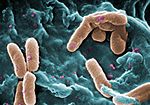 Pseudomonas aeruginosa (bacteria)
 Authors
 Australia, 1items
  Citation

 Structure visualization
 Molmil
 Downloads & links
 Other downloads


 PDBj
PDBj Assembly
 Escherichia coli BL21(DE3) (bacteria) / Variant (production host): C41
 Sample preparation
 Electron microscopy imaging
 FIELD EMISSION GUN / Accelerating voltage: 300 kV / Illumination mode: FLOOD BEAM
 Processing