 Movie
Movie Controller


+ Open data

- Basic information
| Entry | Database: PDB / ID: 9pi8 | ||||||||||||||||||||||||
|---|---|---|---|---|---|---|---|---|---|---|---|---|---|---|---|---|---|---|---|---|---|---|---|---|---|
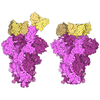
| Title | EV-D68 in complex with G12 Fc | ||||||||||||||||||||||||
 Components Components |
| ||||||||||||||||||||||||
 Keywords Keywords | VIRUS/IMMUNE SYSTEM / EV-D68 / G12 / antibody / Structural Genomics / Center for Structural Biology of Infectious Diseases / CSBID / VIRUS / VIRUS-IMMUNE SYSTEM complex | ||||||||||||||||||||||||
| Function / homology |  Function and homology information Function and homology informationcysteine-type peptidase activity / picornain 2A / symbiont-mediated suppression of host mRNA export from nucleus / symbiont genome entry into host cell via pore formation in plasma membrane / picornain 3C / T=pseudo3 icosahedral viral capsid / host cell cytoplasmic vesicle membrane / nucleoside-triphosphate phosphatase / ribonucleoside triphosphate phosphatase activity / channel activity ...cysteine-type peptidase activity / picornain 2A / symbiont-mediated suppression of host mRNA export from nucleus / symbiont genome entry into host cell via pore formation in plasma membrane / picornain 3C / T=pseudo3 icosahedral viral capsid / host cell cytoplasmic vesicle membrane / nucleoside-triphosphate phosphatase / ribonucleoside triphosphate phosphatase activity / channel activity / monoatomic ion transmembrane transport / RNA helicase activity / symbiont-mediated suppression of host innate immune response / endocytosis involved in viral entry into host cell / symbiont-mediated suppression of host gene expression / symbiont-mediated activation of host autophagy / cysteine-type endopeptidase activity / RNA-directed RNA polymerase / viral RNA genome replication / RNA-directed RNA polymerase activity / host cell cytoplasm / virion attachment to host cell / host cell nucleus / structural molecule activity / DNA-templated transcription / proteolysis / RNA binding / zinc ion binding / ATP binding Similarity search - Function | ||||||||||||||||||||||||
| Biological species |   Vicugna pacos (alpaca) Vicugna pacos (alpaca) enterovirus D68 enterovirus D68 | ||||||||||||||||||||||||
| Method | ELECTRON MICROSCOPY / single particle reconstruction / cryo EM / Resolution: 2.11 Å | ||||||||||||||||||||||||
 Authors Authors | Klose, T. / Kuhn, R.J. / Center for Structural Biology of Infectious Diseases (CSBID) | ||||||||||||||||||||||||
| Funding support |  United States, 1items United States, 1items
| ||||||||||||||||||||||||
 Citation Citation | Journal: Mol Ther / Year: 2026 Title: An RNA-to-RNA pipeline for rapid antiviral antibody development. Authors: Edgar A Hodge / Jacob Archer / Jacqueline S Anderson / Nikole L Warner / Jacque Tremblay / Thomas Klose / Stephanie Park / Troy Hinkley / Amit P Khandhar / Richard Kuhn / Charles B Shoemaker / Jesse H Erasmus / Abstract: Rapid development of antibody therapeutics is often hindered by dependencies on recombinant protein production, both for antigen generation and for antibody manufacturing. To overcome these ...Rapid development of antibody therapeutics is often hindered by dependencies on recombinant protein production, both for antigen generation and for antibody manufacturing. To overcome these bottlenecks, we established a self-amplifying replicon RNA (repRNA) immunization and therapeutic delivery platform that enables an end-to-end RNA-to-antibody-to-RNA workflow. In this approach, alpacas are immunized with repRNA encoding virus-like particles to elicit antibody responses, peripheral blood mononuclear cells are harvested to construct phage display libraries, and broadly neutralizing heavy-chain-only antibodies (VHHs [variable heavy domain of the heavy chain]) are identified through high-throughput screening. Lead VHHs are then re-encoded into repRNA for in vivo delivery as therapeutic constructs, with engineering options for valency, potency, and serum half-life. As proof of concept, we applied this platform against enterovirus D68 (EV-D68), an emerging pathogen associated with severe respiratory disease and acute flaccid myelitis in children for which no vaccines or treatments exist. repRNA-encoded VHHs protected mice from EV-D68 challenge in both lungs and nasal cavities, and cryoelectron microscopy revealed the capsid-binding footprint and mechanism of neutralization. Together, these findings demonstrate a modular platform for rapid discovery and delivery of antiviral biologics, with EV-D68 serving as a prototype application. | ||||||||||||||||||||||||
| History |
|
- Structure visualization
| Structure viewer | Molecule: MolmilJmol/JSmol |
|---|
- Downloads & links
-Download
| PDBx/mmCIF format | 9pi8.cif.gz | 239.1 KB | Display | PDBx/mmCIF format |
|---|---|---|---|---|
| PDB format | pdb9pi8.ent.gz | 149.8 KB | Display | PDB format |
| PDBx/mmJSON format | 9pi8.json.gz | Tree view | PDBx/mmJSON format | |
| Others |  Other downloads Other downloads |
-Validation report
| Arichive directory | https://data.pdbj.org/pub/pdb/validation_reports/pi/9pi8ftp://data.pdbj.org/pub/pdb/validation_reports/pi/9pi8 | HTTPS FTP |
|---|
-Related structure data
| Related structure data |  71655MC  9pi7C M: map data used to model this data C: citing same article ( |
|---|---|
| Similar structure data |

-Links
 PDBj
PDBj

- Assembly
| Deposited unit | 
|
|---|---|
| 1 | x 60
|
| 2 |
|
| 3 | x 5
|
| 4 | x 6
|
| 5 | 
|
| Symmetry | Point symmetry: (Schoenflies symbol: I (icosahedral)) |
-Components
| #1: Protein | Mass: 34242.734 Da / Num. of mol.: 1 / Source method: isolated from a natural source / Source: (natural) enterovirus D68References: UniProt: A0A097BW12, picornain 2A, nucleoside-triphosphate phosphatase, picornain 3C, RNA-directed RNA polymerase |
|---|---|
| #2: Protein | Mass: 27567.135 Da / Num. of mol.: 1 / Fragment: UNP residues 70-317 / Source method: isolated from a natural source / Source: (natural) enterovirus D68 / References: UniProt: A0A0A7X639 |
| #3: Protein | Mass: 27112.814 Da / Num. of mol.: 1 / Fragment: UNP residues 318-564 / Source method: isolated from a natural source / Source: (natural) enterovirus D68 / References: UniProt: A0A097BW12 |
| #4: Protein | Mass: 7336.960 Da / Num. of mol.: 1 / Fragment: UNP residues 2-69 / Source method: isolated from a natural source / Source: (natural) enterovirus D68 / References: UniProt: A0A097BW12 |
| #5: Antibody | Mass: 40503.598 Da / Num. of mol.: 1 Source method: isolated from a genetically manipulated source Source: (gene. exp.) Vicugna pacos (alpaca) / Production host:  Homo sapiens (human) Homo sapiens (human) |
| Has protein modification | N |
-Experimental details
-Experiment
| Experiment | Method: ELECTRON MICROSCOPY |
|---|---|
| EM experiment | Aggregation state: PARTICLE / 3D reconstruction method: single particle reconstruction |
- Sample preparation
| Component | Name: EV-D68 in complex with G12 Fc / Type: COMPLEX / Entity ID: all / Source: NATURAL |
|---|---|
| Source (natural) | Organism: enterovirus D68 / Strain: US/MO/14-18949 |
| Details of virus | Empty: NO / Enveloped: NO / Isolate: STRAIN / Type: VIRION |
| Natural host | Organism: Homo sapiens |
| Buffer solution | pH: 7 |
| Specimen | Embedding applied: NO / Shadowing applied: NO / Staining applied: NO / Vitrification applied: YES |
| Vitrification | Instrument: LEICA EM GP / Cryogen name: ETHANE / Humidity: 95 % / Chamber temperature: 295 K |
- Electron microscopy imaging
| Experimental equipment |  Model: Titan Krios / Image courtesy: FEI Company |
|---|---|
| Microscopy | Model: TFS KRIOS |
| Electron gun | Electron source:  FIELD EMISSION GUN / Accelerating voltage: 300 kV / Illumination mode: FLOOD BEAM FIELD EMISSION GUN / Accelerating voltage: 300 kV / Illumination mode: FLOOD BEAM |
| Electron lens | Mode: BRIGHT FIELD / Nominal magnification: 64000 X / Nominal defocus max: 1800 nm / Nominal defocus min: 600 nm / Cs: 2.7 mm / Alignment procedure: COMA FREE |
| Specimen holder | Cryogen: NITROGEN / Specimen holder model: FEI TITAN KRIOS AUTOGRID HOLDER |
| Image recording | Electron dose: 36.2 e/Å2 / Film or detector model: GATAN K3 BIOQUANTUM (6k x 4k) / Num. of grids imaged: 1 / Num. of real images: 6000 |
- Processing
| EM software |
| ||||||||||||||||||||||||||||||||||||||||||||
|---|---|---|---|---|---|---|---|---|---|---|---|---|---|---|---|---|---|---|---|---|---|---|---|---|---|---|---|---|---|---|---|---|---|---|---|---|---|---|---|---|---|---|---|---|---|
| CTF correction | Type: PHASE FLIPPING AND AMPLITUDE CORRECTION | ||||||||||||||||||||||||||||||||||||||||||||
| Particle selection | Num. of particles selected: 140113 | ||||||||||||||||||||||||||||||||||||||||||||
| 3D reconstruction | Resolution: 2.11 Å / Resolution method: FSC 0.143 CUT-OFF / Num. of particles: 103582 / Symmetry type: POINT | ||||||||||||||||||||||||||||||||||||||||||||
| Atomic model building | Protocol: AB INITIO MODEL / Space: REAL | ||||||||||||||||||||||||||||||||||||||||||||
| Refinement | Cross valid method: NONE Stereochemistry target values: GeoStd + Monomer Library + CDL v1.2 | ||||||||||||||||||||||||||||||||||||||||||||
| Displacement parameters | Biso mean: 31.59 Å2 | ||||||||||||||||||||||||||||||||||||||||||||
| Refine LS restraints |
|
