 Movie
Movie Controller

[English] 日本語
 Yorodumi
- PDB-9p6u: Cryo-EM structure of chimeric immunoglobulin M comprising bony fi... -
+ Open data

- Basic information
| Entry | Database: PDB / ID: 9p6u | ||||||||||||||||||||||||
|---|---|---|---|---|---|---|---|---|---|---|---|---|---|---|---|---|---|---|---|---|---|---|---|---|---|
| Title | Cryo-EM structure of chimeric immunoglobulin M comprising bony fish and human sequences, hFcm-tFcm-chi3 | ||||||||||||||||||||||||
 Components Components | Chimeric Immunoglobulin heavy constant mu | ||||||||||||||||||||||||
 Keywords Keywords | IMMUNE SYSTEM / immunoglobulin M / fragment crystallization | ||||||||||||||||||||||||
| Function / homology |  Function and homology information Function and homology informationhexameric IgM immunoglobulin complex / IgM B cell receptor complex / pentameric IgM immunoglobulin complex / pre-B cell allelic exclusion / CD22 mediated BCR regulation / antigen binding / B cell receptor signaling pathway / Antigen activates B Cell Receptor (BCR) leading to generation of second messengers / Cell surface interactions at the vascular wall / blood microparticle ...hexameric IgM immunoglobulin complex / IgM B cell receptor complex / pentameric IgM immunoglobulin complex / pre-B cell allelic exclusion / CD22 mediated BCR regulation / antigen binding / B cell receptor signaling pathway / Antigen activates B Cell Receptor (BCR) leading to generation of second messengers / Cell surface interactions at the vascular wall / blood microparticle / antibacterial humoral response / defense response to Gram-negative bacterium / Potential therapeutics for SARS / adaptive immune response / innate immune response / cell surface / : / extracellular exosome / plasma membrane Similarity search - Function | ||||||||||||||||||||||||
| Biological species |  Homo sapiens (human) Homo sapiens (human)  Oncorhynchus mykiss (rainbow trout) Oncorhynchus mykiss (rainbow trout) | ||||||||||||||||||||||||
| Method | ELECTRON MICROSCOPY / single particle reconstruction / cryo EM / Resolution: 3.9 Å | ||||||||||||||||||||||||
 Authors Authors | Lyu, M. / Stadtmueller, B.M. | ||||||||||||||||||||||||
| Funding support |  United States, 1items United States, 1items
| ||||||||||||||||||||||||
 Citation Citation | Journal: bioRxiv / Year: 2025 Title: Chimeric Immunoglobulin and human Immunoglobulin M structures provide insights on joining-chain independent assembly and function. Authors: Mengfan Lyu / Beth M Stadtmueller / Abstract: Polymeric (p) immunoglobulins (Igs) play critical roles in vertebrate immunity. IgM is the evolutionarily oldest pIg and functions both in circulation and in the mucosa. pIgM typically comprises ...Polymeric (p) immunoglobulins (Igs) play critical roles in vertebrate immunity. IgM is the evolutionarily oldest pIg and functions both in circulation and in the mucosa. pIgM typically comprises between four and six IgM monomers and up to one joining chain (JC), which in mammals facilitates pIg assembly and promotes delivery to mucosal secretions. Bony fish (teleosts) lack JC and assemble tetrameric IgM whereas humans can express JC-containing pentamers and JC-free hexamers. Here we report cryo-electron microscopy structures of two JC-free chimeric IgM, comprising bony fish and human sequences, and the structure of human hexameric IgM. Chimeric IgM structures adopted unique pentameric geometry distinct from both human and fish pIgM whereas the human hexameric IgM structure adopted hexagonal geometry similar to JC-containing pentameric IgM, albeit with structural differences in center of the molecule. Together results provide new insights on how IgM heavy chain motifs contribute to JC-free pIgM assembly and reveal plasticity of this process, which can be manipulated to create pIg structures not observed in nature. Moreover, we found that antigen-targeting chimeric IgM could neutralize toxin cytotoxicity, indicating potential to engineer uniquely structured pIgs to prevent or treat disease. | ||||||||||||||||||||||||
| History |
|
- Structure visualization
| Structure viewer | Molecule: MolmilJmol/JSmol |
|---|
- Downloads & links
-Download
| PDBx/mmCIF format | 9p6u.cif.gz | 765.3 KB | Display | PDBx/mmCIF format |
|---|---|---|---|---|
| PDB format | pdb9p6u.ent.gz | 575.5 KB | Display | PDB format |
| PDBx/mmJSON format | 9p6u.json.gz | Tree view | PDBx/mmJSON format | |
| Others |  Other downloads Other downloads |
-Validation report
| Arichive directory | https://data.pdbj.org/pub/pdb/validation_reports/p6/9p6uftp://data.pdbj.org/pub/pdb/validation_reports/p6/9p6u | HTTPS FTP |
|---|
-Related structure data
| Related structure data |  71326MC  9p6vC M: map data used to model this data C: citing same article ( |
|---|---|
| Similar structure data | |
| Other databases |
|


-Links
 PDBj
PDBj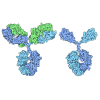




- Assembly
| Deposited unit | 
|
|---|---|
| 1 |
|
-Components
| #1: Protein | Mass: 26804.037 Da / Num. of mol.: 10 Source method: isolated from a genetically manipulated source Details: His-tagged chimeric IgM comprising Oncorhynchus mykiss and human sequences, hFcm-tFcm-chi3 Source: (gene. exp.) Homo sapiens (human), (gene. exp.) Oncorhynchus mykiss (rainbow trout)Gene: IGHM / Plasmid: pD2610-v1 / Cell (production host): embryo / Cell line (production host): HEK293 / Production host: Homo sapiens (human) / Tissue (production host): Kidney / References: UniProt: P01871Has protein modification | Y | Sequence details | Residues 343-552 are from human (Homo Sapiens) and residues 553-575 are from rainbow trout ...Residues 343-552 are from human (Homo Sapiens) and residues 553-575 are from rainbow trout (Oncorhynchus mykiss). | |
|---|
-Experimental details
-Experiment
| Experiment | Method: ELECTRON MICROSCOPY |
|---|---|
| EM experiment | Aggregation state: PARTICLE / 3D reconstruction method: single particle reconstruction |
- Sample preparation
| Component | Name: pentameric chimeric immunoglobulin M-Fc comprising Oncorhynchus mykiss and human sequences Type: COMPLEX / Entity ID: all / Source: RECOMBINANT | |||||||||||||||
|---|---|---|---|---|---|---|---|---|---|---|---|---|---|---|---|---|
| Molecular weight | Value: 0.27 MDa / Experimental value: YES | |||||||||||||||
| Source (natural) |
| |||||||||||||||
| Source (recombinant) | Organism: Homo sapiens (human) / Cell: HEK-293 / Plasmid: pD2610-v1 | |||||||||||||||
| Buffer solution | pH: 7.8 Details: 1x tris buffered saline (20mM Tris-HCl and 150mL NaCl, pH 7.8) | |||||||||||||||
| Buffer component |
| |||||||||||||||
| Specimen | Conc.: 0.2 mg/ml / Embedding applied: NO / Shadowing applied: NO / Staining applied: NO / Vitrification applied: YES | |||||||||||||||
| Specimen support | Grid material: COPPER / Grid mesh size: 400 divisions/in. / Grid type: Quantifoil R2/2 | |||||||||||||||
| Vitrification | Instrument: FEI VITROBOT MARK IV / Cryogen name: ETHANE / Humidity: 100 % / Chamber temperature: 277 K Details: Cryo-EM grids were prepared at 4 degree celsius, 100% humidity, with blot force of 3, wait time of 2 seconds, and blotting time of 2 seconds in a Vitrobot Mark IV (Thermo Fisher). |
- Electron microscopy imaging
| Experimental equipment |  Model: Titan Krios / Image courtesy: FEI Company |
|---|---|
| Microscopy | Model: TFS KRIOS |
| Electron gun | Electron source:  FIELD EMISSION GUN / Accelerating voltage: 300 kV / Illumination mode: FLOOD BEAM FIELD EMISSION GUN / Accelerating voltage: 300 kV / Illumination mode: FLOOD BEAM |
| Electron lens | Mode: BRIGHT FIELD / Nominal defocus max: 3800 nm / Nominal defocus min: 500 nm / Cs: 2.7 mm |
| Specimen holder | Cryogen: NITROGEN |
| Image recording | Electron dose: 57.35 e/Å2 / Film or detector model: GATAN K3 (6k x 4k) / Num. of real images: 4012 Details: Movies were collected on Titan Krios G4 Cryo-TEM (Thermo Fisher) operating at 300kV. 1986 movies were recorded on untilted stage whereas 2026 movies were recored on 30 degree tilted stage. ...Details: Movies were collected on Titan Krios G4 Cryo-TEM (Thermo Fisher) operating at 300kV. 1986 movies were recorded on untilted stage whereas 2026 movies were recored on 30 degree tilted stage. All movies were recorded using SerialEM on a post-GIF K3 Direct Electron Detector (Gatan) with 57.35 e/A2 total dose. |
- Processing
| EM software |
| ||||||||||||||||||||||||
|---|---|---|---|---|---|---|---|---|---|---|---|---|---|---|---|---|---|---|---|---|---|---|---|---|---|
| CTF correction | Type: PHASE FLIPPING AND AMPLITUDE CORRECTION | ||||||||||||||||||||||||
| Particle selection | Num. of particles selected: 821548 | ||||||||||||||||||||||||
| 3D reconstruction | Resolution: 3.9 Å / Resolution method: FSC 0.143 CUT-OFF / Num. of particles: 244125 / Symmetry type: POINT | ||||||||||||||||||||||||
| Atomic model building | Protocol: AB INITIO MODEL | ||||||||||||||||||||||||
| Refinement | Cross valid method: NONE Stereochemistry target values: GeoStd + Monomer Library + CDL v1.2 | ||||||||||||||||||||||||
| Displacement parameters | Biso mean: 123.08 Å2 | ||||||||||||||||||||||||
| Refine LS restraints |
|
