 Movie
Movie Controller

[English] 日本語
 Yorodumi
- PDB-9p6g: eN49P7-FRv1-23 Fab in complex with BG505 MD39 SOSIP and RM20A3 Fab -
+ Open data

- Basic information
| Entry | Database: PDB / ID: 9p6g | |||||||||||||||||||||||||||
|---|---|---|---|---|---|---|---|---|---|---|---|---|---|---|---|---|---|---|---|---|---|---|---|---|---|---|---|---|
| Title | eN49P7-FRv1-23 Fab in complex with BG505 MD39 SOSIP and RM20A3 Fab | |||||||||||||||||||||||||||
 Components Components |
| |||||||||||||||||||||||||||
 Keywords Keywords | VIRAL PROTEIN / antibody engineering / HIV-1 / bnAb / broadly neutralizing antibody / CD4 binding site / Env | |||||||||||||||||||||||||||
| Function / homology |  Function and homology information Function and homology informationpositive regulation of plasma membrane raft polarization / positive regulation of receptor clustering / symbiont-mediated perturbation of host defense response / host cell endosome membrane / clathrin-dependent endocytosis of virus by host cell / viral protein processing / fusion of virus membrane with host plasma membrane / fusion of virus membrane with host endosome membrane / viral envelope / virion attachment to host cell ...positive regulation of plasma membrane raft polarization / positive regulation of receptor clustering / symbiont-mediated perturbation of host defense response / host cell endosome membrane / clathrin-dependent endocytosis of virus by host cell / viral protein processing / fusion of virus membrane with host plasma membrane / fusion of virus membrane with host endosome membrane / viral envelope / virion attachment to host cell / host cell plasma membrane / virion membrane / structural molecule activity / membrane / identical protein binding Similarity search - Function | |||||||||||||||||||||||||||
| Biological species |  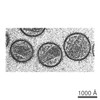 Human immunodeficiency virus 1 Human immunodeficiency virus 1  Macaca mulatta (Rhesus monkey) Macaca mulatta (Rhesus monkey) Homo sapiens (human) Homo sapiens (human) | |||||||||||||||||||||||||||
| Method | ELECTRON MICROSCOPY / single particle reconstruction / cryo EM / Resolution: 2.7 Å | |||||||||||||||||||||||||||
 Authors Authors | Phulera, S. / Ozorowski, G. / Ward, A.B. | |||||||||||||||||||||||||||
| Funding support | 1items
| |||||||||||||||||||||||||||
 Citation Citation | Journal: bioRxiv / Year: 2025 Title: Engineering HIV antibodies with enhanced breadth and potency of neutralization through multistate affinity maturation. Authors: Mateusz Kędzior / Swastik Phulera / Monica L Fernández-Quintero / Johannes R Loeffler / Collin Joyce / Jordan Woehl / Abdolrahim Abbasi / Maryam Karimi / Arash Aslanabadi / Mahsa Hojabri / ...Authors: Mateusz Kędzior / Swastik Phulera / Monica L Fernández-Quintero / Johannes R Loeffler / Collin Joyce / Jordan Woehl / Abdolrahim Abbasi / Maryam Karimi / Arash Aslanabadi / Mahsa Hojabri / Roza Zareidoodeji / Ben Atkinson / Eduar Fernando Pinzon Burgos / Alonso Heredia / Karen Saye-Francisco / Quoc Tran / Yoojin Kim / Fernando Acosta-Puente / Lara Shahin / Amelia Zhou / Pilar X Altman / Nathaniel R Felbinger / Brian G Pierce / Devin Sok / Michael S Seaman / Dennis R Burton / Anthony L DeVico / Andrew B Ward / Gabriel Ozorowski / Mohammad M Sajadi / Joseph G Jardine /  Abstract: Broadly neutralizing antibodies (bnAbs) against HIV hold promise as therapeutic and prophylactic agents, but realizing this potential requires antibodies that function across the antigenic ...Broadly neutralizing antibodies (bnAbs) against HIV hold promise as therapeutic and prophylactic agents, but realizing this potential requires antibodies that function across the antigenic heterogeneity of the HIV envelope glycoprotein (Env). Although numerous bnAbs have been isolated from infected individuals, their breadth and potency may not be sufficient to tackle global viral diversity, motivating efforts to further improve their neutralization capacity. Here, we address this challenge using a multistate antibody engineering approach integrating deep mutational scanning with combinatorial library screening across diverse Env variants. This strategy enables identification of mutation patterns that confer improved binding across antigenically distinct targets. Starting from one of the best-in-class CD4-binding site bnAbs, we performed iterative optimization to increase binding affinity across diverse Env variants. The resulting lead candidate exhibited improved breadth and up to 100-fold higher potency against pseudoviruses from large cross-clade historical and contemporary panels while maintaining biophysical and pharmacokinetic profiles conducive to clinical development. Structural and molecular dynamics analyses revealed a unique tri-tyrosine aromatic triad and reinforced electrostatic contacts that stabilized the bnAb/Env interface. These findings demonstrate that systematic engineering can generate bnAbs with enhanced breadth and potency, providing a generalizable strategy for developing therapeutic antibodies against highly diverse pathogens. | |||||||||||||||||||||||||||
| History |
|
- Structure visualization
| Structure viewer | Molecule: MolmilJmol/JSmol |
|---|
- Downloads & links
-Download
| PDBx/mmCIF format | 9p6g.cif.gz | 618.6 KB | Display | PDBx/mmCIF format |
|---|---|---|---|---|
| PDB format | pdb9p6g.ent.gz | Display | PDB format | |
| PDBx/mmJSON format | 9p6g.json.gz | Tree view | PDBx/mmJSON format | |
| Others |  Other downloads Other downloads |
-Validation report
| Arichive directory | https://data.pdbj.org/pub/pdb/validation_reports/p6/9p6gftp://data.pdbj.org/pub/pdb/validation_reports/p6/9p6g | HTTPS FTP |
|---|
-Related structure data
| Related structure data |  71308MC  9p6eC M: map data used to model this data C: citing same article ( |
|---|---|
| Similar structure data |

-Links
 PDBj
PDBj

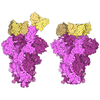
- Assembly
| Deposited unit | 
|
|---|---|
| 1 |
|
-Components
-Envelope glycoprotein ... , 2 types, 6 molecules ACEBDF
| #1: Protein | Mass: 54088.289 Da / Num. of mol.: 3 Mutation: T105E, M270I, F287L, R303V, A316Y, T330N, N361Q, A498C, E506R, K507R, A509R, V510R Source method: isolated from a genetically manipulated source Source: (gene. exp.) Human immunodeficiency virus 1 / Gene: env / Production host: Homo sapiens (human) / References: UniProt: Q2N0S5#2: Protein | Mass: 17134.324 Da / Num. of mol.: 3 / Mutation: F516S, I556P, S558P, L565D, V567H, R582H, T602C Source method: isolated from a genetically manipulated source Source: (gene. exp.) Human immunodeficiency virus 1 / Gene: env / Production host: Homo sapiens (human) / References: UniProt: Q2N0S6 |
|---|
-EN49P7-FRv1-23 ... , 2 types, 6 molecules HKPLNR
| #5: Protein | Mass: 15432.193 Da / Num. of mol.: 3 Source method: isolated from a genetically manipulated source Source: (gene. exp.) Homo sapiens (human) / Production host: Homo sapiens (human)#6: Protein | Mass: 10855.144 Da / Num. of mol.: 3 Source method: isolated from a genetically manipulated source Source: (gene. exp.) Homo sapiens (human) / Production host: Homo sapiens (human) |
|---|
-Antibody , 2 types, 6 molecules GJOIMQ
| #3: Antibody | Mass: 13511.111 Da / Num. of mol.: 3 Source method: isolated from a genetically manipulated source Source: (gene. exp.) Macaca mulatta (Rhesus monkey) / Production host: Homo sapiens (human)#4: Antibody | Mass: 11540.614 Da / Num. of mol.: 3 Source method: isolated from a genetically manipulated source Source: (gene. exp.) Macaca mulatta (Rhesus monkey) / Production host: Homo sapiens (human) |
|---|
-Sugars , 4 types, 48 molecules 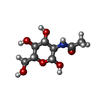
| #7: Polysaccharide | Source method: isolated from a genetically manipulated source #8: Polysaccharide | 2-acetamido-2-deoxy-beta-D-glucopyranose-(1-4)-2-acetamido-2-deoxy-beta-D-glucopyranose Source method: isolated from a genetically manipulated source #9: Polysaccharide | Source method: isolated from a genetically manipulated source #10: Sugar | ChemComp-NAG / 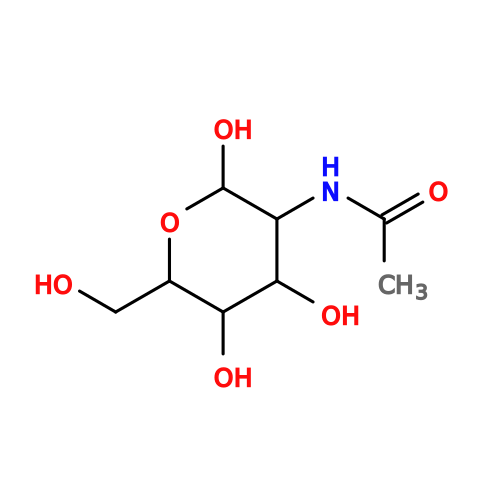 Type: D-saccharide, beta linking / Mass: 221.208 Da / Num. of mol.: 36 / Source method: obtained synthetically / Formula: C8H15NO6 Type: D-saccharide, beta linking / Mass: 221.208 Da / Num. of mol.: 36 / Source method: obtained synthetically / Formula: C8H15NO6 |
|---|
-Details
| Has ligand of interest | N |
|---|---|
| Has protein modification | Y |
-Experimental details
-Experiment
| Experiment | Method: ELECTRON MICROSCOPY |
|---|---|
| EM experiment | Aggregation state: PARTICLE / 3D reconstruction method: single particle reconstruction |
- Sample preparation
| Component | Name: eN49P7-FRv1-23 Fab in complex with BG505 MD39 SOSIP and RM20A3 Fab Type: COMPLEX / Entity ID: #1-#6 / Source: MULTIPLE SOURCES |
|---|---|
| Source (natural) | Organism: Human immunodeficiency virus 1 |
| Source (recombinant) | Organism: Homo sapiens (human) |
| Buffer solution | pH: 5.9 |
| Specimen | Embedding applied: NO / Shadowing applied: NO / Staining applied: NO / Vitrification applied: YES |
| Specimen support | Grid material: GOLD / Grid mesh size: 300 divisions/in. / Grid type: UltrAuFoil R1.2/1.3 |
| Vitrification | Instrument: FEI VITROBOT MARK IV / Cryogen name: ETHANE / Humidity: 100 % / Chamber temperature: 277 K |
- Electron microscopy imaging
| Microscopy | Model: TFS GLACIOS |
|---|---|
| Electron gun | Electron source:  FIELD EMISSION GUN / Accelerating voltage: 200 kV / Illumination mode: FLOOD BEAM FIELD EMISSION GUN / Accelerating voltage: 200 kV / Illumination mode: FLOOD BEAM |
| Electron lens | Mode: BRIGHT FIELD / Nominal magnification: 190000 X / Nominal defocus max: 1800 nm / Nominal defocus min: 700 nm / C2 aperture diameter: 20 µm |
| Specimen holder | Specimen holder model: FEI TITAN KRIOS AUTOGRID HOLDER |
| Image recording | Electron dose: 45 e/Å2 / Film or detector model: TFS FALCON 4i (4k x 4k) |
- Processing
| EM software |
| ||||||||||||||||||||||||
|---|---|---|---|---|---|---|---|---|---|---|---|---|---|---|---|---|---|---|---|---|---|---|---|---|---|
| CTF correction | Type: PHASE FLIPPING AND AMPLITUDE CORRECTION | ||||||||||||||||||||||||
| Symmetry | Point symmetry: C3 (3 fold cyclic) | ||||||||||||||||||||||||
| 3D reconstruction | Resolution: 2.7 Å / Resolution method: FSC 0.143 CUT-OFF / Num. of particles: 212503 / Symmetry type: POINT | ||||||||||||||||||||||||
| Refinement | Highest resolution: 2.7 Å Stereochemistry target values: REAL-SPACE (WEIGHTED MAP SUM AT ATOM CENTERS) | ||||||||||||||||||||||||
| Refine LS restraints |
|
