 Movie
Movie Controller

[English] 日本語
 Yorodumi
- PDB-9oum: Native GABA-A receptor from rat cerebella, beta2-alpha1-beta1-alp... -
+ Open data

- Basic information
| Entry | Database: PDB / ID: 9oum | |||||||||||||||||||||||||||
|---|---|---|---|---|---|---|---|---|---|---|---|---|---|---|---|---|---|---|---|---|---|---|---|---|---|---|---|---|
| Title | Native GABA-A receptor from rat cerebella, beta2-alpha1-beta1-alpha6-gamma2 subtype, in complex with GABA and PZ-II-029 | |||||||||||||||||||||||||||
 Components Components |
| |||||||||||||||||||||||||||
 Keywords Keywords | MEMBRANE PROTEIN / neurotransmitter receptor / cys-loop receptor / ligand-gated ion channel | |||||||||||||||||||||||||||
| Function / homology |  Function and homology information Function and homology informationcerebellar Golgi cell to granule cell synapse / GABA receptor activation / ovulation cycle / inhibitory extracellular ligand-gated monoatomic ion channel activity / diazepam binding / : / inner ear auditory receptor cell differentiation / response to methamphetamine hydrochloride / response to auditory stimulus / inhibitory synapse ...cerebellar Golgi cell to granule cell synapse / GABA receptor activation / ovulation cycle / inhibitory extracellular ligand-gated monoatomic ion channel activity / diazepam binding / : / inner ear auditory receptor cell differentiation / response to methamphetamine hydrochloride / response to auditory stimulus / inhibitory synapse / GABA receptor complex / response to anesthetic / monoatomic anion channel activity / GABA receptor binding / post-embryonic development / adult behavior / cellular response to histamine / inner ear receptor cell development / innervation / GABA-gated chloride ion channel activity / GABA-A receptor complex / heterocyclic compound binding / inhibitory synapse assembly / GABA-A receptor activity / cellular response to zinc ion / synaptic transmission, GABAergic / gamma-aminobutyric acid signaling pathway / neuron development / chloride channel complex / chloride transport / central nervous system neuron development / chloride channel activity / neuronal cell body membrane / postsynaptic specialization membrane / ligand-gated monoatomic ion channel activity / response to progesterone / monoatomic ion transport / cochlea development / presynaptic active zone membrane / ligand-gated monoatomic ion channel activity involved in regulation of presynaptic membrane potential / dendrite membrane / chloride transmembrane transport / hippocampal mossy fiber to CA3 synapse / cytoplasmic vesicle membrane / transmitter-gated monoatomic ion channel activity involved in regulation of postsynaptic membrane potential / GABA-ergic synapse / response to toxic substance / Schaffer collateral - CA1 synapse / nuclear envelope / chemical synaptic transmission / presynaptic membrane / dendritic spine / response to ethanol / postsynapse / signaling receptor complex / postsynaptic membrane / axon / dendrite / protein-containing complex binding / glutamatergic synapse / cell surface / plasma membrane Similarity search - Function | |||||||||||||||||||||||||||
| Biological species |   Mus musculus (house mouse) Mus musculus (house mouse) Rattus norvegicus (Norway rat) Rattus norvegicus (Norway rat) | |||||||||||||||||||||||||||
| Method | ELECTRON MICROSCOPY / single particle reconstruction / cryo EM / Resolution: 2.9 Å | |||||||||||||||||||||||||||
 Authors Authors | Sun, C. / Gouaux, E. | |||||||||||||||||||||||||||
| Funding support |  United States, 1items United States, 1items
| |||||||||||||||||||||||||||
 Citation Citation | Journal: Proc Natl Acad Sci U S A / Year: 2026 Title: Molecular assemblies and pharmacology of cerebellar GABA receptors. Authors: Chang Sun / Jennifer N Jahncke / Kevin M Wright / Eric Gouaux / Abstract: GABA receptors (GABARs) mediate fast inhibitory neurotransmission in the brain and are assembled from 19 subunit isoforms into multiple pentameric assemblies. Although α1-containing GABARs are ...GABA receptors (GABARs) mediate fast inhibitory neurotransmission in the brain and are assembled from 19 subunit isoforms into multiple pentameric assemblies. Although α1-containing GABARs are broadly expressed and are pharmacologically important, the molecular diversity of native α1-based assemblies in specific brain regions remains incompletely understood. Here, we use immunofluorescence, mass spectrometry, and cryogenic electron microscopy (cryo-EM) to characterize the spatial distribution, subunit composition, and structural architecture of native α1-containing GABARs in the rat cerebellum. Confocal microscopy reveals robust colocalization of α1 and γ2 subunits across cerebellar layers, including prominent labeling at glomerular synapses. Biochemical purification and proteomic analysis identify a range of α, β, and γ subunits, along with abundant α6 and δ subunits. Using cryo-EM and automated subunit identification, we resolve eight α1-containing receptor assemblies, including the first structure of α6-containing receptors. We further determine the binding mode of the α6-selective pyrazoloquinolinone modulator PZ-II-029 at the α/γ interface, showing ligand-induced expansion of the entire extracellular domain (ECD). Together, our study defines the structure and subunit composition of the α1-containing cerebellar GABARs and elaborates the molecular interactions between native receptors and pyrazoloquinolinone, thereby laying the groundwork for brain region and subunit-specific pharmacology. | |||||||||||||||||||||||||||
| History |
|
- Structure visualization
| Structure viewer | Molecule: MolmilJmol/JSmol |
|---|
- Downloads & links
-Download
| PDBx/mmCIF format | 9oum.cif.gz | 538.3 KB | Display | PDBx/mmCIF format |
|---|---|---|---|---|
| PDB format | pdb9oum.ent.gz | Display | PDB format | |
| PDBx/mmJSON format | 9oum.json.gz | Tree view | PDBx/mmJSON format | |
| Others |  Other downloads Other downloads |
-Validation report
| Arichive directory | https://data.pdbj.org/pub/pdb/validation_reports/ou/9oumftp://data.pdbj.org/pub/pdb/validation_reports/ou/9oum | HTTPS FTP |
|---|
-Related structure data
| Related structure data |  70872MC  9ounC  9ouoC  9oupC  9ouqC  9ourC  9ov4C M: map data used to model this data C: citing same article ( |
|---|---|
| Similar structure data |


-Links
 PDBj
PDBj
- Assembly
| Deposited unit | 
|
|---|---|
| 1 |
|
-Components
-Gamma-aminobutyric acid receptor subunit beta- ... , 2 types, 2 molecules BE
| #1: Protein | Mass: 54133.164 Da / Num. of mol.: 1 / Source method: isolated from a natural source / Source: (natural) Rattus norvegicus (Norway rat) / References: UniProt: P15431 |
|---|---|
| #6: Protein | Mass: 54697.297 Da / Num. of mol.: 1 / Source method: isolated from a natural source / Source: (natural) Rattus norvegicus (Norway rat) / References: UniProt: P63138 |
-Protein , 1 types, 1 molecules D
| #2: Protein | Mass: 54136.945 Da / Num. of mol.: 1 / Source method: isolated from a natural source / Source: (natural) Rattus norvegicus (Norway rat) / References: UniProt: P18508 |
|---|
-Gamma-aminobutyric acid receptor subunit alpha- ... , 2 types, 2 molecules AC
| #5: Protein | Mass: 51818.516 Da / Num. of mol.: 1 / Source method: isolated from a natural source / Source: (natural) Rattus norvegicus (Norway rat) / References: UniProt: P62813 |
|---|---|
| #7: Protein | Mass: 51232.020 Da / Num. of mol.: 1 / Source method: isolated from a natural source / Source: (natural) Rattus norvegicus (Norway rat) / References: UniProt: P30191 |
-Antibody , 2 types, 2 molecules HL
| #3: Antibody | Mass: 24159.895 Da / Num. of mol.: 1 Source method: isolated from a genetically manipulated source Source: (gene. exp.) Mus musculus (house mouse) / Production host:  Spodoptera frugiperda ascovirus 1a Spodoptera frugiperda ascovirus 1a |
|---|---|
| #4: Antibody | Mass: 23624.080 Da / Num. of mol.: 1 Source method: isolated from a genetically manipulated source Source: (gene. exp.) Mus musculus (house mouse) / Production host:   Spodoptera frugiperda (fall armyworm) Spodoptera frugiperda (fall armyworm) |
-Sugars , 4 types, 9 molecules 
| #8: Polysaccharide | 2-acetamido-2-deoxy-beta-D-glucopyranose-(1-4)-2-acetamido-2-deoxy-beta-D-glucopyranose Source method: isolated from a genetically manipulated source #9: Polysaccharide | #10: Polysaccharide | alpha-D-mannopyranose-(1-2)-alpha-D-mannopyranose-(1-3)-[alpha-D-mannopyranose-(1-3)-alpha-D- ...alpha-D-mannopyranose-(1-2)-alpha-D-mannopyranose-(1-3)-[alpha-D-mannopyranose-(1-3)-alpha-D-mannopyranose-(1-6)]beta-D-mannopyranose-(1-4)-2-acetamido-2-deoxy-beta-D-glucopyranose-(1-4)-2-acetamido-2-deoxy-beta-D-glucopyranose | Source method: isolated from a genetically manipulated source #12: Sugar | ChemComp-NAG / | 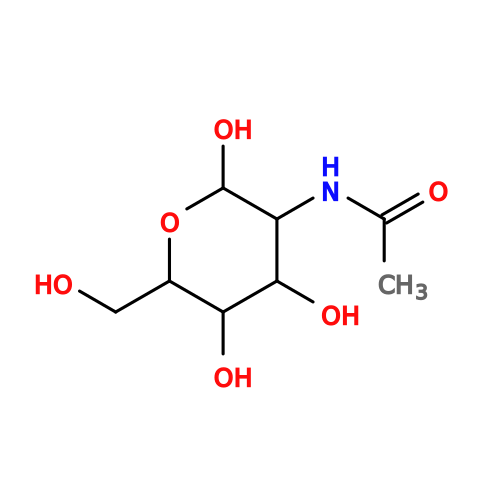 Type: D-saccharide, beta linking / Mass: 221.208 Da / Num. of mol.: 1 / Source method: obtained synthetically / Formula: C8H15NO6 Type: D-saccharide, beta linking / Mass: 221.208 Da / Num. of mol.: 1 / Source method: obtained synthetically / Formula: C8H15NO6 |
|---|
-Non-polymers , 2 types, 3 molecules 
| #11: Chemical |  Mass: 103.120 Da / Num. of mol.: 2 / Source method: obtained synthetically / Formula: C4H9NO2 / Feature type: SUBJECT OF INVESTIGATION Mass: 103.120 Da / Num. of mol.: 2 / Source method: obtained synthetically / Formula: C4H9NO2 / Feature type: SUBJECT OF INVESTIGATION#13: Chemical | ChemComp-A1CEP / | Mass: 321.330 Da / Num. of mol.: 1 / Source method: obtained synthetically / Formula: C18H15N3O3 / Feature type: SUBJECT OF INVESTIGATION |
|---|
-Details
| Has ligand of interest | Y |
|---|---|
| Has protein modification | Y |
-Experimental details
-Experiment
| Experiment | Method: ELECTRON MICROSCOPY |
|---|---|
| EM experiment | Aggregation state: PARTICLE / 3D reconstruction method: single particle reconstruction |
- Sample preparation
| Component | Name: Native GABA-A receptor from rat cerebella, beta2-alpha1-beta1-alpha6-gamma2 subtype, in complex with GABA and PZ-II-029 Type: COMPLEX / Entity ID: #1-#7 / Source: NATURAL |
|---|---|
| Molecular weight | Value: 0.30 MDa / Experimental value: NO |
| Source (natural) | Organism: Rattus norvegicus (Norway rat) |
| Buffer solution | pH: 8 |
| Specimen | Embedding applied: NO / Shadowing applied: NO / Staining applied: NO / Vitrification applied: YES |
| Vitrification | Cryogen name: ETHANE-PROPANE |
- Electron microscopy imaging
| Experimental equipment |  Model: Titan Krios / Image courtesy: FEI Company |
|---|---|
| Microscopy | Model: TFS KRIOS |
| Electron gun | Electron source:  FIELD EMISSION GUN / Accelerating voltage: 300 kV / Illumination mode: FLOOD BEAM FIELD EMISSION GUN / Accelerating voltage: 300 kV / Illumination mode: FLOOD BEAM |
| Electron lens | Mode: BRIGHT FIELD / Nominal defocus max: 2500 nm / Nominal defocus min: 1200 nm |
| Image recording | Electron dose: 43 e/Å2 / Film or detector model: GATAN K3 BIOQUANTUM (6k x 4k) |
- Processing
| CTF correction | Type: PHASE FLIPPING AND AMPLITUDE CORRECTION |
|---|---|
| 3D reconstruction | Resolution: 2.9 Å / Resolution method: FSC 0.143 CUT-OFF / Num. of particles: 125387 / Symmetry type: POINT |
