ANTIVIRAL PROTEIN / Saf-2TM-SAVED / Cap14 / cGAMP / antiphage
Function / homology
SMODS-associated and fused to various effectors / SMODS-associated and fused to various effectors sensor domain / cGAMP / SAVED domain-containing protein
Function and homology information
Biological species
Bacillus thuringiensis (bacteria)
Method
ELECTRON MICROSCOPY / single particle reconstruction / cryo EM / Resolution: 3.3 Å
National Institutes of Health/Office of the Director
DP2AT012346
United States
Citation
Journal: Cell Host Microbe / Year: 2026 Title: Bacterial 2',3'-cGAMP activates a SAVED effector to form membrane-disrupting filaments and restrict phage replication. Authors: Uday Tak / Kate Schinkel / Peace Walth / Jian Wei Tay / Erik W Hartwick / Aaron T Whiteley / Abstract: Mammalian cells initiate antiviral signaling when cyclic GMP-AMP synthase (cGAS) detects cytoplasmic DNA and synthesizes 2',3'-cyclic GMP-AMP (2',3'-cGAMP), which activates stimulator of interferon ...Mammalian cells initiate antiviral signaling when cyclic GMP-AMP synthase (cGAS) detects cytoplasmic DNA and synthesizes 2',3'-cyclic GMP-AMP (2',3'-cGAMP), which activates stimulator of interferon genes (STING). Similarly, bacteria use cyclic oligonucleotide-based antiphage signaling systems (CBASS) to detect phage using ancestral cGAS/DncV-like nucleotidyltransferases (CD-NTases), but they are not known to use 2',3'-cGAMP. Here, we discover a bacterial CD-NTase that produces 2',3'-cGAMP to activate a Saf-2TM-SMODS-associated fused to various effector domains (SAVED) effector (CD-NTase-associated protein 14 [Cap14]), which initiates membrane disruption to restrict phage replication. Cryo-electron microscopy (cryo-EM) reveals that Cap14 binds 2',3'-cGAMP to form a filament, while electrophysiology suggests that cGAMP activates membrane disruption. Swapping the Cap14 transmembrane domain with a nuclease domain yields a functional chimera that exclusively responds to 2',3'-cGAMP. We hypothesize that other predicted transmembrane effectors in CBASS operons disrupt membranes, and we confirm this by showing that bacterial STING homologs with transmembrane domains restrict phage through membrane disruption. These findings expand our understanding of cGAS-STING-like pathways in bacterial immunity.
History
Deposition
May 13, 2025
Deposition site: RCSB / Processing site: RCSB
Revision 1.0
Apr 1, 2026
Provider: repository / Type: Initial release
Revision 1.0
Apr 1, 2026
Data content type: EM metadata / Data content type: EM metadata / Provider: repository / Type: Initial release
Revision 1.0
Apr 1, 2026
Data content type: FSC / Data content type: FSC / Provider: repository / Type: Initial release
Revision 1.0
Apr 1, 2026
Data content type: Half map / Part number: 1 / Data content type: Half map / Provider: repository / Type: Initial release
Revision 1.0
Apr 1, 2026
Data content type: Half map / Part number: 2 / Data content type: Half map / Provider: repository / Type: Initial release
Revision 1.0
Apr 1, 2026
Data content type: Image / Data content type: Image / Provider: repository / Type: Initial release
Revision 1.0
Apr 1, 2026
Data content type: Primary map / Data content type: Primary map / Provider: repository / Type: Initial release
Data content type: EM metadata / Data content type: EM metadata / EM metadata / Group: Database references / Experimental summary / Data content type: EM metadata / EM metadata / EM metadata / Category: citation / citation_author / em_admin Data content type: EM metadata / EM metadata ...EM metadata / EM metadata / EM metadata / EM metadata / EM metadata / EM metadata / EM metadata / EM metadata / EM metadata / EM metadata Item: _citation.country / _citation.journal_abbrev ..._citation.country / _citation.journal_abbrev / _citation.journal_id_CSD / _citation.journal_id_ISSN / _citation.pdbx_database_id_DOI / _citation.pdbx_database_id_PubMed / _citation.title / _citation.year / _citation_author.identifier_ORCID / _em_admin.last_update
Data content type: EM metadata / Data content type: EM metadata / EM metadata / Group: Database references / Experimental summary / Data content type: EM metadata / EM metadata / Category: citation / em_admin / Data content type: EM metadata / EM metadata / EM metadata Item: _citation.journal_volume / _citation.page_first / _em_admin.last_update
F: SAVED domain-containing protein E: SAVED domain-containing protein B: SAVED domain-containing protein D: SAVED domain-containing protein A: SAVED domain-containing protein C: SAVED domain-containing protein hetero molecules
In the structure databanks used in Yorodumi, some data are registered as the other names, "COVID-19 virus" and "2019-nCoV". Here are the details of the virus and the list of structure data.
Jan 31, 2019. EMDB accession codes are about to change! (news from PDBe EMDB page)
EMDB accession codes are about to change! (news from PDBe EMDB page)
The allocation of 4 digits for EMDB accession codes will soon come to an end. Whilst these codes will remain in use, new EMDB accession codes will include an additional digit and will expand incrementally as the available range of codes is exhausted. The current 4-digit format prefixed with “EMD-” (i.e. EMD-XXXX) will advance to a 5-digit format (i.e. EMD-XXXXX), and so on. It is currently estimated that the 4-digit codes will be depleted around Spring 2019, at which point the 5-digit format will come into force.
The EM Navigator/Yorodumi systems omit the EMD- prefix.
Related info.:Q: What is EMD? / ID/Accession-code notation in Yorodumi/EM Navigator
Yorodumi is a browser for structure data from EMDB, PDB, SASBDB, etc.
This page is also the successor to EM Navigator detail page, and also detail information page/front-end page for Omokage search.
The word "yorodu" (or yorozu) is an old Japanese word meaning "ten thousand". "mi" (miru) is to see.
Related info.:EMDB / PDB / SASBDB / Comparison of 3 databanks / Yorodumi Search / Aug 31, 2016. New EM Navigator & Yorodumi / Yorodumi Papers / Jmol/JSmol / Function and homology information / Changes in new EM Navigator and Yorodumi
 Movie
Movie Controller


 Open data
 Basic information
 Components
 Keywords
 Function and homology information
 Bacillus thuringiensis (bacteria)
 Authors
 United States, 1items
  Citation
 Structure visualization
 Downloads & links
 Other downloads
 PDBj
PDBj Assembly
 Escherichia coli BL21(DE3) (bacteria) / Variant (production host): C43 / References: UniProt: A0AAP4Q8A7
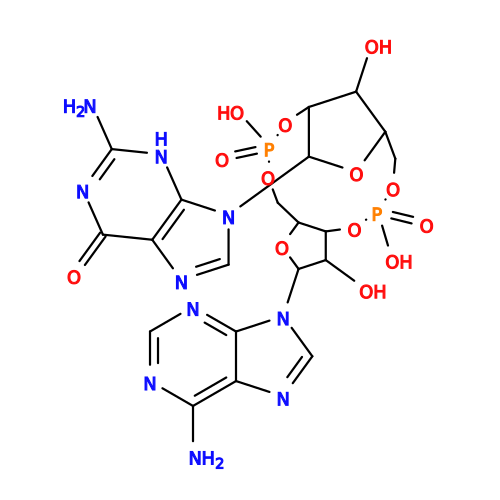 Mass: 674.411 Da / Num. of mol.: 6 / Source method: obtained synthetically / Formula: C20H24N10O13P2 / Feature type: SUBJECT OF INVESTIGATION
 Sample preparation
 Electron microscopy imaging
 FIELD EMISSION GUN / Accelerating voltage: 300 kV / Illumination mode: OTHER
 Processing