 Movie
Movie Controller

[English] 日本語
 Yorodumi
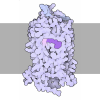
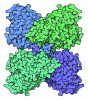
- PDB-9oer: HalA with lysine, Fe(II), chloride, and a peroxyhemiketal intermediate -
+ Open data

- Basic information
| Entry | Database: PDB / ID: 9oer | |||||||||
|---|---|---|---|---|---|---|---|---|---|---|
| Title | HalA with lysine, Fe(II), chloride, and a peroxyhemiketal intermediate | |||||||||
 Components Components | Lysine halogenase | |||||||||
 Keywords Keywords | BIOSYNTHETIC PROTEIN / Halogenase / Fe/2OG oxidase | |||||||||
| Function / homology | : / Halogenase D / : / 2-OXOGLUTARIC ACID / : / LYSINE / SUCCINIC ACID / : / ArpA protein Function and homology information Function and homology information | |||||||||
| Biological species |  Actinoplanes teichomyceticus (bacteria) Actinoplanes teichomyceticus (bacteria) | |||||||||
| Method |  X-RAY DIFFRACTION / SYNCHROTRON / MOLECULAR REPLACEMENT / Resolution: 1.72 Å X-RAY DIFFRACTION / SYNCHROTRON / MOLECULAR REPLACEMENT / Resolution: 1.72 Å | |||||||||
 Authors Authors | Kissman, E.N. / Yang, A.Y. / Chang, M.C.Y. | |||||||||
| Funding support |  United States, 2items United States, 2items
| |||||||||
 Citation Citation | Journal: Nat.Chem.Biol. / Year: 2026 Title: Dynamic metal coordination controls chemoselectivity in a radical halogenase. Authors: Kissman, E.N. / Kipouros, I. / Slater, J.W. / Stone, E.A. / Yang, A.Y. / Braun, A. / Ensberg, A.R. / Whitten, A.M. / Chatterjee, K. / Bogacz, I. / Yano, J. / Martin Bollinger Jr., J. / Chang, M.C.Y. | |||||||||
| History |
|
- Structure visualization
| Structure viewer | Molecule: MolmilJmol/JSmol |
|---|
- Downloads & links
-Download
| PDBx/mmCIF format | 9oer.cif.gz | 800 KB | Display | PDBx/mmCIF format |
|---|---|---|---|---|
| PDB format | pdb9oer.ent.gz | Display | PDB format | |
| PDBx/mmJSON format | 9oer.json.gz | Tree view | PDBx/mmJSON format | |
| Others |  Other downloads Other downloads |
-Validation report
| Arichive directory | https://data.pdbj.org/pub/pdb/validation_reports/oe/9oerftp://data.pdbj.org/pub/pdb/validation_reports/oe/9oer | HTTPS FTP |
|---|
-Related structure data


-Links
 PDBj
PDBj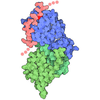
- Assembly
| Deposited unit | 
| ||||||||||
|---|---|---|---|---|---|---|---|---|---|---|---|
| 1 | 
| ||||||||||
| 2 | 
| ||||||||||
| Unit cell |
| ||||||||||
| Components on special symmetry positions |
|
-Components
-Protein , 1 types, 8 molecules ABCDEFGH
| #1: Protein | Mass: 29815.410 Da / Num. of mol.: 8 Source method: isolated from a genetically manipulated source Source: (gene. exp.) Actinoplanes teichomyceticus (bacteria)Gene: FHX34_1011265 / Production host:  Escherichia coli BL21(DE3) (bacteria) / References: UniProt: A0A561WR11 Escherichia coli BL21(DE3) (bacteria) / References: UniProt: A0A561WR11 |
|---|
-Non-polymers , 8 types, 729 molecules 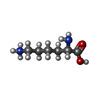
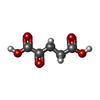


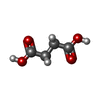

| #2: Chemical | ChemComp-LYS / 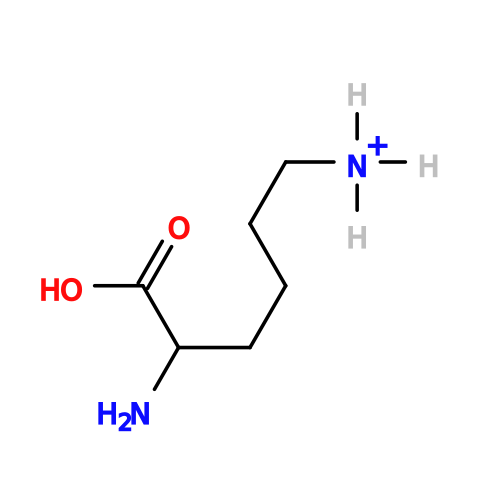 Type: L-peptide linking / Mass: 147.195 Da / Num. of mol.: 5 / Source method: obtained synthetically / Formula: C6H15N2O2 / Feature type: SUBJECT OF INVESTIGATION Type: L-peptide linking / Mass: 147.195 Da / Num. of mol.: 5 / Source method: obtained synthetically / Formula: C6H15N2O2 / Feature type: SUBJECT OF INVESTIGATION#3: Chemical | 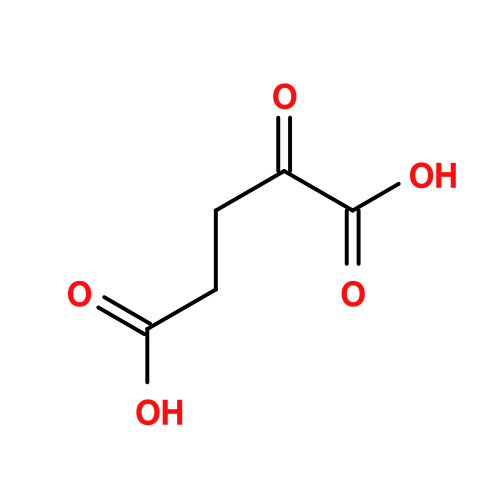 Mass: 146.098 Da / Num. of mol.: 2 / Source method: obtained synthetically / Formula: C5H6O5 / Feature type: SUBJECT OF INVESTIGATION Mass: 146.098 Da / Num. of mol.: 2 / Source method: obtained synthetically / Formula: C5H6O5 / Feature type: SUBJECT OF INVESTIGATION#4: Chemical | ChemComp-FE2 /  Mass: 55.845 Da / Num. of mol.: 8 / Source method: isolated from a natural source / Formula: Fe / Feature type: SUBJECT OF INVESTIGATION Mass: 55.845 Da / Num. of mol.: 8 / Source method: isolated from a natural source / Formula: Fe / Feature type: SUBJECT OF INVESTIGATION#5: Chemical | ChemComp-CL /  Mass: 35.453 Da / Num. of mol.: 8 / Source method: obtained synthetically / Formula: Cl / Feature type: SUBJECT OF INVESTIGATION Mass: 35.453 Da / Num. of mol.: 8 / Source method: obtained synthetically / Formula: Cl / Feature type: SUBJECT OF INVESTIGATION#6: Chemical | ChemComp-SIN / 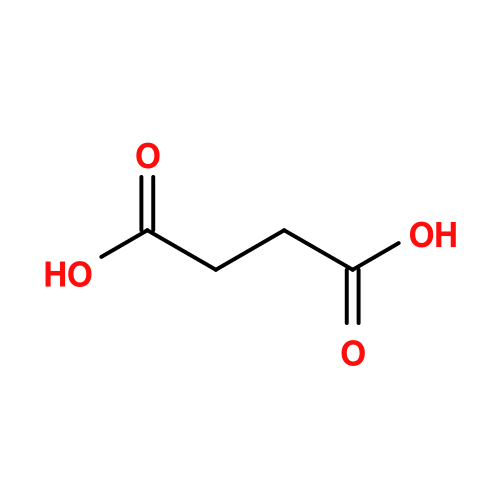 Mass: 118.088 Da / Num. of mol.: 5 / Source method: obtained synthetically / Formula: C4H6O4 / Feature type: SUBJECT OF INVESTIGATION Mass: 118.088 Da / Num. of mol.: 5 / Source method: obtained synthetically / Formula: C4H6O4 / Feature type: SUBJECT OF INVESTIGATION#7: Chemical | Mass: 180.633 Da / Num. of mol.: 3 / Source method: obtained synthetically / Formula: C6H13ClN2O2 / Feature type: SUBJECT OF INVESTIGATION #8: Chemical | ChemComp-A1CA1 / ( | Mass: 180.113 Da / Num. of mol.: 1 / Source method: obtained synthetically / Formula: C5H8O7 / Feature type: SUBJECT OF INVESTIGATION #9: Water | ChemComp-HOH / | Mass: 18.015 Da / Num. of mol.: 697 / Source method: isolated from a natural source / Formula: H2O |
|---|
-Details
| Has ligand of interest | Y |
|---|---|
| Has protein modification | N |
-Experimental details
-Experiment
| Experiment | Method: X-RAY DIFFRACTION / Number of used crystals: 1 |
|---|
- Sample preparation
| Crystal | Density Matthews: 2.52 Å3/Da / Density % sol: 51.19 % |
|---|---|
| Crystal grow | Temperature: 298 K / Method: vapor diffusion, hanging drop / pH: 7 Details: HalA crystals were obtained by the hanging drop vapor diffusion method by combining equal volumes of protein solution (HalA (5 mg/ml), lysine (50 mM, pH 7), and aKG (20 mM, pH 7)) and ...Details: HalA crystals were obtained by the hanging drop vapor diffusion method by combining equal volumes of protein solution (HalA (5 mg/ml), lysine (50 mM, pH 7), and aKG (20 mM, pH 7)) and reservoir solution (potassium phosphate monobasic (40 mM), 20% (w/v) PEG 8000, 15% (v/v) glycerol). Crystals grew in three days and were transferred to an Eppendorf tube containing 250 uL of reservoir solution and vortexed for 30 seconds with 10 x 1 uM diameter zirconia/silica beads to produce a micro-seed solution. The seed solution was stored at -80C for future use. Subsequent crystals were prepared by micro-seeding equal volumes of protein solution (HalA (5 mg/ml), lysine (50 mM, pH 7), and aKG (20 mM, pH 7)) and reservoir solution (potassium phosphate monobasic (40 mM), 20% (w/v) PEG 8000, 15% (v/v) glycerol). Crystals grew after two weeks inside a Coy anaerobic chamber. Crystals were soaked with (NH4)2Fe(SO4)2 6H2O (1.42 mM) while NO accumulated in the well. To introduce NO, diethylamine NONOate was prepared by dissolving solid in 10 mM NaOH. The stock concentration was determined based on the published extinction coefficient of e250 = 6,500 M-1 cm-1 using a Nanodrop. NONOate was added to a final concentration of 26 mM in each well along with 150 mM HEPES pH 7.5 to trigger NONOate decomposition. The wells were quickly re-sealed and NO was allowed to accumulate for approximately 1 hour, after which the crystals were flash frozen in liquid nitrogen |
-Data collection
| Diffraction | Mean temperature: 90 K / Serial crystal experiment: N |
|---|---|
| Diffraction source | Source: SYNCHROTRON / Site: ALS / Beamline: 8.3.1 / Wavelength: 1.11583 Å |
| Detector | Type: DECTRIS PILATUS3 S 6M / Detector: PIXEL / Date: Dec 22, 2022 |
| Radiation | Protocol: SINGLE WAVELENGTH / Monochromatic (M) / Laue (L): M / Scattering type: x-ray |
| Radiation wavelength | Wavelength: 1.11583 Å / Relative weight: 1 |
| Reflection twin | Operator: h,-h-k,-l / Fraction: 0.46 |
| Reflection | Resolution: 1.72→95.96 Å / Num. obs: 246753 / % possible obs: 99.7 % / Redundancy: 38.94 % / CC1/2: 0.996 / CC star: 1 / Rmerge(I) obs: 0.181 / Rpim(I) all: 0.041 / Rrim(I) all: 0.186 / Net I/σ(I): 19.5 |
| Reflection shell | Resolution: 1.72→1.781 Å / Redundancy: 26.67 % / Rmerge(I) obs: 2.376 / Mean I/σ(I) obs: 1.84 / Num. unique obs: 24600 / CC1/2: 0.657 / CC star: 0.89 / Rpim(I) all: 0.4643 / Rrim(I) all: 2.422 / % possible all: 99.13 |
- Processing
| Software |
| |||||||||||||||||||||||||||||||||||||||||||||||||||||||||||||||||||||||||||||||||||||||||||||||||||||||||||||||||||||||||||||||||||||||||||||||||||
|---|---|---|---|---|---|---|---|---|---|---|---|---|---|---|---|---|---|---|---|---|---|---|---|---|---|---|---|---|---|---|---|---|---|---|---|---|---|---|---|---|---|---|---|---|---|---|---|---|---|---|---|---|---|---|---|---|---|---|---|---|---|---|---|---|---|---|---|---|---|---|---|---|---|---|---|---|---|---|---|---|---|---|---|---|---|---|---|---|---|---|---|---|---|---|---|---|---|---|---|---|---|---|---|---|---|---|---|---|---|---|---|---|---|---|---|---|---|---|---|---|---|---|---|---|---|---|---|---|---|---|---|---|---|---|---|---|---|---|---|---|---|---|---|---|---|---|---|---|
| Refinement | Method to determine structure: MOLECULAR REPLACEMENT / Resolution: 1.72→95.96 Å / Cross valid method: FREE R-VALUE / σ(F): 1.96 / Phase error: 22.58 / Stereochemistry target values: TWIN_LSQ_F
| |||||||||||||||||||||||||||||||||||||||||||||||||||||||||||||||||||||||||||||||||||||||||||||||||||||||||||||||||||||||||||||||||||||||||||||||||||
| Solvent computation | Shrinkage radii: 0.9 Å / VDW probe radii: 1.1 Å / Solvent model: FLAT BULK SOLVENT MODEL | |||||||||||||||||||||||||||||||||||||||||||||||||||||||||||||||||||||||||||||||||||||||||||||||||||||||||||||||||||||||||||||||||||||||||||||||||||
| Refinement step | Cycle: LAST / Resolution: 1.72→95.96 Å
| |||||||||||||||||||||||||||||||||||||||||||||||||||||||||||||||||||||||||||||||||||||||||||||||||||||||||||||||||||||||||||||||||||||||||||||||||||
| Refine LS restraints |
| |||||||||||||||||||||||||||||||||||||||||||||||||||||||||||||||||||||||||||||||||||||||||||||||||||||||||||||||||||||||||||||||||||||||||||||||||||
| LS refinement shell |
| |||||||||||||||||||||||||||||||||||||||||||||||||||||||||||||||||||||||||||||||||||||||||||||||||||||||||||||||||||||||||||||||||||||||||||||||||||
| Refinement TLS params. | Method: refined / Origin x: 26.2442 Å / Origin y: 42.5742 Å / Origin z: -33.5577 Å
| |||||||||||||||||||||||||||||||||||||||||||||||||||||||||||||||||||||||||||||||||||||||||||||||||||||||||||||||||||||||||||||||||||||||||||||||||||
| Refinement TLS group | Selection details: all |
