[English] 日本語
Yorodumi
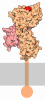
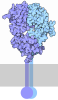
- PDB-9o4x: Gamma delta T cell receptor bound to CD1d -

+
Open data


ID or keywords:

Loading...

-
Basic information

Entry
Database: PDB / ID: 9o4x
TitleGamma delta T cell receptor bound to CD1d
Components
  • (T cell receptor ...) x 2
  • Antigen-presenting glycoprotein CD1d
  • Beta-2-microglobulin
KeywordsIMMUNE SYSTEM / T cell receptor complex / gamma delta TCR / Immune complex
Function / homology
Function and homology information


lipid antigen binding / exogenous lipid antigen binding / antigen processing and presentation, endogenous lipid antigen via MHC class Ib / lipopeptide binding / T cell selection / endogenous lipid antigen binding / antigen processing and presentation, exogenous lipid antigen via MHC class Ib / positive regulation of innate immune response / heterotypic cell-cell adhesion / beta-2-microglobulin binding ...lipid antigen binding / exogenous lipid antigen binding / antigen processing and presentation, endogenous lipid antigen via MHC class Ib / lipopeptide binding / T cell selection / endogenous lipid antigen binding / antigen processing and presentation, exogenous lipid antigen via MHC class Ib / positive regulation of innate immune response / heterotypic cell-cell adhesion / beta-2-microglobulin binding / detection of bacterium / cell adhesion molecule binding / positive regulation of T cell proliferation / negative regulation of receptor binding / early endosome lumen / Nef mediated downregulation of MHC class I complex cell surface expression / DAP12 interactions / transferrin transport / cellular response to iron ion / Endosomal/Vacuolar pathway / Antigen Presentation: Folding, assembly and peptide loading of class I MHC / peptide antigen assembly with MHC class II protein complex / cellular response to iron(III) ion / MHC class II protein complex / negative regulation of forebrain neuron differentiation / antigen processing and presentation of exogenous protein antigen via MHC class Ib, TAP-dependent / ER to Golgi transport vesicle membrane / peptide antigen assembly with MHC class I protein complex / regulation of iron ion transport / regulation of erythrocyte differentiation / HFE-transferrin receptor complex / response to molecule of bacterial origin / MHC class I peptide loading complex / T cell mediated cytotoxicity / positive regulation of T cell cytokine production / antigen processing and presentation of endogenous peptide antigen via MHC class I / antigen processing and presentation of exogenous peptide antigen via MHC class II / positive regulation of immune response / MHC class I protein complex / peptide antigen binding / positive regulation of T cell activation / positive regulation of receptor-mediated endocytosis / negative regulation of neurogenesis / cellular response to nicotine / positive regulation of T cell mediated cytotoxicity / multicellular organismal-level iron ion homeostasis / specific granule lumen / phagocytic vesicle membrane / recycling endosome membrane / Interferon gamma signaling / Immunoregulatory interactions between a Lymphoid and a non-Lymphoid cell / negative regulation of epithelial cell proliferation / MHC class II protein complex binding / Modulation by Mtb of host immune system / late endosome membrane / sensory perception of smell / positive regulation of cellular senescence / tertiary granule lumen / DAP12 signaling / T cell differentiation in thymus / negative regulation of neuron projection development / ER-Phagosome pathway / protein refolding / early endosome membrane / protein homotetramerization / basolateral plasma membrane / amyloid fibril formation / intracellular iron ion homeostasis / learning or memory / lysosome / endosome membrane / immune response / endoplasmic reticulum lumen / Amyloid fiber formation / Golgi membrane / innate immune response / lysosomal membrane / external side of plasma membrane / focal adhesion / Neutrophil degranulation / endoplasmic reticulum membrane / SARS-CoV-2 activates/modulates innate and adaptive immune responses / structural molecule activity / cell surface / endoplasmic reticulum / Golgi apparatus / protein homodimerization activity / extracellular space / extracellular exosome / extracellular region / identical protein binding / membrane / plasma membrane / cytosol / cytoplasm
Similarity search - Function
MHC-I family domain / Beta-2-Microglobulin / : / MHC class I-like antigen recognition-like / MHC class I-like antigen recognition-like superfamily / MHC classes I/II-like antigen recognition protein / : / Immunoglobulin/major histocompatibility complex, conserved site / Immunoglobulins and major histocompatibility complex proteins signature. / Immunoglobulin C-Type ...MHC-I family domain / Beta-2-Microglobulin / : / MHC class I-like antigen recognition-like / MHC class I-like antigen recognition-like superfamily / MHC classes I/II-like antigen recognition protein / : / Immunoglobulin/major histocompatibility complex, conserved site / Immunoglobulins and major histocompatibility complex proteins signature. / Immunoglobulin C-Type / Immunoglobulin C1-set / Immunoglobulin C1-set domain / Ig-like domain profile. / Immunoglobulin-like domain / Immunoglobulin-like domain superfamily / Immunoglobulin-like fold
Similarity search - Domain/homology
sphingomyelin / Antigen-presenting glycoprotein CD1d / Beta-2-microglobulin
Similarity search - Component
Biological speciesHomo sapiens (human)
MethodX-RAY DIFFRACTION / SYNCHROTRON / MOLECULAR REPLACEMENT / Resolution: 2.86 Å
AuthorsRice, M.T. / Gully, B.S. / Rossjohn, J.
Funding support Australia, 1items
OrganizationGrant numberCountry
Australian Research Council (ARC) Australia
CitationJournal: To Be Published
Title: gamma delta T cell receptor bound to CD1d
Authors: Rice, M.T. / Gully, B.S. / Rossjohn, J.
History
DepositionApr 9, 2025Deposition site: RCSB / Processing site: RCSB
Revision 1.0Dec 10, 2025Provider: repository / Type: Initial release

-
Structure visualization

Structure viewerMolecule:
MolmilJmol/JSmol

Downloads & links

-
Assembly

Deposited unit
B: Beta-2-microglobulin
D: T cell receptor delta chain
G: T cell receptor gamma chain
A: Antigen-presenting glycoprotein CD1d
hetero molecules


Theoretical massNumber of molelcules
Total (without water)92,9809
Polymers90,8574
Non-polymers2,1235
Water00
1
B: Beta-2-microglobulin
A: Antigen-presenting glycoprotein CD1d
hetero molecules

D: T cell receptor delta chain
G: T cell receptor gamma chain
hetero molecules


Theoretical massNumber of molelcules
Total (without water)92,9809
Polymers90,8574
Non-polymers2,1235
Water0
TypeNameSymmetry operationNumber
identity operation1_555x,y,z1
crystal symmetry operation3_544-y+1/2,x-1/2,z-1/41
Buried area10400 Å2
ΔGint-28 kcal/mol
Surface area38770 Å2
MethodPISA
Unit cell
Length a, b, c (Å)178.093, 178.093, 75.428
Angle α, β, γ (deg.)90.000, 90.000, 90.000
Int Tables number96
Space group name H-MP43212
Space group name HallP4nw2abw
Symmetry operation#1: x,y,z
#2: -y+1/2,x+1/2,z+3/4
#3: y+1/2,-x+1/2,z+1/4
#4: x+1/2,-y+1/2,-z+1/4
#5: -x+1/2,y+1/2,-z+3/4
#6: -x,-y,z+1/2
#7: y,x,-z
#8: -y,-x,-z+1/2

-
Components

-
Protein , 2 types, 2 molecules BA

#1: Protein Beta-2-microglobulin


Mass: 11748.160 Da / Num. of mol.: 1
Source method: isolated from a genetically manipulated source
Source: (gene. exp.) Homo sapiens (human) / Gene: B2M, CDABP0092, HDCMA22P / Production host: Homo sapiens (human) / References: UniProt: P61769
#4: Protein Antigen-presenting glycoprotein CD1d / R3G1


Mass: 31074.029 Da / Num. of mol.: 1
Source method: isolated from a genetically manipulated source
Source: (gene. exp.) Homo sapiens (human) / Gene: CD1D / Production host: Homo sapiens (human) / References: UniProt: P15813

-
T cell receptor ... , 2 types, 2 molecules DG

#2: Protein T cell receptor delta chain


Mass: 22211.477 Da / Num. of mol.: 1
Source method: isolated from a genetically manipulated source
Source: (gene. exp.) Homo sapiens (human) / Production host: Homo sapiens (human)
#3: Protein T cell receptor gamma chain


Mass: 25823.322 Da / Num. of mol.: 1
Source method: isolated from a genetically manipulated source
Source: (gene. exp.) Homo sapiens (human) / Production host: Homo sapiens (human)

-
Sugars , 2 types, 3 molecules

#5: Polysaccharide 2-acetamido-2-deoxy-beta-D-glucopyranose-(1-4)-2-acetamido-2-deoxy-beta-D-glucopyranose


Type: oligosaccharide / Mass: 424.401 Da / Num. of mol.: 2
Source method: isolated from a genetically manipulated source
DescriptorTypeProgram
DGlcpNAcb1-4DGlcpNAcb1-ROHGlycam Condensed SequenceGMML 1.0
WURCS=2.0/1,2,1/[a2122h-1b_1-5_2*NCC/3=O]/1-1/a4-b1WURCSPDB2Glycan 1.1.0
[][D-1-deoxy-GlcpNAc]{[(4+1)][b-D-GlcpNAc]{}}LINUCSPDB-CARE
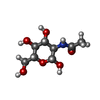
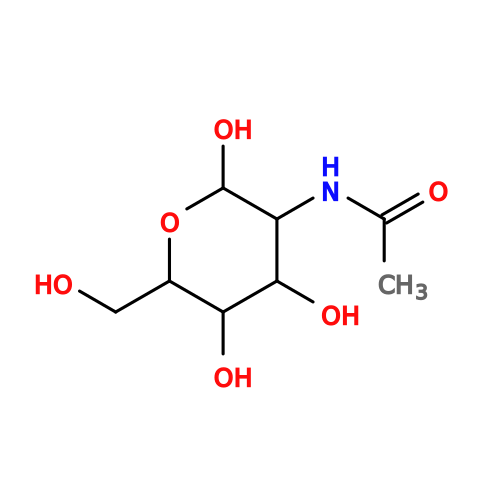
#6: Sugar ChemComp-NAG / 2-acetamido-2-deoxy-beta-D-glucopyranose / N-acetyl-beta-D-glucosamine / 2-acetamido-2-deoxy-beta-D-glucose / 2-acetamido-2-deoxy-D-glucose / 2-acetamido-2-deoxy-glucose / N-ACETYL-D-GLUCOSAMINE


Type: D-saccharide, beta linking / Mass: 221.208 Da / Num. of mol.: 1 / Source method: obtained synthetically / Formula: C8H15NO6
IdentifierTypeProgram
DGlcpNAcbCONDENSED IUPAC CARBOHYDRATE SYMBOLGMML 1.0
N-acetyl-b-D-glucopyranosamineCOMMON NAMEGMML 1.0
b-D-GlcpNAcIUPAC CARBOHYDRATE SYMBOLPDB-CARE 1.0
GlcNAcSNFG CARBOHYDRATE SYMBOLGMML 1.0

-
Non-polymers , 2 types, 2 molecules

#7: Chemical ChemComp-FO4 / sphingomyelin


Mass: 814.233 Da / Num. of mol.: 1 / Source method: obtained synthetically / Formula: C47H94N2O6P / Feature type: SUBJECT OF INVESTIGATION
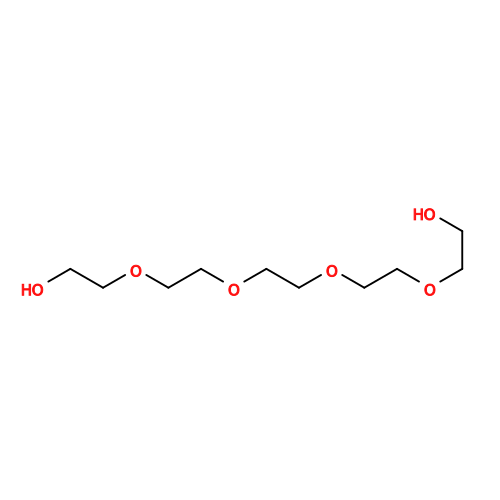
#8: Chemical ChemComp-1PE / PENTAETHYLENE GLYCOL / PEG400


Mass: 238.278 Da / Num. of mol.: 1 / Source method: obtained synthetically / Formula: C10H22O6 / Comment: precipitant*YM

-
Details

Has ligand of interestY
Has protein modificationY

-
Experimental details

-
Experiment

ExperimentMethod: X-RAY DIFFRACTION / Number of used crystals: 1

-
Sample preparation

CrystalDensity Matthews: 3.22 Å3/Da / Density % sol: 61.83 %
Crystal growTemperature: 293 K / Method: vapor diffusion, hanging drop / Details: 16% PEG 3350, 0.05M CBTP pH 5

-
Data collection

DiffractionMean temperature: 100 K / Serial crystal experiment: N
Diffraction sourceSource: SYNCHROTRON / Site: Australian Synchrotron / Beamline: MX2 / Wavelength: 0.97958 Å
DetectorType: DECTRIS EIGER X 16M / Detector: PIXEL / Date: Jul 6, 2023
RadiationProtocol: SINGLE WAVELENGTH / Monochromatic (M) / Laue (L): M / Scattering type: x-ray
Radiation wavelengthWavelength: 0.97958 Å / Relative weight: 1
ReflectionResolution: 2.86→46.65 Å / Num. obs: 28516 / % possible obs: 99.8 % / Redundancy: 10.4 % / Biso Wilson estimate: 68.32 Å2 / CC1/2: 0.999 / Net I/σ(I): 16.4
Reflection shellResolution: 2.86→3.02 Å / Redundancy: 10.6 % / Mean I/σ(I) obs: 2.3 / Num. unique obs: 4072 / CC1/2: 0.75 / Rpim(I) all: 0.491 / % possible all: 98.7

-
Processing

Software
NameVersionClassification
PHENIX1.21.2_5419refinement
XDSdata reduction
XDSdata scaling
PHENIXphasing
RefinementMethod to determine structure: MOLECULAR REPLACEMENT / Resolution: 2.86→46.65 Å / SU ML: 0.3855 / Cross valid method: FREE R-VALUE / σ(F): 1.34 / Phase error: 26.1399
Stereochemistry target values: GeoStd + Monomer Library + CDL v1.2
RfactorNum. reflection% reflection
Rfree0.2553 1999 7.02 %
Rwork0.2149 26464 -
obs0.2177 28463 99.79 %
Solvent computationShrinkage radii: 0.9 Å / VDW probe radii: 1.1 Å / Solvent model: FLAT BULK SOLVENT MODEL
Displacement parametersBiso mean: 82.59 Å2
Refinement stepCycle: LAST / Resolution: 2.86→46.65 Å
ProteinNucleic acidLigandSolventTotal
Num. atoms6386 0 142 0 6528
Refine LS restraints
Refine-IDTypeDev idealNumber
X-RAY DIFFRACTIONf_bond_d0.00466713
X-RAY DIFFRACTIONf_angle_d0.94259100
X-RAY DIFFRACTIONf_chiral_restr0.0554994
X-RAY DIFFRACTIONf_plane_restr0.00631139
X-RAY DIFFRACTIONf_dihedral_angle_d17.34142566
LS refinement shell
Resolution (Å)Rfactor RfreeNum. reflection RfreeRfactor RworkNum. reflection RworkRefine-ID% reflection obs (%)
2.86-2.930.38881370.33081821X-RAY DIFFRACTION97.17
2.94-3.010.34421410.31171862X-RAY DIFFRACTION100
3.01-3.10.35061400.29771845X-RAY DIFFRACTION100
3.1-3.20.36971410.30761863X-RAY DIFFRACTION100
3.2-3.320.35371410.27761861X-RAY DIFFRACTION100
3.32-3.450.28481410.25281875X-RAY DIFFRACTION100
3.45-3.610.26941420.24821878X-RAY DIFFRACTION100
3.61-3.80.28871410.23011871X-RAY DIFFRACTION99.95
3.8-4.040.26241420.22361879X-RAY DIFFRACTION100
4.04-4.350.21191420.1831888X-RAY DIFFRACTION100
4.35-4.780.19121450.16351902X-RAY DIFFRACTION100
4.78-5.470.2411450.18011922X-RAY DIFFRACTION100
5.48-6.890.25241470.20371945X-RAY DIFFRACTION100
6.89-46.650.21341540.18962052X-RAY DIFFRACTION99.86
Refinement TLS params.Method: refined / Origin x: 58.961 Å / Origin y: -26.295 Å / Origin z: 14.05 Å
111213212223313233
T0.387904126113 Å2-0.0762846173692 Å2-0.0478246028086 Å2-0.412966421114 Å2-0.0139230043134 Å2--0.474989099933 Å2
L1.73546771918 °2-1.02291998397 °2-1.03079799995 °2-1.1225591592 °20.697529274695 °2--1.31252455888 °2
S0.143095898843 Å °0.210745285267 Å °0.251300980422 Å °-0.0730357448054 Å °-0.0545095433523 Å °-0.211197024489 Å °-0.261759442719 Å °-0.00641932230203 Å °-0.094450698086 Å °
Refinement TLS group
IDRefine-IDRefine TLS-IDSelection detailsAuth asym-IDAuth seq-ID
1X-RAY DIFFRACTION1( CHAIN B AND RESID 1:99 ) OR ( CHAIN D AND ( RESID 5:201 OR RESID 301:301 ) ) OR ( CHAIN G AND RESID 4:227 ) OR ( CHAIN A AND ( RESID 6:279 OR RESID 301:302 ) )B1 - 99
2X-RAY DIFFRACTION1( CHAIN B AND RESID 1:99 ) OR ( CHAIN D AND ( RESID 5:201 OR RESID 301:301 ) ) OR ( CHAIN G AND RESID 4:227 ) OR ( CHAIN A AND ( RESID 6:279 OR RESID 301:302 ) )D5 - 201
3X-RAY DIFFRACTION1( CHAIN B AND RESID 1:99 ) OR ( CHAIN D AND ( RESID 5:201 OR RESID 301:301 ) ) OR ( CHAIN G AND RESID 4:227 ) OR ( CHAIN A AND ( RESID 6:279 OR RESID 301:302 ) )D301
4X-RAY DIFFRACTION1( CHAIN B AND RESID 1:99 ) OR ( CHAIN D AND ( RESID 5:201 OR RESID 301:301 ) ) OR ( CHAIN G AND RESID 4:227 ) OR ( CHAIN A AND ( RESID 6:279 OR RESID 301:302 ) )G4 - 227
5X-RAY DIFFRACTION1( CHAIN B AND RESID 1:99 ) OR ( CHAIN D AND ( RESID 5:201 OR RESID 301:301 ) ) OR ( CHAIN G AND RESID 4:227 ) OR ( CHAIN A AND ( RESID 6:279 OR RESID 301:302 ) )A6 - 279
6X-RAY DIFFRACTION1( CHAIN B AND RESID 1:99 ) OR ( CHAIN D AND ( RESID 5:201 OR RESID 301:301 ) ) OR ( CHAIN G AND RESID 4:227 ) OR ( CHAIN A AND ( RESID 6:279 OR RESID 301:302 ) )A301 - 302

+
About Yorodumi

-
News

-
Feb 9, 2022. New format data for meta-information of EMDB entries

New format data for meta-information of EMDB entries

  • Version 3 of the EMDB header file is now the official format.
  • The previous official version 1.9 will be removed from the archive.

Related info.:EMDB header

External links:wwPDB to switch to version 3 of the EMDB data model

-
Aug 12, 2020. Covid-19 info

Covid-19 info

URL: https://pdbj.org/emnavi/covid19.php

New page: Covid-19 featured information page in EM Navigator.

Related info.:Covid-19 info / Mar 5, 2020. Novel coronavirus structure data

+
Mar 5, 2020. Novel coronavirus structure data

Novel coronavirus structure data

Related info.:Yorodumi Speices / Aug 12, 2020. Covid-19 info

External links:COVID-19 featured content - PDBj / Molecule of the Month (242):Coronavirus Proteases

+
Jan 31, 2019. EMDB accession codes are about to change! (news from PDBe EMDB page)

EMDB accession codes are about to change! (news from PDBe EMDB page)

  • The allocation of 4 digits for EMDB accession codes will soon come to an end. Whilst these codes will remain in use, new EMDB accession codes will include an additional digit and will expand incrementally as the available range of codes is exhausted. The current 4-digit format prefixed with “EMD-” (i.e. EMD-XXXX) will advance to a 5-digit format (i.e. EMD-XXXXX), and so on. It is currently estimated that the 4-digit codes will be depleted around Spring 2019, at which point the 5-digit format will come into force.
  • The EM Navigator/Yorodumi systems omit the EMD- prefix.

Related info.:Q: What is EMD? / ID/Accession-code notation in Yorodumi/EM Navigator

External links:EMDB Accession Codes are Changing Soon! / Contact to PDBj

+
Jul 12, 2017. Major update of PDB

Major update of PDB

  • wwPDB released updated PDB data conforming to the new PDBx/mmCIF dictionary.
  • This is a major update changing the version number from 4 to 5, and with Remediation, in which all the entries are updated.
  • In this update, many items about electron microscopy experimental information are reorganized (e.g. em_software).
  • Now, EM Navigator and Yorodumi are based on the updated data.

External links:wwPDB Remediation / Enriched Model Files Conforming to OneDep Data Standards Now Available in the PDB FTP Archive

-
Yorodumi

Thousand views of thousand structures

  • Yorodumi is a browser for structure data from EMDB, PDB, SASBDB, etc.
  • This page is also the successor to EM Navigator detail page, and also detail information page/front-end page for Omokage search.
  • The word "yorodu" (or yorozu) is an old Japanese word meaning "ten thousand". "mi" (miru) is to see.

Related info.:EMDB / PDB / SASBDB / Comparison of 3 databanks / Yorodumi Search / Aug 31, 2016. New EM Navigator & Yorodumi / Yorodumi Papers / Jmol/JSmol / Function and homology information / Changes in new EM Navigator and Yorodumi

Read more