 Movie
Movie Controller

[English] 日本語
 Yorodumi
- PDB-9nww: Single-particle cryo-EM structure of the first variant of mobiliz... -
+ Open data

- Basic information
| Entry | Database: PDB / ID: 9nww | ||||||||||||||||||||||||
|---|---|---|---|---|---|---|---|---|---|---|---|---|---|---|---|---|---|---|---|---|---|---|---|---|---|
| Title | Single-particle cryo-EM structure of the first variant of mobilized colistin resistance (MCR-1) in its ligand-bound state | ||||||||||||||||||||||||
 Components Components |
| ||||||||||||||||||||||||
 Keywords Keywords | TRANSFERASE / Membrane protein / phosphoethanolamine transferase / lipid A modification / polymyxin resistance | ||||||||||||||||||||||||
| Function / homology |  Function and homology information Function and homology informationlipid A phosphoethanolamine transferase / phosphotransferase activity, phosphate group as acceptor / lipopolysaccharide core region biosynthetic process / response to antibiotic / metal ion binding / plasma membrane Similarity search - Function | ||||||||||||||||||||||||
| Biological species |   Escherichia coli (E. coli) Escherichia coli (E. coli) Homo sapiens (human) Homo sapiens (human) | ||||||||||||||||||||||||
| Method | ELECTRON MICROSCOPY / single particle reconstruction / cryo EM / Resolution: 3.58 Å | ||||||||||||||||||||||||
 Authors Authors | Zinkle, A.P. / Bunuro-Batista, M. / Herrera, C.M. / Erramilli, S.K. / Kloss, B. / Ashraf, K.U. / Nosol, K. / Zhang, G. / Cater, R.J. / Marty, M.T. ...Zinkle, A.P. / Bunuro-Batista, M. / Herrera, C.M. / Erramilli, S.K. / Kloss, B. / Ashraf, K.U. / Nosol, K. / Zhang, G. / Cater, R.J. / Marty, M.T. / Kossiakoff, A.A. / Trent, M.S. / Nygaard, R. / Stansfeld, P.J. / Mancia, F. | ||||||||||||||||||||||||
| Funding support |  United States, 5items United States, 5items
| ||||||||||||||||||||||||
 Citation Citation | Journal: Nat Commun / Year: 2025 Title: Mechanistic basis of antimicrobial resistance mediated by the phosphoethanolamine transferase MCR-1. Authors: Allen P Zinkle / Mariana Bunoro Batista / Carmen M Herrera / Satchal K Erramilli / Brian Kloss / Khuram U Ashraf / Kamil Nosol / Guozhi Zhang / Rosemary J Cater / Michael T Marty / Anthony A ...Authors: Allen P Zinkle / Mariana Bunoro Batista / Carmen M Herrera / Satchal K Erramilli / Brian Kloss / Khuram U Ashraf / Kamil Nosol / Guozhi Zhang / Rosemary J Cater / Michael T Marty / Anthony A Kossiakoff / M Stephen Trent / Rie Nygaard / Phillip J Stansfeld / Filippo Mancia /   Abstract: Polymyxins are used to treat infections caused by multidrug-resistant Gram-negative bacteria. They are cationic peptides that target the negatively charged lipid A component of lipopolysaccharides, ...Polymyxins are used to treat infections caused by multidrug-resistant Gram-negative bacteria. They are cationic peptides that target the negatively charged lipid A component of lipopolysaccharides, disrupting the outer membrane and lysing the cell. Polymyxin resistance is conferred by inner-membrane enzymes, such as phosphoethanolamine transferases, which add positively charged phosphoethanolamine to lipid A. Here, we present the structure of MCR-1, a plasmid-encoded phosphoethanolamine transferase, in its liganded form. The phosphatidylethanolamine donor substrate is bound near the active site in the periplasmic domain, and lipid A is bound over 20 Å away, within the transmembrane region. Integrating structural, biochemical, and drug-resistance data with computational analyses, we propose a two-state model in which the periplasmic domain rotates to bring the active site to lipid A, near the preferential phosphate modification site for MCR-1. This enzymatic mechanism may be generally applicable to other phosphoform transferases with large, globular soluble domains. | ||||||||||||||||||||||||
| History |
|
- Structure visualization
| Structure viewer | Molecule: MolmilJmol/JSmol |
|---|
- Downloads & links
-Download
| PDBx/mmCIF format | 9nww.cif.gz | 159 KB | Display | PDBx/mmCIF format |
|---|---|---|---|---|
| PDB format | pdb9nww.ent.gz | 115.3 KB | Display | PDB format |
| PDBx/mmJSON format | 9nww.json.gz | Tree view | PDBx/mmJSON format | |
| Others |  Other downloads Other downloads |
-Validation report
| Arichive directory | https://data.pdbj.org/pub/pdb/validation_reports/nw/9nwwftp://data.pdbj.org/pub/pdb/validation_reports/nw/9nww | HTTPS FTP |
|---|
-Related structure data
| Related structure data |  49896MC M: map data used to model this data C: citing same article ( |
|---|---|
| Similar structure data |
-Links
 PDBj
PDBj
- Assembly
| Deposited unit | 
|
|---|---|
| 1 |
|
-Components
| #1: Protein | Mass: 63996.855 Da / Num. of mol.: 1 Source method: isolated from a genetically manipulated source Source: (gene. exp.) Escherichia coli (E. coli) / Gene: mcr1, mcr-1, APZ14_31440 / Production host: Escherichia coli BL21(DE3) (bacteria)References: UniProt: A0A0R6L508, Transferases; Transferring phosphorus-containing groups |
|---|---|
| #2: Antibody | Mass: 23330.891 Da / Num. of mol.: 1 Source method: isolated from a genetically manipulated source Source: (gene. exp.) Homo sapiens (human) / Production host: Escherichia coli (E. coli) |
| #3: Antibody | Mass: 24969.709 Da / Num. of mol.: 1 Source method: isolated from a genetically manipulated source Source: (gene. exp.) Homo sapiens (human) / Production host: Escherichia coli (E. coli) |
| #4: Chemical | ChemComp-KDL / (  Mass: 2238.718 Da / Num. of mol.: 1 / Source method: obtained synthetically / Formula: C110H202N2O39P2 / Feature type: SUBJECT OF INVESTIGATION Mass: 2238.718 Da / Num. of mol.: 1 / Source method: obtained synthetically / Formula: C110H202N2O39P2 / Feature type: SUBJECT OF INVESTIGATION |
| #5: Chemical | ChemComp-PEE / 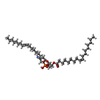 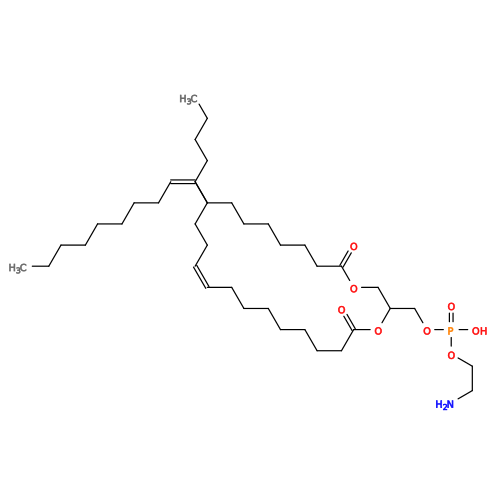 Mass: 744.034 Da / Num. of mol.: 1 / Source method: obtained synthetically / Formula: C41H78NO8P / Feature type: SUBJECT OF INVESTIGATION / Comment: DOPE, phospholipid*YM Mass: 744.034 Da / Num. of mol.: 1 / Source method: obtained synthetically / Formula: C41H78NO8P / Feature type: SUBJECT OF INVESTIGATION / Comment: DOPE, phospholipid*YM |
| Has ligand of interest | Y |
| Has protein modification | Y |
-Experimental details
-Experiment
| Experiment | Method: ELECTRON MICROSCOPY |
|---|---|
| EM experiment | Aggregation state: PARTICLE / 3D reconstruction method: single particle reconstruction |
- Sample preparation
| Component | Name: PE- and KLA-bound MCR-1 complex with Fab fragment / Type: COMPLEX / Entity ID: #1-#3 / Source: RECOMBINANT |
|---|---|
| Molecular weight | Value: 0.137 MDa / Experimental value: NO |
| Source (natural) | Organism: Escherichia coli (E. coli) |
| Source (recombinant) | Organism: Escherichia coli BL21(DE3) (bacteria) |
| Buffer solution | pH: 7.5 |
| Specimen | Embedding applied: NO / Shadowing applied: NO / Staining applied: NO / Vitrification applied: YES |
| Vitrification | Cryogen name: ETHANE |
- Electron microscopy imaging
| Experimental equipment |  Model: Titan Krios / Image courtesy: FEI Company |
|---|---|
| Microscopy | Model: TFS KRIOS |
| Electron gun | Electron source:  FIELD EMISSION GUN / Accelerating voltage: 300 kV / Illumination mode: FLOOD BEAM FIELD EMISSION GUN / Accelerating voltage: 300 kV / Illumination mode: FLOOD BEAM |
| Electron lens | Mode: BRIGHT FIELD / Nominal defocus max: 2500 nm / Nominal defocus min: 1000 nm |
| Image recording | Electron dose: 58.2 e/Å2 / Film or detector model: GATAN K3 BIOQUANTUM (6k x 4k) |
- Processing
| EM software | Name: PHENIX / Version: 1.21.2_5419 / Category: model refinement | ||||||||||||||||||||||||
|---|---|---|---|---|---|---|---|---|---|---|---|---|---|---|---|---|---|---|---|---|---|---|---|---|---|
| CTF correction | Type: PHASE FLIPPING AND AMPLITUDE CORRECTION | ||||||||||||||||||||||||
| 3D reconstruction | Resolution: 3.58 Å / Resolution method: FSC 0.143 CUT-OFF / Num. of particles: 32882 / Symmetry type: POINT | ||||||||||||||||||||||||
| Refinement | Highest resolution: 3.58 Å Stereochemistry target values: REAL-SPACE (WEIGHTED MAP SUM AT ATOM CENTERS) | ||||||||||||||||||||||||
| Refine LS restraints |
|
