 Movie
Movie Controller

[English] 日本語
 Yorodumi
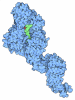
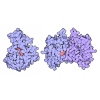
- PDB-9ne5: cryoEM structure of the B-chain of the human OGA-L Catalytic Dimer -
+ Open data

- Basic information
| Entry | Database: PDB / ID: 9ne5 | ||||||||||||||||||||||||||||||
|---|---|---|---|---|---|---|---|---|---|---|---|---|---|---|---|---|---|---|---|---|---|---|---|---|---|---|---|---|---|---|---|
| Title | cryoEM structure of the B-chain of the human OGA-L Catalytic Dimer | ||||||||||||||||||||||||||||||
 Components Components | Protein O-GlcNAcase | ||||||||||||||||||||||||||||||
 Keywords Keywords | HYDROLASE / O-GlcNAC / Histones / DNA repair / DNA Damage / Transcription / Epigenetics | ||||||||||||||||||||||||||||||
| Function / homology |  Function and homology information Function and homology informationglycoprotein metabolic process / hyalurononglucosaminidase activity / protein deglycosylation / N-acetylglucosamine metabolic process / hexosaminidase activity / protein O-GlcNAcase / [protein]-3-O-(N-acetyl-D-glucosaminyl)-L-serine/L-threonine O-N-acetyl-alpha-D-glucosaminase activity / glycoprotein catabolic process / protein O-linked glycosylation / membrane ...glycoprotein metabolic process / hyalurononglucosaminidase activity / protein deglycosylation / N-acetylglucosamine metabolic process / hexosaminidase activity / protein O-GlcNAcase / [protein]-3-O-(N-acetyl-D-glucosaminyl)-L-serine/L-threonine O-N-acetyl-alpha-D-glucosaminase activity / glycoprotein catabolic process / protein O-linked glycosylation / membrane / identical protein binding / nucleus / cytosol / cytoplasm Similarity search - Function | ||||||||||||||||||||||||||||||
| Biological species |  Homo sapiens (human) Homo sapiens (human) | ||||||||||||||||||||||||||||||
| Method | ELECTRON MICROSCOPY / single particle reconstruction / cryo EM / Resolution: 3.05 Å | ||||||||||||||||||||||||||||||
 Authors Authors | Nyenhuis, S.B. / Steenackers, A. / Hinshaw, J.E. / Hanover, J.A. | ||||||||||||||||||||||||||||||
| Funding support |  United States, 1items United States, 1items
| ||||||||||||||||||||||||||||||
 Citation Citation | Journal: Commun Chem / Year: 2025 Title: Human O-GlcNAcase catalytic-stalk dimer anchors flexible histone binding domains. Authors: Sarah B Nyenhuis / Agata Steenackers / Mana Mohan Mukherjee / Jenny E Hinshaw / John A Hanover / Abstract: Although thousands of proteins are specifically O-GlcNAc modified, the molecular features recognized by the enzymes of O-GlcNAc cycling (OGT/OGA) remain poorly defined. Here we solved the structure ...Although thousands of proteins are specifically O-GlcNAc modified, the molecular features recognized by the enzymes of O-GlcNAc cycling (OGT/OGA) remain poorly defined. Here we solved the structure of the long isoform of human OGA (OGA-L) by cryo-electron microscopy (cryo-EM) providing a physiologically relevant platform to study the enzyme. The catalytic-stalk dimer structure was solved to a resolution of 3.63 Å, and the locally refined OGA A- and B-chains to 2.98 Å and 3.05 Å respectively. Intriguingly, the cryo-EM structures also exhibit lower resolution densities associated with the pHAT domains, suggesting substantial flexion of these domains relative to the catalytic-stalk dimer. OGA-L binds to a small subset of the 384 modified histone tails on a commercial histone peptide array. High affinity binding of OGA-L was detected to recombinant DNA-containing mononucleosomes bearing the H3K36 and H4K modifications. The OGA-L-H3K36 interaction was further validated by traditional ChIP experiments in MEFs. Thus, OGA-L binds to two modified histone tails of nucleosomes linked to open chromatin, whereas it does not bind to marks associated with repressive chromatin. This model is consistent with OGA-L acting as a 'reader' of histone modifications linked to development, transcriptional activation, transposon silencing, and DNA damage repair. | ||||||||||||||||||||||||||||||
| History |
|
- Structure visualization
| Structure viewer | Molecule: MolmilJmol/JSmol |
|---|
- Downloads & links
-Download
| PDBx/mmCIF format | 9ne5.cif.gz | 103.2 KB | Display | PDBx/mmCIF format |
|---|---|---|---|---|
| PDB format | pdb9ne5.ent.gz | 73.7 KB | Display | PDB format |
| PDBx/mmJSON format | 9ne5.json.gz | Tree view | PDBx/mmJSON format | |
| Others |  Other downloads Other downloads |
-Validation report
| Arichive directory | https://data.pdbj.org/pub/pdb/validation_reports/ne/9ne5ftp://data.pdbj.org/pub/pdb/validation_reports/ne/9ne5 | HTTPS FTP |
|---|
-Related structure data
| Related structure data |  49295MC  9ne2C  9ne4C C: citing same article ( M: map data used to model this data |
|---|---|
| Similar structure data |


-Links
 PDBj
PDBj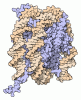
- Assembly
| Deposited unit | 
|
|---|---|
| 1 |
|
-Components
| #1: Protein | Mass: 103020.906 Da / Num. of mol.: 1 Source method: isolated from a genetically manipulated source Source: (gene. exp.) Homo sapiens (human) / Gene: OGA, HEXC, KIAA0679, MEA5, MGEA5 / Production host:   Escherichia coli (E. coli) / References: UniProt: O60502, protein O-GlcNAcase Escherichia coli (E. coli) / References: UniProt: O60502, protein O-GlcNAcase |
|---|---|
| Has protein modification | N |
-Experimental details
-Experiment
| Experiment | Method: ELECTRON MICROSCOPY |
|---|---|
| EM experiment | Aggregation state: PARTICLE / 3D reconstruction method: single particle reconstruction |
- Sample preparation
| Component | Name: B-chain of the human OGA-L Catalytic Dimer / Type: COMPLEX / Entity ID: all / Source: RECOMBINANT |
|---|---|
| Source (natural) | Organism: Homo sapiens (human) |
| Source (recombinant) | Organism: Escherichia coli (E. coli) |
| Buffer solution | pH: 7.4 |
| Specimen | Embedding applied: NO / Shadowing applied: NO / Staining applied: NO / Vitrification applied: YES |
| Vitrification | Cryogen name: ETHANE |
- Electron microscopy imaging
| Experimental equipment |  Model: Titan Krios / Image courtesy: FEI Company |
|---|---|
| Microscopy | Model: TFS KRIOS |
| Electron gun | Electron source:  FIELD EMISSION GUN / Accelerating voltage: 300 kV / Illumination mode: FLOOD BEAM FIELD EMISSION GUN / Accelerating voltage: 300 kV / Illumination mode: FLOOD BEAM |
| Electron lens | Mode: BRIGHT FIELD / Nominal defocus max: 2400 nm / Nominal defocus min: 300 nm |
| Image recording | Electron dose: 67 e/Å2 / Film or detector model: GATAN K3 BIOQUANTUM (6k x 4k) |
- Processing
| EM software | Name: PHENIX / Version: 1.20.1_4487: / Category: model refinement |
|---|---|
| CTF correction | Type: PHASE FLIPPING AND AMPLITUDE CORRECTION |
| 3D reconstruction | Resolution: 3.05 Å / Resolution method: FSC 0.143 CUT-OFF / Num. of particles: 65831 / Symmetry type: POINT |
| Atomic model building | Protocol: FLEXIBLE FIT / Space: REAL |
