Journal: Nature / Year: 2026 Title: De novo design of quasisymmetric two-component protein cages. Authors: Shunzhi Wang / Ying Xie / David Chmielewski / Connor Weidle / Tong Shu / Green Ahn / Ryan D Kibler / Cindy Hernandez / Wei Chen / David Camilo Duran / Ann Carr / Asim K Bera / Sangmin Lee / ...Authors: Shunzhi Wang / Ying Xie / David Chmielewski / Connor Weidle / Tong Shu / Green Ahn / Ryan D Kibler / Cindy Hernandez / Wei Chen / David Camilo Duran / Ann Carr / Asim K Bera / Sangmin Lee / Justin Decarreau / Alex Kang / Evans Brackenbrough / Emily Joyce / Kejia Wu / Andrew J Borst / Andrew Favor / Buwei Huang / Frank DiMaio / Liam J Holt / David Baker / Abstract: Quasisymmetric icosahedral viral capsids achieve larger sizes than possible with strictly symmetric icosahedra by tessellating pentagons and hexagons using a single subunit that adopts different ...Quasisymmetric icosahedral viral capsids achieve larger sizes than possible with strictly symmetric icosahedra by tessellating pentagons and hexagons using a single subunit that adopts different conformations in symmetrically non-equivalent locations. Recapitulating such quasisymmetric architectures through computational design is a considerable challenge in nanomaterials engineering. Here we introduce a computational design strategy based on geometric frustration to generate two-component, quasisymmetric protein cages with customizable properties. We designed complementary trimeric and dimeric protein components that co-assemble into positively curved local hexagonal assemblies. Hexagonal lattices cannot tile spherical surfaces; instead, the components form closed sphere-like cage assemblies through incorporation of curvature-inducing pentagonal defects, as evidenced by electron microscopy. By designing dimers that encode different local curvatures, we programmed cage dimensions ranging from 40 to over 200 nm in diameter and with molecular weights from 2 MDa to over 50 MDa, comparable with natural virus capsids. We further functionalized these large cages with additional protein domains to enable ribonucleoprotein cargo loading and cellular uptake. Fluorescently labelled cage assemblies expressed in mammalian cells function as rheological probes and cargo recruiters, enabling a systematic study of size-dependent cytoplasmic diffusion and protein localization. Thus, the quasi-symmetry that has long fascinated structural biologists can now be achieved by computational protein design, with immediate applications to biologics delivery and molecular cell biology.
Mass: 11520.281 Da / Num. of mol.: 3 Source method: isolated from a genetically manipulated source Source: (gene. exp.) synthetic construct (others) / Production host: Escherichia coli (E. coli)
In the structure databanks used in Yorodumi, some data are registered as the other names, "COVID-19 virus" and "2019-nCoV". Here are the details of the virus and the list of structure data.
Jan 31, 2019. EMDB accession codes are about to change! (news from PDBe EMDB page)
EMDB accession codes are about to change! (news from PDBe EMDB page)
The allocation of 4 digits for EMDB accession codes will soon come to an end. Whilst these codes will remain in use, new EMDB accession codes will include an additional digit and will expand incrementally as the available range of codes is exhausted. The current 4-digit format prefixed with “EMD-” (i.e. EMD-XXXX) will advance to a 5-digit format (i.e. EMD-XXXXX), and so on. It is currently estimated that the 4-digit codes will be depleted around Spring 2019, at which point the 5-digit format will come into force.
The EM Navigator/Yorodumi systems omit the EMD- prefix.
Related info.:Q: What is EMD? / ID/Accession-code notation in Yorodumi/EM Navigator
Yorodumi is a browser for structure data from EMDB, PDB, SASBDB, etc.
This page is also the successor to EM Navigator detail page, and also detail information page/front-end page for Omokage search.
The word "yorodu" (or yorozu) is an old Japanese word meaning "ten thousand". "mi" (miru) is to see.
Related info.:EMDB / PDB / SASBDB / Comparison of 3 databanks / Yorodumi Search / Aug 31, 2016. New EM Navigator & Yorodumi / Yorodumi Papers / Jmol/JSmol / Function and homology information / Changes in new EM Navigator and Yorodumi
 Movie
Movie Controller


 Open data
 Basic information
 Components
 Keywords
 X-RAY DIFFRACTION /
  Authors
 United States, 1items
  Citation
 Structure visualization
 Molmil
 Downloads & links
 Other downloads


 PDBj
PDBj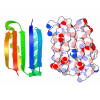
 Assembly


 Escherichia coli (E. coli)
 Mass: 18.015 Da / Num. of mol.: 36 / Source method: isolated from a natural source / Formula: H2O
 Sample preparation
 Processing