 Movie
Movie Controller


+ Open data

- Basic information
| Entry | Database: PDB / ID: 9nbg | |||||||||||||||||||||
|---|---|---|---|---|---|---|---|---|---|---|---|---|---|---|---|---|---|---|---|---|---|---|
| Title | H-1 Parvovirus VLP - Glycan [s(Lex)2] | |||||||||||||||||||||
 Components Components | Major capsid protein | |||||||||||||||||||||
 Keywords Keywords | VIRUS LIKE PARTICLE / Icosahedron / Virus / Glycan / Complex / Receptor | |||||||||||||||||||||
| Function / homology |  Function and homology information Function and homology informationsymbiont entry into host cell via permeabilization of host membrane / T=1 icosahedral viral capsid / clathrin-dependent endocytosis of virus by host cell / virion attachment to host cell / structural molecule activity Similarity search - Function | |||||||||||||||||||||
| Biological species |  H-1 parvovirus H-1 parvovirus | |||||||||||||||||||||
| Method | ELECTRON MICROSCOPY / single particle reconstruction / cryo EM / Resolution: 2.57 Å | |||||||||||||||||||||
 Authors Authors | Busuttil, K.B. / Bennett, A.B. / McKenna, R. | |||||||||||||||||||||
| Funding support |  United States, 1items United States, 1items
| |||||||||||||||||||||
 Citation Citation | Journal: J Virol / Year: 2025 Title: Mapping the sialic acid-binding sites of LuIII and H-1 parvovirus. Authors: Kevin Busuttil / Nikéa Pittman / Jon Zachary / Sujata Halder / Lorena Geilen / Amriti Singh / Adam Misseldine / Paulina Kaplonek / Paul Chipman / Jaime Heimburg-Molinaro / Peter H Seeberger ...Authors: Kevin Busuttil / Nikéa Pittman / Jon Zachary / Sujata Halder / Lorena Geilen / Amriti Singh / Adam Misseldine / Paulina Kaplonek / Paul Chipman / Jaime Heimburg-Molinaro / Peter H Seeberger / Mario Mietzsch / Antonette D Bennett / Robert McKenna /  Abstract: Oncolytic protoparvoviruses, including LuIII, H-1 parvovirus (H-1PV), and the prototypic strain of minute virus of mice (MVMp), can target and destroy cancer cells. Host cell targeting is based ...Oncolytic protoparvoviruses, including LuIII, H-1 parvovirus (H-1PV), and the prototypic strain of minute virus of mice (MVMp), can target and destroy cancer cells. Host cell targeting is based largely on the identification and interaction of the virus with the primary receptor. Previously, it has been shown that MVMp and H-1PV bind to sialic acid (SIA), which is the primary glycan receptor. This study investigates whether LuIII also utilizes a similar glycan for host cell attachment. Microarray analysis confirmed that α2-3-linked SIA is a shared receptor requirement for cell binding for all three viruses. Three glycans were identified in the array, namely, Neu5Acα2-3Galβ1-4GlcNAcβ1-3Galβ1-4GlcNAc, Neu5Acα2-3Galβ1-4GlcNAcβ1-3Galβ1-4GlcNAcβ1-3Galβ1-4GlcNAc, and Neu5Acα2-3Galβ1-4(Fucα1-3)-GlcNAcβ1-3-Galβ1-4(Fucα1-3)-GlcNAc. The cryo-EM structures of the LuIII and H-1PV glycan complexes were determined to resolutions ranging from 2.57 to 2.88 Å. Small structural perturbations were observed between the cryo-EM map and the previous X-ray crystallographic maps for H-1PV, including several histidine residues within the HI loop. Overall, LuIII and H-1PV utilize a shared SIA recognition pocket near the icosahedral twofold axis adjacent to (but not overlapping with) the known MVMp SIA binding site. In addition, structural differences between the major capsid protein (VP2) of LuIII, H-1PV, and MVMp all clustered around these glycan-binding pockets. This structural phenotype may contribute to the differences observed in tumor cell killing efficiency among the rodent protoparvoviruses. IMPORTANCE: Oncolytic viruses could provide a safe alternative for targeting aggressive tumors that evade standard therapies. While rodent protoparvoviruses are innocuous in non-cancerous cells, they ...IMPORTANCE: Oncolytic viruses could provide a safe alternative for targeting aggressive tumors that evade standard therapies. While rodent protoparvoviruses are innocuous in non-cancerous cells, they carry out efficient cell killing in tumors. Differences in cell tropism and killing efficiency are determined by the viral capsid proteins; thus, structural studies provide insight into understanding the protoparvovirus infection in both wild-type and cancerous cells. Binding to extracellular sialic acid (SIA) initiates cell entry for protoparvoviruses H-1PV, MVMp, and this is also hypothesized for LuIII. This study investigates the structures of LuIII and H-1PV in the presence of their glycan receptors to identify and map the capsid loci that are responsible for this interaction. This knowledge may aid future capsid engineering to improve oncolytic targeting efficiency. | |||||||||||||||||||||
| History |
|
- Structure visualization
| Structure viewer | Molecule: MolmilJmol/JSmol |
|---|
- Downloads & links
-Download
| PDBx/mmCIF format | 9nbg.cif.gz | 6.1 MB | Display | PDBx/mmCIF format |
|---|---|---|---|---|
| PDB format | pdb9nbg.ent.gz | Display | PDB format | |
| PDBx/mmJSON format | 9nbg.json.gz | Tree view | PDBx/mmJSON format | |
| Others |  Other downloads Other downloads |
-Validation report
| Arichive directory | https://data.pdbj.org/pub/pdb/validation_reports/nb/9nbgftp://data.pdbj.org/pub/pdb/validation_reports/nb/9nbg | HTTPS FTP |
|---|
-Related structure data
| Related structure data |  49228MC M: map data used to model this data C: citing same article ( |
|---|---|
| Similar structure data |
-Links
 PDBj
PDBj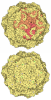
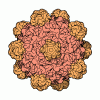
- Assembly
| Deposited unit | 
|
|---|---|
| 1 |
|
-Components
| #1: Protein | Mass: 62413.285 Da / Num. of mol.: 60 Source method: isolated from a genetically manipulated source Source: (gene. exp.) H-1 parvovirus / Production host: Baculoviridae sp. (virus) / References: UniProt: J9RQD1#2: Polysaccharide | N-acetyl-alpha-neuraminic acid-(2-3)-alpha-D-galactopyranose-(1-4)-2-acetamido-2-deoxy-beta-D-glucopyranose 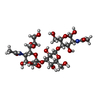  Type: oligosaccharide, Oligosaccharide / Class: Substrate analog / Mass: 674.604 Da / Num. of mol.: 60 Type: oligosaccharide, Oligosaccharide / Class: Substrate analog / Mass: 674.604 Da / Num. of mol.: 60Source method: isolated from a genetically manipulated source Details: oligosaccharide / References: 3'-sialyl-N-acetyllactosamine Has ligand of interest | Y | Has protein modification | N | |
|---|
-Experimental details
-Experiment
| Experiment | Method: ELECTRON MICROSCOPY |
|---|---|
| EM experiment | Aggregation state: PARTICLE / 3D reconstruction method: single particle reconstruction |
- Sample preparation
| Component | Name: H-1 parvovirus / Type: VIRUS / Entity ID: #1 / Source: RECOMBINANT |
|---|---|
| Source (natural) | Organism: H-1 parvovirus |
| Source (recombinant) | Organism: Baculoviridae sp. (virus) |
| Details of virus | Empty: YES / Enveloped: NO / Isolate: SEROTYPE / Type: VIRUS-LIKE PARTICLE |
| Buffer solution | pH: 7.4 |
| Specimen | Embedding applied: NO / Shadowing applied: NO / Staining applied: NO / Vitrification applied: YES |
| Vitrification | Cryogen name: ETHANE |
- Electron microscopy imaging
| Experimental equipment |  Model: Titan Krios / Image courtesy: FEI Company |
|---|---|
| Microscopy | Model: TFS KRIOS |
| Electron gun | Electron source:  FIELD EMISSION GUN / Accelerating voltage: 300 kV / Illumination mode: FLOOD BEAM FIELD EMISSION GUN / Accelerating voltage: 300 kV / Illumination mode: FLOOD BEAM |
| Electron lens | Mode: BRIGHT FIELD / Nominal defocus max: 2200 nm / Nominal defocus min: 1120 nm |
| Image recording | Electron dose: 75 e/Å2 / Film or detector model: GATAN K2 SUMMIT (4k x 4k) |
- Processing
| EM software |
| ||||||||||||||||||||
|---|---|---|---|---|---|---|---|---|---|---|---|---|---|---|---|---|---|---|---|---|---|
| CTF correction | Type: PHASE FLIPPING AND AMPLITUDE CORRECTION | ||||||||||||||||||||
| 3D reconstruction | Resolution: 2.57 Å / Resolution method: FSC 0.143 CUT-OFF / Num. of particles: 30120 / Symmetry type: POINT |
