 Movie
Movie Controller


+ Open data

- Basic information
| Entry | Database: PDB / ID: 9n2q | ||||||
|---|---|---|---|---|---|---|---|
| Title | Structure of GDP-bound GM4951 | ||||||
 Components Components | Interferon inducible GTPase 1C | ||||||
 Keywords Keywords | LIPID BINDING PROTEIN / Lipid droplet associated protein / GTPase | ||||||
| Function / homology |  Function and homology information Function and homology informationautophagosome assembly / cellular response to interferon-beta / innate immune response / GTPase activity / GTP binding / endoplasmic reticulum membrane Similarity search - Function | ||||||
| Biological species |   Mus musculus (house mouse) Mus musculus (house mouse) | ||||||
| Method |  X-RAY DIFFRACTION / SYNCHROTRON / MOLECULAR REPLACEMENT / Resolution: 2.51 Å X-RAY DIFFRACTION / SYNCHROTRON / MOLECULAR REPLACEMENT / Resolution: 2.51 Å | ||||||
 Authors Authors | Raj, R. / Beutler, B. | ||||||
| Funding support |  United States, 1items United States, 1items
| ||||||
 Citation Citation | Journal: Nat Commun / Year: 2025 Title: Structural insights into GM4951 as a lipid droplet GTPase regulating hepatic lipid metabolism. Authors: Rishi Raj / Yiao Jiang / Rahul Kumar Jha / Eva Marie Y Moresco / Himanshu Joshi / Zhao Zhang / Bruce Beutler /  Abstract: GM4951 is an immunity-related GTPase (IRG) that counteracts hepatic lipid accumulation in mice fed a high-fat diet. We determine full-length protein structures of GTPγS- and GDP-bound GM4951, and ...GM4951 is an immunity-related GTPase (IRG) that counteracts hepatic lipid accumulation in mice fed a high-fat diet. We determine full-length protein structures of GTPγS- and GDP-bound GM4951, and two missense mutants (N86K or D125G) associated with metabolic dysfunction-associated steatotic liver disease (MASLD) in mice. All four structures reveal a conserved GTPase domain fold and a helix bundle composed of the N- and C-terminal regions. Each mutation alters the dynamics of the switch-I and switch-II loops important for catalytic function and lipid droplet (LD) localization. GM4951 predominantly forms dimers in vitro. Cryo-electron microscopy reveals a dimer interface formed by the helical domains of two protomers (tail to tail), distinct from other IRGs. The N-terminal helices are necessary for LD localization, while a disulfide bond between helices in the GTPase domain and C-terminus is necessary for interaction with MASLD-associated HSD17B13. Distinct N- and C-terminal conformations set GM4951 apart from other IRGs structurally and functionally. | ||||||
| History |
|
- Structure visualization
| Structure viewer | Molecule: MolmilJmol/JSmol |
|---|
- Downloads & links
-Download
| PDBx/mmCIF format | 9n2q.cif.gz | 480.7 KB | Display | PDBx/mmCIF format |
|---|---|---|---|---|
| PDB format | pdb9n2q.ent.gz | 392.3 KB | Display | PDB format |
| PDBx/mmJSON format | 9n2q.json.gz | Tree view | PDBx/mmJSON format | |
| Others |  Other downloads Other downloads |
-Validation report
| Arichive directory | https://data.pdbj.org/pub/pdb/validation_reports/n2/9n2qftp://data.pdbj.org/pub/pdb/validation_reports/n2/9n2q | HTTPS FTP |
|---|
-Related structure data


-Links
 PDBj
PDBj- Assembly
| Deposited unit | 
| ||||||||
|---|---|---|---|---|---|---|---|---|---|
| 1 | 
| ||||||||
| 2 | 
| ||||||||
| 3 | 
| ||||||||
| Unit cell |
|
-Components
| #1: Protein | Mass: 48562.184 Da / Num. of mol.: 6 Source method: isolated from a genetically manipulated source Source: (gene. exp.) Mus musculus (house mouse) / Gene: Iigp1c, EG240327, Gm4951, Ifgga2 / Production host:   Escherichia coli (E. coli) / References: UniProt: Q3UED7 Escherichia coli (E. coli) / References: UniProt: Q3UED7#2: Chemical | ChemComp-GDP / 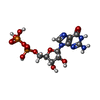 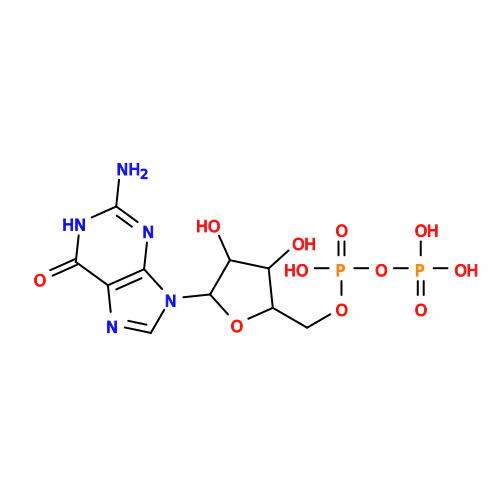 Type: RNA linking / Mass: 443.201 Da / Num. of mol.: 6 / Source method: obtained synthetically / Formula: C10H15N5O11P2 / Feature type: SUBJECT OF INVESTIGATION / Comment: GDP, energy-carrying molecule*YM Type: RNA linking / Mass: 443.201 Da / Num. of mol.: 6 / Source method: obtained synthetically / Formula: C10H15N5O11P2 / Feature type: SUBJECT OF INVESTIGATION / Comment: GDP, energy-carrying molecule*YM#3: Chemical | ChemComp-GOL /  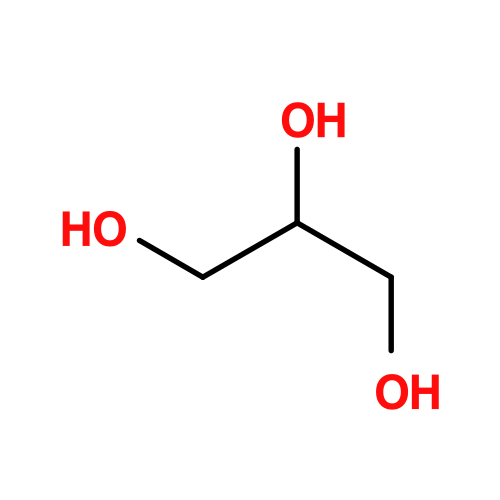 Mass: 92.094 Da / Num. of mol.: 7 / Source method: obtained synthetically / Formula: C3H8O3 Mass: 92.094 Da / Num. of mol.: 7 / Source method: obtained synthetically / Formula: C3H8O3#4: Water | ChemComp-HOH / |  Mass: 18.015 Da / Num. of mol.: 30 / Source method: isolated from a natural source / Formula: H2O Mass: 18.015 Da / Num. of mol.: 30 / Source method: isolated from a natural source / Formula: H2OHas ligand of interest | Y | Has protein modification | Y | |
|---|
-Experimental details
-Experiment
| Experiment | Method: X-RAY DIFFRACTION / Number of used crystals: 1 |
|---|
- Sample preparation
| Crystal | Density Matthews: 3.11 Å3/Da / Density % sol: 60.42 % |
|---|---|
| Crystal grow | Temperature: 291 K / Method: vapor diffusion, sitting drop / Details: 36% tacsimate pH 7.0 |
-Data collection
| Diffraction | Mean temperature: 100 K / Serial crystal experiment: N |
|---|---|
| Diffraction source | Source: SYNCHROTRON / Site: APS / Beamline: 19-ID / Wavelength: 0.97918 Å |
| Detector | Type: DECTRIS PILATUS 6M / Detector: PIXEL / Date: Jul 20, 2022 |
| Radiation | Protocol: SINGLE WAVELENGTH / Monochromatic (M) / Laue (L): M / Scattering type: x-ray |
| Radiation wavelength | Wavelength: 0.97918 Å / Relative weight: 1 |
| Reflection | Resolution: 2.508→49.72 Å / Num. obs: 108885 / % possible obs: 91.1 % / Redundancy: 2.5 % / CC1/2: 0.754 / Net I/σ(I): 8.7 |
| Reflection shell | Resolution: 2.508→2.54 Å / Num. unique obs: 4137 / CC1/2: 0.494 |
- Processing
| Software |
| ||||||||||||||||||||||||||||||||||||||||||||||||||||||||||||||||||||||||||||||||||||||||||||||||||||||||||||||||||||||||||||||||||||||||||||||||||||||||||||||||||||||||||||||||||||||
|---|---|---|---|---|---|---|---|---|---|---|---|---|---|---|---|---|---|---|---|---|---|---|---|---|---|---|---|---|---|---|---|---|---|---|---|---|---|---|---|---|---|---|---|---|---|---|---|---|---|---|---|---|---|---|---|---|---|---|---|---|---|---|---|---|---|---|---|---|---|---|---|---|---|---|---|---|---|---|---|---|---|---|---|---|---|---|---|---|---|---|---|---|---|---|---|---|---|---|---|---|---|---|---|---|---|---|---|---|---|---|---|---|---|---|---|---|---|---|---|---|---|---|---|---|---|---|---|---|---|---|---|---|---|---|---|---|---|---|---|---|---|---|---|---|---|---|---|---|---|---|---|---|---|---|---|---|---|---|---|---|---|---|---|---|---|---|---|---|---|---|---|---|---|---|---|---|---|---|---|---|---|---|---|
| Refinement | Method to determine structure: MOLECULAR REPLACEMENT / Resolution: 2.51→49.72 Å / Cor.coef. Fo:Fc: 0.947 / Cor.coef. Fo:Fc free: 0.926 / SU B: 19.943 / SU ML: 0.368 / Cross valid method: THROUGHOUT / ESU R: 0.52 / ESU R Free: 0.312 / Stereochemistry target values: MAXIMUM LIKELIHOOD / Details: HYDROGENS HAVE BEEN ADDED IN THE RIDING POSITIONS
| ||||||||||||||||||||||||||||||||||||||||||||||||||||||||||||||||||||||||||||||||||||||||||||||||||||||||||||||||||||||||||||||||||||||||||||||||||||||||||||||||||||||||||||||||||||||
| Solvent computation | Ion probe radii: 0.8 Å / Shrinkage radii: 0.8 Å / VDW probe radii: 1.2 Å / Solvent model: MASK | ||||||||||||||||||||||||||||||||||||||||||||||||||||||||||||||||||||||||||||||||||||||||||||||||||||||||||||||||||||||||||||||||||||||||||||||||||||||||||||||||||||||||||||||||||||||
| Displacement parameters | Biso mean: 74.994 Å2
| ||||||||||||||||||||||||||||||||||||||||||||||||||||||||||||||||||||||||||||||||||||||||||||||||||||||||||||||||||||||||||||||||||||||||||||||||||||||||||||||||||||||||||||||||||||||
| Refinement step | Cycle: 1 / Resolution: 2.51→49.72 Å
| ||||||||||||||||||||||||||||||||||||||||||||||||||||||||||||||||||||||||||||||||||||||||||||||||||||||||||||||||||||||||||||||||||||||||||||||||||||||||||||||||||||||||||||||||||||||
| Refine LS restraints |
|