 Movie
Movie Controller

[English] 日本語
 Yorodumi
- PDB-9n1k: Cryo-EM structure of rabbit TRPM3 in apo activated state at 37 de... -
+ Open data

- Basic information
| Entry | Database: PDB / ID: 9n1k | |||||||||||||||||||||
|---|---|---|---|---|---|---|---|---|---|---|---|---|---|---|---|---|---|---|---|---|---|---|
| Title | Cryo-EM structure of rabbit TRPM3 in apo activated state at 37 degrees Celsius | |||||||||||||||||||||
 Components Components | rTRPM3 | |||||||||||||||||||||
 Keywords Keywords | MEMBRANE PROTEIN / TRPM3 / ion channel | |||||||||||||||||||||
| Function / homology | CHOLESTEROL HEMISUCCINATE Function and homology information Function and homology information | |||||||||||||||||||||
| Biological species |   Oryctolagus cuniculus (rabbit) Oryctolagus cuniculus (rabbit) | |||||||||||||||||||||
| Method | ELECTRON MICROSCOPY / single particle reconstruction / cryo EM / Resolution: 3.68 Å | |||||||||||||||||||||
 Authors Authors | Kumar, S. / Lu, W. / Du, J. | |||||||||||||||||||||
| Funding support |  United States, 2items United States, 2items
| |||||||||||||||||||||
 Citation Citation | Journal: Nat Struct Mol Biol / Year: 2026 Title: Structural basis for agonist and heat activation of nociceptor TRPM3. Authors: Sushant Kumar / Fei Jin / Sung Jin Park / Wooyoung Choi / Sarah I Keuning / Richard P Massimino / Simon Vu / Wei Lü / Juan Du /  Abstract: Detecting noxious heat is vital for survival, triggering protective pain responses. The TRPM3 channel is a key nociceptor and a promising therapeutic target for pain and neurological disorders. Here ...Detecting noxious heat is vital for survival, triggering protective pain responses. The TRPM3 channel is a key nociceptor and a promising therapeutic target for pain and neurological disorders. Here we show that the rabbit TRPM3 is intrinsically dynamic, with its intracellular domain (ICD) sampling both resting and activated states, but favoring the resting state in the absence of stimulation. We reveal that heat and the synthetic agonist CIM0216 shift the equilibrium toward activation by inducing a similar ICD rearrangement. Mutations that facilitate ICD movement enhance sensitivity to both thermal and chemical stimuli, underscoring the central role of the ICD in channel gating. We also show that the antagonist primidone binds the same site as CIM0216 in the S1-S4 domain but inhibits channel activation. This study provides a structural framework for a mechanistic understanding of thermal and chemical gating of TRPM3 and for guiding the rational design of TRPM3-targeted analgesics and neurotherapeutics. | |||||||||||||||||||||
| History |
|
- Structure visualization
| Structure viewer | Molecule: MolmilJmol/JSmol |
|---|
- Downloads & links
-Download
| PDBx/mmCIF format | 9n1k.cif.gz | 742.7 KB | Display | PDBx/mmCIF format |
|---|---|---|---|---|
| PDB format | pdb9n1k.ent.gz | 598.9 KB | Display | PDB format |
| PDBx/mmJSON format | 9n1k.json.gz | Tree view | PDBx/mmJSON format | |
| Others |  Other downloads Other downloads |
-Validation report
| Arichive directory | https://data.pdbj.org/pub/pdb/validation_reports/n1/9n1kftp://data.pdbj.org/pub/pdb/validation_reports/n1/9n1k | HTTPS FTP |
|---|
-Related structure data
| Related structure data |  48815MC  9n1gC  9n1hC  9n1iC  9n1jC  9n1lC  9n1mC  9n1nC  9n4jC  9o7wC  9o7xC  9o7yC  9o7zC  9o80C  9o81C  9o82C  9o83C  9o86C  9o87C  9o88C  9o89C  9o8cC  9o8dC  9o8fC  9o8gC M: map data used to model this data C: citing same article ( |
|---|---|
| Similar structure data |


-Links
 PDBj
PDBj- Assembly
| Deposited unit | 
|
|---|---|
| 1 |
|
-Components
| #1: Protein | Mass: 150840.328 Da / Num. of mol.: 4 Source method: isolated from a genetically manipulated source Source: (gene. exp.) Oryctolagus cuniculus (rabbit) / Cell line (production host): HEK293 / Production host:  Homo sapiens (human) Homo sapiens (human)#2: Chemical | ChemComp-Y01 / 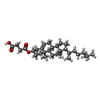 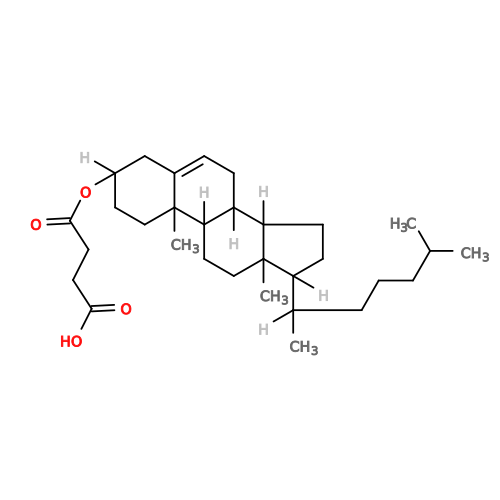 Mass: 486.726 Da / Num. of mol.: 24 / Source method: obtained synthetically / Formula: C31H50O4 Mass: 486.726 Da / Num. of mol.: 24 / Source method: obtained synthetically / Formula: C31H50O4Has ligand of interest | N | Has protein modification | Y | |
|---|
-Experimental details
-Experiment
| Experiment | Method: ELECTRON MICROSCOPY |
|---|---|
| EM experiment | Aggregation state: PARTICLE / 3D reconstruction method: single particle reconstruction |
- Sample preparation
| Component | Name: tetramer of TRPM3 / Type: ORGANELLE OR CELLULAR COMPONENT / Entity ID: #1 / Source: RECOMBINANT |
|---|---|
| Source (natural) | Organism: Oryctolagus cuniculus (rabbit) |
| Source (recombinant) | Organism: Homo sapiens (human) |
| Buffer solution | pH: 7.5 Details: 20 mM Hepes pH 7.5, 150 mM NaCl, 0.001 % LMNG/CHS, 10 mM beta-mercaptoethanol, 5 mM EDTA |
| Specimen | Conc.: 8 mg/ml / Embedding applied: NO / Shadowing applied: NO / Staining applied: NO / Vitrification applied: YES |
| Specimen support | Grid material: GOLD / Grid mesh size: 300 divisions/in. / Grid type: Quantifoil R2/1 |
| Vitrification | Instrument: FEI VITROBOT MARK III / Cryogen name: ETHANE / Humidity: 100 % / Chamber temperature: 310.15 K |
- Electron microscopy imaging
| Experimental equipment |  Model: Titan Krios / Image courtesy: FEI Company |
|---|---|
| Microscopy | Model: TFS KRIOS |
| Electron gun | Electron source:  FIELD EMISSION GUN / Accelerating voltage: 300 kV / Illumination mode: FLOOD BEAM FIELD EMISSION GUN / Accelerating voltage: 300 kV / Illumination mode: FLOOD BEAM |
| Electron lens | Mode: BRIGHT FIELD / Nominal defocus max: 1400 nm / Nominal defocus min: 1100 nm |
| Image recording | Electron dose: 58 e/Å2 / Film or detector model: GATAN K3 (6k x 4k) |
- Processing
| EM software | Name: PHENIX / Version: 1.21.2_5419 / Category: model refinement | ||||||||||||||||||||||||
|---|---|---|---|---|---|---|---|---|---|---|---|---|---|---|---|---|---|---|---|---|---|---|---|---|---|
| CTF correction | Type: PHASE FLIPPING AND AMPLITUDE CORRECTION | ||||||||||||||||||||||||
| 3D reconstruction | Resolution: 3.68 Å / Resolution method: FSC 0.143 CUT-OFF / Num. of particles: 40005 / Symmetry type: POINT | ||||||||||||||||||||||||
| Refinement | Highest resolution: 3.68 Å Stereochemistry target values: REAL-SPACE (WEIGHTED MAP SUM AT ATOM CENTERS) | ||||||||||||||||||||||||
| Refine LS restraints |
|
