Journal: Nat Chem Biol / Year: 2026 Title: De novo design of potent CRISPR-Cas13 inhibitors. Authors: Cyntia Taveneau / Her Xiang Chai / Jovita D'Silva / Rebecca S Bamert / Honglin Chen / Brooke K Hayes / Roland W Calvert / Jacob Purcell / Daniel J Curwen / Fabian Munder / Lisandra L Martin ...Authors: Cyntia Taveneau / Her Xiang Chai / Jovita D'Silva / Rebecca S Bamert / Honglin Chen / Brooke K Hayes / Roland W Calvert / Jacob Purcell / Daniel J Curwen / Fabian Munder / Lisandra L Martin / Jeremy J Barr / Joseph Rosenbluh / Mohamed Fareh / Rhys Grinter / Gavin J Knott / Abstract: CRISPR-Cas systems are transformative tools for gene editing that can be tuned or controlled by anti-CRISPRs (Acrs)-phage-derived inhibitors that regulate CRISPR-Cas activity. However, Acrs that can ...CRISPR-Cas systems are transformative tools for gene editing that can be tuned or controlled by anti-CRISPRs (Acrs)-phage-derived inhibitors that regulate CRISPR-Cas activity. However, Acrs that can inhibit biotechnologically relevant CRISPR systems are relatively rare and challenging to discover. To overcome this limitation, we describe a highly successful and rapid approach that leverages de novo protein design to develop new-to-nature proteins for controlling CRISPR-Cas activity. Here, using Leptotrichia buccalis CRISPR-Cas13a as a representative example, we demonstrate that Acrs designed using artificial intelligence (AIcrs) are capable of highly potent and specific inhibition of CRISPR-Cas13a nuclease activity. We present a comprehensive workflow for design validation and demonstrate AIcr functionality in controlling CRISPR-Cas13 activity in bacterial and human cells. The ability to design bespoke inhibitors of Cas effectors will contribute to the ongoing development of CRISPR-Cas tools in diverse applications across research, medicine, agriculture and microbiology.
Mass: 9698.852 Da / Num. of mol.: 2 Source method: isolated from a genetically manipulated source Source: (gene. exp.) synthetic construct (others) / Production host: Escherichia coli (E. coli)
In the structure databanks used in Yorodumi, some data are registered as the other names, "COVID-19 virus" and "2019-nCoV". Here are the details of the virus and the list of structure data.
Jan 31, 2019. EMDB accession codes are about to change! (news from PDBe EMDB page)
EMDB accession codes are about to change! (news from PDBe EMDB page)
The allocation of 4 digits for EMDB accession codes will soon come to an end. Whilst these codes will remain in use, new EMDB accession codes will include an additional digit and will expand incrementally as the available range of codes is exhausted. The current 4-digit format prefixed with “EMD-” (i.e. EMD-XXXX) will advance to a 5-digit format (i.e. EMD-XXXXX), and so on. It is currently estimated that the 4-digit codes will be depleted around Spring 2019, at which point the 5-digit format will come into force.
The EM Navigator/Yorodumi systems omit the EMD- prefix.
Related info.:Q: What is EMD? / ID/Accession-code notation in Yorodumi/EM Navigator
Yorodumi is a browser for structure data from EMDB, PDB, SASBDB, etc.
This page is also the successor to EM Navigator detail page, and also detail information page/front-end page for Omokage search.
The word "yorodu" (or yorozu) is an old Japanese word meaning "ten thousand". "mi" (miru) is to see.
Related info.:EMDB / PDB / SASBDB / Comparison of 3 databanks / Yorodumi Search / Aug 31, 2016. New EM Navigator & Yorodumi / Yorodumi Papers / Jmol/JSmol / Function and homology information / Changes in new EM Navigator and Yorodumi
 Movie
Movie Controller


 Open data
 Basic information
 Components
 Keywords
 X-RAY DIFFRACTION /
  Authors
 Australia, 1items
  Citation
 Structure visualization
 Molmil
 Downloads & links
 Other downloads

 PDBj
PDBj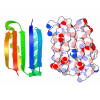
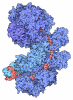
 Assembly


 Escherichia coli (E. coli)
 Mass: 35.453 Da / Num. of mol.: 1 / Source method: obtained synthetically / Formula: Cl / Feature type: SUBJECT OF INVESTIGATION
 Mass: 18.015 Da / Num. of mol.: 82 / Source method: isolated from a natural source / Formula: H2O
 Sample preparation
 Processing