Journal: Nat Cell Biol / Year: 2026 Title: SLC33A1 exports oxidized glutathione to maintain endoplasmic reticulum redox homeostasis. Authors: Shanshan Liu / Mark Gad / Caifan Li / Kevin Cho / Yuyang Liu / Khando Wangdu / Viktor Belay / Alon Millet / Hiroyuki Kojima / Henry Sanford / Michele Wölk / Linas Urnavicius / Maria ...Authors: Shanshan Liu / Mark Gad / Caifan Li / Kevin Cho / Yuyang Liu / Khando Wangdu / Viktor Belay / Alon Millet / Hiroyuki Kojima / Henry Sanford / Michele Wölk / Linas Urnavicius / Maria Fedorova / Gary J Patti / Ekaterina V Vinogradova / Richard K Hite / Kıvanç Birsoy / Abstract: The endoplasmic reticulum (ER) requires an oxidative environment to support the efficient maturation of secretory and membrane proteins. This is in part established by glutathione, a redox-active ...The endoplasmic reticulum (ER) requires an oxidative environment to support the efficient maturation of secretory and membrane proteins. This is in part established by glutathione, a redox-active metabolite present in reduced (GSH) and oxidized (GSSG) forms. The ER maintains a higher GSSG:GSH ratio than the cytosol; however, the mechanisms controlling ER redox balance remain poorly understood. To address this, we developed a method for the rapid immunopurification of the ER, enabling comprehensive profiling of its proteome and metabolome. Combining this approach with CRISPR screening, we identified SLC33A1 as the major ER GSSG exporter in mammalian cells. Loss of SLC33A1 led to GSSG accumulation in the ER and a liposome-based assay demonstrated that SLC33A1 directly transports GSSG. Cryogenic electron microscopy structures and molecular dynamics simulations revealed how SLC33A1 binds GSSG and identified residues critical for its transport. Finally, an imbalance in GSSG:GSH ratio induced ER stress and dependency on the ER-associated degradation pathway, driven by a shift in protein disulfide isomerases towards their oxidized forms. Together, our work establishes SLC33A1-mediated GSSG export as a key mechanism for ER redox homeostasis and protein maturation.
History
Deposition
Jan 14, 2025
Deposition site: RCSB / Processing site: RCSB
Revision 1.0
Feb 25, 2026
Provider: repository / Type: Initial release
Revision 1.0
Feb 25, 2026
Data content type: EM metadata / Data content type: EM metadata / Provider: repository / Type: Initial release
Revision 1.0
Feb 25, 2026
Data content type: Half map / Part number: 1 / Data content type: Half map / Provider: repository / Type: Initial release
Revision 1.0
Feb 25, 2026
Data content type: Half map / Part number: 2 / Data content type: Half map / Provider: repository / Type: Initial release
Revision 1.0
Feb 25, 2026
Data content type: Image / Data content type: Image / Provider: repository / Type: Initial release
Revision 1.0
Feb 25, 2026
Data content type: Primary map / Data content type: Primary map / Provider: repository / Type: Initial release
Data content type: EM metadata / Data content type: EM metadata / EM metadata / Group: Database references / Experimental summary / Data content type: EM metadata / EM metadata / EM metadata / Category: citation / citation_author / em_admin Data content type: EM metadata / EM metadata ...EM metadata / EM metadata / EM metadata / EM metadata / EM metadata / EM metadata / EM metadata / EM metadata / EM metadata Item: _citation.country / _citation.journal_abbrev ..._citation.country / _citation.journal_abbrev / _citation.journal_id_CSD / _citation.journal_id_ISSN / _citation.pdbx_database_id_DOI / _citation.pdbx_database_id_PubMed / _citation.title / _citation.year / _em_admin.last_update
Data content type: EM metadata / Data content type: EM metadata / EM metadata / Group: Database references / Experimental summary / Data content type: EM metadata / EM metadata / EM metadata / Category: citation / citation_author / em_admin Data content type: EM metadata / EM metadata ...EM metadata / EM metadata / EM metadata / EM metadata / EM metadata Item: _citation.journal_volume / _citation.page_first ..._citation.journal_volume / _citation.page_first / _citation.page_last / _citation_author.identifier_ORCID / _em_admin.last_update
In the structure databanks used in Yorodumi, some data are registered as the other names, "COVID-19 virus" and "2019-nCoV". Here are the details of the virus and the list of structure data.
Jan 31, 2019. EMDB accession codes are about to change! (news from PDBe EMDB page)
EMDB accession codes are about to change! (news from PDBe EMDB page)
The allocation of 4 digits for EMDB accession codes will soon come to an end. Whilst these codes will remain in use, new EMDB accession codes will include an additional digit and will expand incrementally as the available range of codes is exhausted. The current 4-digit format prefixed with “EMD-” (i.e. EMD-XXXX) will advance to a 5-digit format (i.e. EMD-XXXXX), and so on. It is currently estimated that the 4-digit codes will be depleted around Spring 2019, at which point the 5-digit format will come into force.
The EM Navigator/Yorodumi systems omit the EMD- prefix.
Related info.:Q: What is EMD? / ID/Accession-code notation in Yorodumi/EM Navigator
Yorodumi is a browser for structure data from EMDB, PDB, SASBDB, etc.
This page is also the successor to EM Navigator detail page, and also detail information page/front-end page for Omokage search.
The word "yorodu" (or yorozu) is an old Japanese word meaning "ten thousand". "mi" (miru) is to see.
Related info.:EMDB / PDB / SASBDB / Comparison of 3 databanks / Yorodumi Search / Aug 31, 2016. New EM Navigator & Yorodumi / Yorodumi Papers / Jmol/JSmol / Function and homology information / Changes in new EM Navigator and Yorodumi
 Movie
Movie Controller


 Open data
 Basic information
 Components
 Keywords
 Function and homology information
 Homo sapiens (human)
 Authors
 Citation

 Structure visualization
 Downloads & links
 Other downloads
 PDBj
PDBj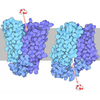
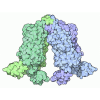
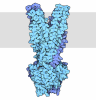
 Assembly

 Mass: 612.631 Da / Num. of mol.: 1 / Source method: obtained synthetically / Formula: C20H32N6O12S2 / Feature type: SUBJECT OF INVESTIGATION
 Sample preparation
 Electron microscopy imaging
 FIELD EMISSION GUN / Accelerating voltage: 300 kV / Illumination mode: FLOOD BEAM
 Processing