 Movie
Movie Controller


+ Open data

- Basic information
| Entry | Database: PDB / ID: 9ltr | ||||||||||||||||||||||||
|---|---|---|---|---|---|---|---|---|---|---|---|---|---|---|---|---|---|---|---|---|---|---|---|---|---|
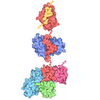
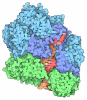
| Title | Cryo-EM structure of dimeric DDB1-DDA1-DET1-Ube2e2-COP1 complex | ||||||||||||||||||||||||
 Components Components |
| ||||||||||||||||||||||||
 Keywords Keywords | LIGASE / E3 ligase component | ||||||||||||||||||||||||
| Function / homology |  Function and homology information Function and homology informationISG15 transferase activity / ISG15-protein conjugation / regulation of proteasomal ubiquitin-dependent protein catabolic process / negative regulation of fatty acid biosynthetic process / cullin-RING ubiquitin ligase complex / protein K11-linked ubiquitination / positive regulation by virus of viral protein levels in host cell / spindle assembly involved in female meiosis / epigenetic programming in the zygotic pronuclei / UV-damage excision repair ...ISG15 transferase activity / ISG15-protein conjugation / regulation of proteasomal ubiquitin-dependent protein catabolic process / negative regulation of fatty acid biosynthetic process / cullin-RING ubiquitin ligase complex / protein K11-linked ubiquitination / positive regulation by virus of viral protein levels in host cell / spindle assembly involved in female meiosis / epigenetic programming in the zygotic pronuclei / UV-damage excision repair / E2 ubiquitin-conjugating enzyme / biological process involved in interaction with symbiont / response to ionizing radiation / regulation of mitotic cytokinesis / regulation of mitotic cell cycle phase transition / regulation of miRNA-mediated gene silencing / regulation of natural killer cell activation / WD40-repeat domain binding / nucleotide-excision repair complex / regulation of cell cycle phase transition / Cul4-RING E3 ubiquitin ligase complex / regulation of stem cell population maintenance / Cul4A-RING E3 ubiquitin ligase complex / ubiquitin ligase complex scaffold activity / negative regulation of adipose tissue development / ubiquitin conjugating enzyme activity / Cul4B-RING E3 ubiquitin ligase complex / regulation of cellular response to stress / viral release from host cell / protein monoubiquitination / cullin family protein binding / regulation of DNA-templated DNA replication initiation / positive regulation of G1/S transition of mitotic cell cycle / positive regulation of viral genome replication / ubiquitin-like ligase-substrate adaptor activity / positive regulation of gluconeogenesis / protein K63-linked ubiquitination / protein K48-linked ubiquitination / regulation of embryonic development / replication fork processing / proteasomal protein catabolic process / epigenetic regulation of gene expression / nucleotide-excision repair / regulation of autophagy / Autodegradation of the E3 ubiquitin ligase COP1 / Recognition of DNA damage by PCNA-containing replication complex / RING-type E3 ubiquitin transferase / regulation of circadian rhythm / DNA Damage Recognition in GG-NER / cell population proliferation / Dual Incision in GG-NER / Transcription-Coupled Nucleotide Excision Repair (TC-NER) / Formation of TC-NER Pre-Incision Complex / protein polyubiquitination / Formation of Incision Complex in GG-NER / ubiquitin-protein transferase activity / cellular response to UV / positive regulation of protein catabolic process / Dual incision in TC-NER / Gap-filling DNA repair synthesis and ligation in TC-NER / positive regulation of proteasomal ubiquitin-dependent protein catabolic process / ubiquitin protein ligase activity / Antigen processing: Ubiquitination & Proteasome degradation / site of double-strand break / regulation of cell population proliferation / Neddylation / protein-containing complex assembly / spermatogenesis / ubiquitin-dependent protein catabolic process / damaged DNA binding / proteasome-mediated ubiquitin-dependent protein catabolic process / regulation of apoptotic process / chromosome, telomeric region / nuclear speck / protein-macromolecule adaptor activity / protein ubiquitination / DNA repair / Golgi membrane / ubiquitin protein ligase binding / DNA damage response / nucleolus / protein-containing complex binding / protein-containing complex / DNA binding / extracellular exosome / zinc ion binding / nucleoplasm / ATP binding / extracellular region / nucleus / cytosol / cytoplasm Similarity search - Function | ||||||||||||||||||||||||
| Biological species |  Homo sapiens (human) Homo sapiens (human) | ||||||||||||||||||||||||
| Method | ELECTRON MICROSCOPY / single particle reconstruction / cryo EM / Resolution: 3.03 Å | ||||||||||||||||||||||||
 Authors Authors | Su, M.-Y. / Wang, S. / Teng, F. | ||||||||||||||||||||||||
| Funding support |  China, 1items China, 1items
| ||||||||||||||||||||||||
 Citation Citation | Journal: Nat Commun / Year: 2026 Title: Cryo-EM structure of the human COP1-DET1 ubiquitin ligase complex. Authors: Shan Wang / Fei Teng / Goran Stjepanovic / Feng Rao / Ming-Yuan Su / Abstract: Ubiquitin modifications regulate fundamental cellular activities by modulating protein stability and function. The ubiquitin ligase COP1, which is present across species from plants to humans, plays ...Ubiquitin modifications regulate fundamental cellular activities by modulating protein stability and function. The ubiquitin ligase COP1, which is present across species from plants to humans, plays a crucial role in the ubiquitination of developmental transcription factors. While COP1 can function independently, it can also be incorporated into CULLIN4-RING ubiquitin ligase (CRL4) complexes through the DET1 adaptor protein. Despite its biological significance, the structural and functional mechanisms of COP1 and DET1-containing complexes remains poorly understood. Here we present the cryo-electron microscopy structures of human COP1 in complex with DDB1-DDA1-DET1 and Ube2e2, revealing an inactive stacked assembly state. Co-expression with COP1 substrates including c-Jun or ETS2 disrupts this configuration, inducing a conformational rearrangement into a distinct dimeric state that allows substrate access. Structural modelling identifies the spatial organization of COP1 WD40 domains where substrate recruits. DET1 serves as a structural scaffold, bridging COP1 and Ube2e2 to initiate potential ubiquitin addition on substrates, while DDB1 recruits the CULLIN4-RBX1 complex to facilitate Ube2d3-mediated ubiquitin chain elongation. These results reveal the dynamic interplay between the structural states of the CRL4 E3 ligase complex and its substrate specific activation mechanism, offering mechanistic insights into ubiquitination regulation and a basis for future studies on E3 ligase dynamics. | ||||||||||||||||||||||||
| History |
|
- Structure visualization
| Structure viewer | Molecule: MolmilJmol/JSmol |
|---|
- Downloads & links
-Download
| PDBx/mmCIF format | 9ltr.cif.gz | 666.2 KB | Display | PDBx/mmCIF format |
|---|---|---|---|---|
| PDB format | pdb9ltr.ent.gz | 452.4 KB | Display | PDB format |
| PDBx/mmJSON format | 9ltr.json.gz | Tree view | PDBx/mmJSON format | |
| Others |  Other downloads Other downloads |
-Validation report
| Arichive directory | https://data.pdbj.org/pub/pdb/validation_reports/lt/9ltrftp://data.pdbj.org/pub/pdb/validation_reports/lt/9ltr | HTTPS FTP |
|---|
-Related structure data
| Related structure data |  63375MC  9ltjC  9ltlC  9ltoC  9ltwC  9ltzC  9lu1C  9lulC  9m0yC  9w90C C: citing same article ( M: map data used to model this data |
|---|---|
| Similar structure data |


-Links
 PDBj
PDBj
- Assembly
| Deposited unit | 
|
|---|---|
| 1 |
|
-Components
| #1: Protein | Mass: 80569.242 Da / Num. of mol.: 2 Source method: isolated from a genetically manipulated source Source: (gene. exp.) Homo sapiens (human) / Gene: COP1, RFWD2, RNF200 / Production host: Homo sapiens (human)References: UniProt: Q8NHY2, RING-type E3 ubiquitin transferase #2: Protein | Mass: 127097.469 Da / Num. of mol.: 2 Source method: isolated from a genetically manipulated source Source: (gene. exp.) Homo sapiens (human) / Gene: DDB1, XAP1 / Production host: Homo sapiens (human) / References: UniProt: Q16531#3: Protein | Mass: 63931.367 Da / Num. of mol.: 2 Source method: isolated from a genetically manipulated source Source: (gene. exp.) Homo sapiens (human) / Gene: DET1 / Production host: Homo sapiens (human) / References: UniProt: Q7L5Y6#4: Protein | Mass: 11855.297 Da / Num. of mol.: 2 Source method: isolated from a genetically manipulated source Source: (gene. exp.) Homo sapiens (human) / Gene: DDA1, C19orf58, PCIA1 / Production host: Homo sapiens (human) / References: UniProt: Q9BW61#5: Protein | Mass: 22282.092 Da / Num. of mol.: 2 Source method: isolated from a genetically manipulated source Source: (gene. exp.) Homo sapiens (human) / Gene: UBE2E2, UBCH8 / Production host: Homo sapiens (human)References: UniProt: Q96LR5, E2 ubiquitin-conjugating enzyme Has protein modification | N | |
|---|
-Experimental details
-Experiment
| Experiment | Method: ELECTRON MICROSCOPY |
|---|---|
| EM experiment | Aggregation state: PARTICLE / 3D reconstruction method: single particle reconstruction |
- Sample preparation
| Component | Name: protein complex of dimeric DDB1-DDA1-DET1-Ube2e2-COP1 / Type: COMPLEX / Entity ID: all / Source: RECOMBINANT |
|---|---|
| Molecular weight | Value: 0.6 MDa / Experimental value: NO |
| Source (natural) | Organism: Homo sapiens (human) |
| Source (recombinant) | Organism: Homo sapiens (human) |
| Buffer solution | pH: 7.4 |
| Specimen | Conc.: 0.3 mg/ml / Embedding applied: NO / Shadowing applied: NO / Staining applied: NO / Vitrification applied: YES Details: the purified protein was at 0.535 or 0.3 mg/ml and applied to fresh glow-discharged UltrAuFoil (1.2/1.3, 300 mesh) grids |
| Vitrification | Cryogen name: ETHANE |
- Electron microscopy imaging
| Experimental equipment |  Model: Titan Krios / Image courtesy: FEI Company |
|---|---|
| Microscopy | Model: TFS KRIOS |
| Electron gun | Electron source:  FIELD EMISSION GUN / Accelerating voltage: 300 kV / Illumination mode: OTHER FIELD EMISSION GUN / Accelerating voltage: 300 kV / Illumination mode: OTHER |
| Electron lens | Mode: BRIGHT FIELD / Nominal defocus max: 1800 nm / Nominal defocus min: 1200 nm |
| Image recording | Electron dose: 46.55 e/Å2 / Film or detector model: GATAN K3 (6k x 4k) Details: The total dose on the specimen was 46.55, 46.32, 47.42, and 48.6 e-/A2, total exposure time of 2.497 or 1.997 sec, fractionated over 50 frames. |
- Processing
| EM software |
| ||||||||||||||||||||||||
|---|---|---|---|---|---|---|---|---|---|---|---|---|---|---|---|---|---|---|---|---|---|---|---|---|---|
| CTF correction | Type: NONE | ||||||||||||||||||||||||
| 3D reconstruction | Resolution: 3.03 Å / Resolution method: FSC 0.143 CUT-OFF / Num. of particles: 61817 / Symmetry type: POINT | ||||||||||||||||||||||||
| Refinement | Highest resolution: 3.03 Å Stereochemistry target values: REAL-SPACE (WEIGHTED MAP SUM AT ATOM CENTERS) | ||||||||||||||||||||||||
| Refine LS restraints |
|
