 Movie
Movie Controller


+ Open data

- Basic information
| Entry | Database: PDB / ID: 9lq2 | |||||||||||||||||||||||||||
|---|---|---|---|---|---|---|---|---|---|---|---|---|---|---|---|---|---|---|---|---|---|---|---|---|---|---|---|---|
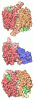
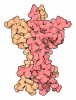
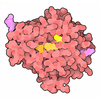
| Title | Structure of human dimeric NLRP7-TCL1A complex | |||||||||||||||||||||||||||
 Components Components |
| |||||||||||||||||||||||||||
 Keywords Keywords | SIGNALING PROTEIN / subcortical maternal complex | |||||||||||||||||||||||||||
| Function / homology |  Function and homology information Function and homology informationinterleukin-1 binding / caspase binding / positive regulation of embryonic development / aspartic-type endopeptidase inhibitor activity / establishment of spindle localization / negative regulation of protein processing / negative regulation of interleukin-1 beta production / cellular response to interleukin-1 / negative regulation of cytokine production involved in inflammatory response / protein serine/threonine kinase activator activity ...interleukin-1 binding / caspase binding / positive regulation of embryonic development / aspartic-type endopeptidase inhibitor activity / establishment of spindle localization / negative regulation of protein processing / negative regulation of interleukin-1 beta production / cellular response to interleukin-1 / negative regulation of cytokine production involved in inflammatory response / protein serine/threonine kinase activator activity / regulation of inflammatory response / cellular response to lipopolysaccharide / cell cortex / intracellular signal transduction / protein kinase binding / endoplasmic reticulum / nucleoplasm / ATP binding / identical protein binding / nucleus / cytosol / cytoplasm Similarity search - Function | |||||||||||||||||||||||||||
| Biological species |  Homo sapiens (human) Homo sapiens (human) | |||||||||||||||||||||||||||
| Method | ELECTRON MICROSCOPY / single particle reconstruction / cryo EM / Resolution: 3.58 Å | |||||||||||||||||||||||||||
 Authors Authors | Liu, Q.T. / Li, J.H. | |||||||||||||||||||||||||||
| Funding support |  China, 1items China, 1items
| |||||||||||||||||||||||||||
 Citation Citation | Journal: Nat Commun / Year: 2026 Title: TCL1A mediates DNA methylation defects in recurrent hydatidiform mole with NLRP7 pathogenic variants. Authors: Zheng Gao / Qingting Liu / Lei Li / Ting Hu / Xukun Lu / Yu Wu / Dandan Qin / Xiaoxiao Wang / Chen Gu / Jinhong Li / Chengpeng Xu / Dan Zhou / Fan Zhou / YanLing Bai / Xiangjin Kang / ...Authors: Zheng Gao / Qingting Liu / Lei Li / Ting Hu / Xukun Lu / Yu Wu / Dandan Qin / Xiaoxiao Wang / Chen Gu / Jinhong Li / Chengpeng Xu / Dan Zhou / Fan Zhou / YanLing Bai / Xiangjin Kang / Jianqiao Liu / Dong Deng / Lei Li / Abstract: Pathogenic variants in NLRP7, implicated in 55% of recurrent hydatidiform mole characterized by hypomethylation at maternally methylated imprinted regions, are proposed to disrupt de novo DNA ...Pathogenic variants in NLRP7, implicated in 55% of recurrent hydatidiform mole characterized by hypomethylation at maternally methylated imprinted regions, are proposed to disrupt de novo DNA methylation in human oocytes. However, the precise mechanism remains unclear. Here, we identify TCL1A, a DNMT3A inhibitor, as an endogenous NLRP7-interacting partner. The cryo-EM structure of the NLRP7-TCL1A complex reveals its fundamental architecture. Comprehensive analysis demonstrates that the majority of recurrent hydatidiform mole-causing NLRP7 variants impair its interaction with TCL1A. Mechanistically, NLRP7 potentially safeguards oocyte methylome by sequestering TCL1A in the cytoplasm, thereby preventing its nuclear entry and subsequent suppression of DNMT3A-mediated de novo methylation. Combining in silico predictions and interaction analysis, we identify L766R as a pathogenic variant. These findings propose a cytoplasmic regulatory mechanism governing nuclear DNA methylation, explaining the hypomethylation pathogenesis in NLRP7 variant-associated recurrent hydatidiform mole. | |||||||||||||||||||||||||||
| History |
|
- Structure visualization
| Structure viewer | Molecule: MolmilJmol/JSmol |
|---|
- Downloads & links
-Download
| PDBx/mmCIF format | 9lq2.cif.gz | 371.3 KB | Display | PDBx/mmCIF format |
|---|---|---|---|---|
| PDB format | pdb9lq2.ent.gz | 297 KB | Display | PDB format |
| PDBx/mmJSON format | 9lq2.json.gz | Tree view | PDBx/mmJSON format | |
| Others |  Other downloads Other downloads |
-Validation report
| Arichive directory | https://data.pdbj.org/pub/pdb/validation_reports/lq/9lq2ftp://data.pdbj.org/pub/pdb/validation_reports/lq/9lq2 | HTTPS FTP |
|---|
-Related structure data
| Related structure data |  63291MC  9lq4C M: map data used to model this data C: citing same article ( |
|---|---|
| Similar structure data |

-Links
 PDBj
PDBj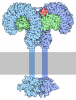

- Assembly
| Deposited unit | 
|
|---|---|
| 1 |
|
-Components
| #1: Protein | Mass: 118448.906 Da / Num. of mol.: 2 Source method: isolated from a genetically manipulated source Source: (gene. exp.) Homo sapiens (human) / Gene: NLRP7, NALP7, NOD12, PYPAF3 / Production host: Homo sapiens (human) / References: UniProt: Q8WX94#2: Protein | Mass: 12672.580 Da / Num. of mol.: 4 Source method: isolated from a genetically manipulated source Source: (gene. exp.) Homo sapiens (human) / Gene: TCL1A, TCL1 / Production host: Homo sapiens (human) / References: UniProt: P56279Has protein modification | N | |
|---|
-Experimental details
-Experiment
| Experiment | Method: ELECTRON MICROSCOPY |
|---|---|
| EM experiment | Aggregation state: PARTICLE / 3D reconstruction method: single particle reconstruction |
- Sample preparation
| Component | Name: Structure of human dimer NLRP7-TCL1A complex / Type: COMPLEX / Entity ID: all / Source: RECOMBINANT | ||||||||||||||||||||
|---|---|---|---|---|---|---|---|---|---|---|---|---|---|---|---|---|---|---|---|---|---|
| Molecular weight | Experimental value: NO | ||||||||||||||||||||
| Source (natural) | Organism: Homo sapiens (human) | ||||||||||||||||||||
| Source (recombinant) | Organism: Homo sapiens (human) | ||||||||||||||||||||
| Buffer solution | pH: 7.5 / Details: 25mM Hepes pH 7.5, 150mM NaCl,5 mM DTT | ||||||||||||||||||||
| Buffer component |
| ||||||||||||||||||||
| Specimen | Conc.: 2.3 mg/ml / Embedding applied: NO / Shadowing applied: NO / Staining applied: NO / Vitrification applied: YES / Details: This sample was monodisperse | ||||||||||||||||||||
| Specimen support | Grid material: GOLD / Grid mesh size: 300 divisions/in. / Grid type: Quantifoil R1.2/1.3 | ||||||||||||||||||||
| Vitrification | Instrument: FEI VITROBOT MARK IV / Cryogen name: ETHANE / Humidity: 100 % / Chamber temperature: 277 K / Details: Vitrification carried out in argon atmosphere |
- Electron microscopy imaging
| Experimental equipment |  Model: Titan Krios / Image courtesy: FEI Company |
|---|---|
| Microscopy | Model: TFS KRIOS |
| Electron gun | Electron source:  FIELD EMISSION GUN / Accelerating voltage: 300 kV / Illumination mode: FLOOD BEAM FIELD EMISSION GUN / Accelerating voltage: 300 kV / Illumination mode: FLOOD BEAM |
| Electron lens | Mode: BRIGHT FIELD / Nominal defocus max: 1800 nm / Nominal defocus min: 1100 nm |
| Image recording | Electron dose: 51.36 e/Å2 / Film or detector model: GATAN K2 SUMMIT (4k x 4k) |
- Processing
| EM software | Name: PHENIX / Category: model refinement | ||||||||||||||||||||||||
|---|---|---|---|---|---|---|---|---|---|---|---|---|---|---|---|---|---|---|---|---|---|---|---|---|---|
| CTF correction | Type: NONE | ||||||||||||||||||||||||
| 3D reconstruction | Resolution: 3.58 Å / Resolution method: FSC 0.143 CUT-OFF / Num. of particles: 1195156 / Symmetry type: POINT | ||||||||||||||||||||||||
| Refinement | Highest resolution: 3.58 Å Stereochemistry target values: REAL-SPACE (WEIGHTED MAP SUM AT ATOM CENTERS) | ||||||||||||||||||||||||
| Refine LS restraints |
|
