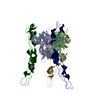
ムービー
ムービー コントローラー


+ データを開く

- 基本情報
基本情報
| 登録情報 | データベース: PDB / ID: 9lfl | |||||||||||||||
|---|---|---|---|---|---|---|---|---|---|---|---|---|---|---|---|---|
| タイトル | Cryo-EM structure of linker-extended biparatopic antibody BA1-GP4 in complex with TNFR2 | |||||||||||||||
 要素 要素 |
| |||||||||||||||
 キーワード キーワード | IMMUNE SYSTEM / Antibody / biparatopic antibody / antagonist | |||||||||||||||
| 機能・相同性 |  機能・相同性情報 機能・相同性情報glial cell-neuron signaling / regulation of cytokine production involved in immune response / pulmonary valve development / tumor necrosis factor receptor superfamily complex / RNA destabilization / aortic valve development / negative regulation of extracellular matrix constituent secretion / tumor necrosis factor receptor activity / positive regulation of apoptotic process involved in morphogenesis / negative regulation of neuroinflammatory response ...glial cell-neuron signaling / regulation of cytokine production involved in immune response / pulmonary valve development / tumor necrosis factor receptor superfamily complex / RNA destabilization / aortic valve development / negative regulation of extracellular matrix constituent secretion / tumor necrosis factor receptor activity / positive regulation of apoptotic process involved in morphogenesis / negative regulation of neuroinflammatory response / TNFs bind their physiological receptors / regulation of T cell cytokine production / tumor necrosis factor binding / negative regulation of cardiac muscle hypertrophy / regulation of neuroinflammatory response / positive regulation of myelination / positive regulation of membrane protein ectodomain proteolysis / regulation of myelination / Interleukin-10 signaling / regulation of T cell proliferation / positive regulation of oligodendrocyte differentiation / specific granule membrane / extrinsic apoptotic signaling pathway / tumor necrosis factor-mediated signaling pathway / TNFR2 non-canonical NF-kB pathway / intrinsic apoptotic signaling pathway in response to DNA damage / cellular response to lipopolysaccharide / Interleukin-4 and Interleukin-13 signaling / membrane raft / inflammatory response / Neutrophil degranulation / ubiquitin protein ligase binding / extracellular region / membrane / plasma membrane 類似検索 - 分子機能 | |||||||||||||||
| 生物種 |  Homo sapiens (ヒト) Homo sapiens (ヒト)  Mus musculus (ハツカネズミ) Mus musculus (ハツカネズミ) | |||||||||||||||
| 手法 | 電子顕微鏡法 / 単粒子再構成法 / クライオ電子顕微鏡法 / 解像度: 3.73 Å | |||||||||||||||
 データ登録者 データ登録者 | Otsuki, T. / Matsumoto, S. / Fujita, J. / Miyata, T. / Namba, K. / Kanada, R. / Okuno, Y. / Kamada, H. / Ohno, H. / Akiba, H. | |||||||||||||||
| 資金援助 |  日本, 4件 日本, 4件
| |||||||||||||||
 引用 引用 | ジャーナル: J Biol Chem / 年: 2025 タイトル: Conversion of an agonistic anti-TNFR2 biparatopic antibody into an antagonist by insertion of peptide linkers into the hinge region. 著者: Takuya Otsuki / Shigeyuki Matsumoto / Junso Fujita / Tomoko Miyata / Keiichi Namba / Ryo Kanada / Yasushi Okuno / Haruhiko Kamada / Hiroaki Ohno / Hiroki Akiba / 要旨: Biparatopic antibodies (BpAbs) bind two different antigen epitopes to form characteristic immunocomplexes. Many BpAbs have been developed for enhanced crosslinking to induce signal transduction or ...Biparatopic antibodies (BpAbs) bind two different antigen epitopes to form characteristic immunocomplexes. Many BpAbs have been developed for enhanced crosslinking to induce signal transduction or cell internalization, whereas few have been reported with smaller immunocomplexes to suppress unwanted signaling. Here, we developed a strategy to induce 1:1 immunocomplex formation to maximize antagonistic function. Various peptide linkers were introduced into the hinge regions of IgG-like agonist BpAbs against tumor necrosis factor receptor 2. Loss of crosslinking activity was observed for one BpAb, allowing the conversion of its function from an agonist to an antagonist. However, crosslinking activity was retained for another agonist, BpAb, which binds to a different epitope pair. In a combined analysis of cryo-electron microscopy and coarse-grained molecular dynamics simulations, the effect of epitope combination on the stability of 1:1 complexes was observed. These results lead to an understanding of the mechanism and design of BpAbs to adopt a 1:1-binding mode. | |||||||||||||||
| 履歴 |
|
- 構造の表示
構造の表示
| 構造ビューア | 分子: MolmilJmol/JSmol |
|---|
- ダウンロードとリンク
-ダウンロード
| PDBx/mmCIF形式 | 9lfl.cif.gz | 183.3 KB | 表示 | PDBx/mmCIF形式 |
|---|---|---|---|---|
| PDB形式 | pdb9lfl.ent.gz | 表示 | PDB形式 | |
| PDBx/mmJSON形式 | 9lfl.json.gz | ツリー表示 | PDBx/mmJSON形式 | |
| その他 |  その他のダウンロード その他のダウンロード |
-検証レポート
| アーカイブディレクトリ | https://data.pdbj.org/pub/pdb/validation_reports/lf/9lflftp://data.pdbj.org/pub/pdb/validation_reports/lf/9lfl | HTTPS FTP |
|---|
-関連構造データ

-リンク
 PDBj
PDBj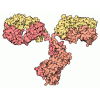
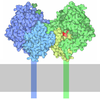
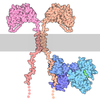
- 集合体
集合体
| 登録構造単位 | 
|
|---|---|
| 1 |
|
-要素
| #1: タンパク質 | 分子量: 16747.895 Da / 分子数: 1 / 変異: A490V / 由来タイプ: 組換発現 詳細: 1-178, Tumor necrosis factor receptor 1B, Homo sapiens; 179-543, Maltose/maltodextrin-binding periplasmic protein - Escherichia coli K-12; 545-550, hexahistidine tag 由来: (組換発現) Homo sapiens (ヒト) / 遺伝子: TNFRSF1B, TNFBR, TNFR2 / 細胞株 (発現宿主): ExpiCHO / 発現宿主: Homo sapiens (ヒト) / 参照: UniProt: P20333 |
|---|---|
| #2: 抗体 | 分子量: 23777.564 Da / 分子数: 1 / 由来タイプ: 組換発現 / 詳細: TR92 antibody heavy chain / 由来: (組換発現) Mus musculus (ハツカネズミ)発現宿主:  Cricetulus griseus (モンゴルキヌゲネズミ) Cricetulus griseus (モンゴルキヌゲネズミ) |
| #3: 抗体 | 分子量: 23242.812 Da / 分子数: 1 / 由来タイプ: 組換発現 / 由来: (組換発現) Mus musculus (ハツカネズミ)発現宿主: Cricetulus griseus (モンゴルキヌゲネズミ) |
| #4: 抗体 | 分子量: 24093.518 Da / 分子数: 1 / 由来タイプ: 組換発現 / 由来: (組換発現) Mus musculus (ハツカネズミ)発現宿主: Cricetulus griseus (モンゴルキヌゲネズミ) |
| #5: 抗体 | 分子量: 22055.656 Da / 分子数: 1 / 由来タイプ: 組換発現 / 由来: (組換発現) Mus musculus (ハツカネズミ)発現宿主: Cricetulus griseus (モンゴルキヌゲネズミ) |
| Has protein modification | Y |
-実験情報
-実験
| 実験 | 手法: 電子顕微鏡法 |
|---|---|
| EM実験 | 試料の集合状態: PARTICLE / 3次元再構成法: 単粒子再構成法 |
- 試料調製
試料調製
| 構成要素 | 名称: Linker-extended biparatopic antibody BA1-GP4 in complex with TNFR2 タイプ: COMPLEX / Entity ID: all / 由来: RECOMBINANT |
|---|---|
| 分子量 | 値: 0.2 MDa / 実験値: YES |
| 由来(天然) | 生物種: Homo sapiens (ヒト) |
| 由来(組換発現) | 生物種: Homo sapiens (ヒト) |
| 緩衝液 | pH: 7.5 |
| 試料 | 濃度: 0.71 mg/ml / 包埋: NO / シャドウイング: NO / 染色: NO / 凍結: YES |
| 試料支持 | グリッドの材料: COPPER / グリッドのサイズ: 200 divisions/in. / グリッドのタイプ: Quantifoil R1.2/1.3 |
| 急速凍結 | 装置: FEI VITROBOT MARK IV / 凍結剤: ETHANE / 湿度: 100 % / 凍結前の試料温度: 277 K |
- 電子顕微鏡撮影
| 顕微鏡 | モデル: JEOL CRYO ARM 300 |
|---|---|
| 電子銃 | 電子線源:  FIELD EMISSION GUN / 加速電圧: 300 kV / 照射モード: FLOOD BEAM FIELD EMISSION GUN / 加速電圧: 300 kV / 照射モード: FLOOD BEAM |
| 電子レンズ | モード: BRIGHT FIELD / 倍率(公称値): 60000 X / 最大 デフォーカス(公称値): 2000 nm / 最小 デフォーカス(公称値): 500 nm / Cs: 2.7 mm / アライメント法: COMA FREE |
| 試料ホルダ | 凍結剤: NITROGEN / 試料ホルダーモデル: JEOL CRYOSPECPORTER |
| 撮影 | 平均露光時間: 4.87 sec. / 電子線照射量: 80 e/Å2 / フィルム・検出器のモデル: GATAN K3 (6k x 4k) / 撮影したグリッド数: 1 / 実像数: 5508 |
| 電子光学装置 | エネルギーフィルター名称: In-column Omega Filter エネルギーフィルタースリット幅: 20 eV |
| 画像スキャン | 横: 5760 / 縦: 4098 |
- 解析
解析
| EMソフトウェア |
| ||||||||||||||||||||||||||||||||||||||||
|---|---|---|---|---|---|---|---|---|---|---|---|---|---|---|---|---|---|---|---|---|---|---|---|---|---|---|---|---|---|---|---|---|---|---|---|---|---|---|---|---|---|
| CTF補正 | タイプ: PHASE FLIPPING AND AMPLITUDE CORRECTION | ||||||||||||||||||||||||||||||||||||||||
| 粒子像の選択 | 選択した粒子像数: 2971529 | ||||||||||||||||||||||||||||||||||||||||
| 対称性 | 点対称性: C1 (非対称) | ||||||||||||||||||||||||||||||||||||||||
| 3次元再構成 | 解像度: 3.73 Å / 解像度の算出法: FSC 0.143 CUT-OFF / 粒子像の数: 178242 / アルゴリズム: FOURIER SPACE / クラス平均像の数: 1 / 対称性のタイプ: POINT | ||||||||||||||||||||||||||||||||||||||||
| 原子モデル構築 | プロトコル: FLEXIBLE FIT / 空間: REAL | ||||||||||||||||||||||||||||||||||||||||
| 原子モデル構築 | PDB-ID: 3ALQ Accession code: 3ALQ / Source name: PDB / タイプ: experimental model |