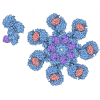
FADD-DED filaments coordinate complex IIa assembly during TNF-induced apoptosis
Components
FAS-associated death domain protein
Keywords
IMMUNE SYSTEM / RNA recognition / RNA helicase / ATP hydrolysis / RLR signaling
Function / homology
Function and homology information
positive regulation of CD8-positive, alpha-beta cytotoxic T cell extravasation / death-inducing signaling complex assembly / negative regulation of activation-induced cell death of T cells / death effector domain binding / tumor necrosis factor receptor superfamily binding / FasL/ CD95L signaling / TRAIL signaling / CD95 death-inducing signaling complex / Defective RIPK1-mediated regulated necrosis / TRAIL-activated apoptotic signaling pathway ...positive regulation of CD8-positive, alpha-beta cytotoxic T cell extravasation / death-inducing signaling complex assembly / negative regulation of activation-induced cell death of T cells / death effector domain binding / tumor necrosis factor receptor superfamily binding / FasL/ CD95L signaling / TRAIL signaling / CD95 death-inducing signaling complex / Defective RIPK1-mediated regulated necrosis / TRAIL-activated apoptotic signaling pathway / caspase binding / TRIF-mediated programmed cell death / ripoptosome / Regulation by c-FLIP / CASP8 activity is inhibited / Dimerization of procaspase-8 / TLR3-mediated TICAM1-dependent programmed cell death / regulation of necroptotic process / positive regulation of macrophage differentiation / Caspase activation via Death Receptors in the presence of ligand / positive regulation of adaptive immune response / necroptotic signaling pathway / NF-kB activation through FADD/RIP-1 pathway mediated by caspase-8 and -10 / death-inducing signaling complex / receptor serine/threonine kinase binding / positive regulation of type I interferon-mediated signaling pathway / positive regulation of innate immune response / tumor necrosis factor receptor binding / death receptor binding / positive regulation of activated T cell proliferation / positive regulation of extrinsic apoptotic signaling pathway / TNFR1-induced proapoptotic signaling / RIPK1-mediated regulated necrosis / T cell homeostasis / extrinsic apoptotic signaling pathway via death domain receptors / positive regulation of proteolysis / spleen development / lymph node development / positive regulation of execution phase of apoptosis / extrinsic apoptotic signaling pathway / thymus development / kidney development / behavioral response to cocaine / signaling adaptor activity / apoptotic signaling pathway / positive regulation of interleukin-8 production / cellular response to mechanical stimulus / Regulation of TNFR1 signaling / positive regulation of T cell mediated cytotoxicity / Regulation of necroptotic cell death / positive regulation of type II interferon production / cytoplasmic side of plasma membrane / T cell differentiation in thymus / positive regulation of tumor necrosis factor production / protease binding / cell body / defense response to virus / positive regulation of canonical NF-kappaB signal transduction / protein-macromolecule adaptor activity / positive regulation of apoptotic process / innate immune response / apoptotic process / protein-containing complex binding / positive regulation of transcription by RNA polymerase II / nucleoplasm / identical protein binding / plasma membrane / cytosol / cytoplasm Similarity search - Function
FADD / : / Death effector domain / Death effector domain / Death effector domain (DED) profile. / Death effector domain / Death domain profile. / DEATH domain, found in proteins involved in cell death (apoptosis). / Death domain / Death domain / Death-like domain superfamily Similarity search - Domain/homology
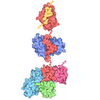
A: FAS-associated death domain protein B: FAS-associated death domain protein C: FAS-associated death domain protein D: FAS-associated death domain protein E: FAS-associated death domain protein F: FAS-associated death domain protein G: FAS-associated death domain protein H: FAS-associated death domain protein I: FAS-associated death domain protein J: FAS-associated death domain protein K: FAS-associated death domain protein L: FAS-associated death domain protein M: FAS-associated death domain protein N: FAS-associated death domain protein O: FAS-associated death domain protein P: FAS-associated death domain protein Q: FAS-associated death domain protein R: FAS-associated death domain protein
FAS-associateddeathdomainprotein / FAS-associating death domain-containing protein / Growth-inhibiting gene 3 protein / Mediator of ...FAS-associating death domain-containing protein / Growth-inhibiting gene 3 protein / Mediator of receptor induced toxicity
Mass: 10104.606 Da / Num. of mol.: 18 Source method: isolated from a genetically manipulated source Source: (gene. exp.) Homo sapiens (human) / Gene: FADD, MORT1, GIG3 / Production host: Escherichia coli BL21(DE3) (bacteria) / References: UniProt: Q13158
Has protein modification
N
-
Experimental details
-
Experiment
Experiment
Method: ELECTRON MICROSCOPY
EM experiment
Aggregation state: FILAMENT / 3D reconstruction method: helical reconstruction
-
Sample preparation
Component
ID
Name
Type
Details (eV)
Entity ID
Parent-ID
Source
1
FADD-DED filament
COMPLEX
FADD-DED filament formation during apoptosis
all
0
RECOMBINANT
2
FADD-filament
COMPLEX
FADD-filament
all
1
RECOMBINANT
Molecular weight
Value: 0.42 kDa/nm / Experimental value: NO
Source (natural)
Organism: Homo sapiens (human)
Source (recombinant)
Organism: Escherichia coli (E. coli)
Buffer solution
pH: 7.4 / Details: 25mM HEPES, 150mM NaCl
Buffer component
ID
Conc.
Name
Formula
Buffer-ID
1
25mM
HEPES
HEPES
1
2
150mM
sodiumchloride
NaCl
1
Specimen
Conc.: 0.175 mg/ml / Embedding applied: NO / Shadowing applied: NO / Staining applied: NO / Vitrification applied: YES / Details: The sample forms filament.
Specimen support
Details: grid was precoated with graphene monolayer and glow discharged. Grid material: GOLD / Grid mesh size: 300 divisions/in. / Grid type: UltrAuFoil R1.2/1.3
Vitrification
Instrument: FEI VITROBOT MARK III / Cryogen name: ETHANE / Humidity: 100 % / Chamber temperature: 283.15 K
-
Electron microscopy imaging
Experimental equipment
Model: Titan Krios / Image courtesy: FEI Company
Microscopy
Model: TFS KRIOS
Electron gun
Electron source: FIELD EMISSION GUN / Accelerating voltage: 300 kV / Illumination mode: FLOOD BEAM
In the structure databanks used in Yorodumi, some data are registered as the other names, "COVID-19 virus" and "2019-nCoV". Here are the details of the virus and the list of structure data.
Jan 31, 2019. EMDB accession codes are about to change! (news from PDBe EMDB page)
EMDB accession codes are about to change! (news from PDBe EMDB page)
The allocation of 4 digits for EMDB accession codes will soon come to an end. Whilst these codes will remain in use, new EMDB accession codes will include an additional digit and will expand incrementally as the available range of codes is exhausted. The current 4-digit format prefixed with “EMD-” (i.e. EMD-XXXX) will advance to a 5-digit format (i.e. EMD-XXXXX), and so on. It is currently estimated that the 4-digit codes will be depleted around Spring 2019, at which point the 5-digit format will come into force.
The EM Navigator/Yorodumi systems omit the EMD- prefix.
Related info.:Q: What is EMD? / ID/Accession-code notation in Yorodumi/EM Navigator
Yorodumi is a browser for structure data from EMDB, PDB, SASBDB, etc.
This page is also the successor to EM Navigator detail page, and also detail information page/front-end page for Omokage search.
The word "yorodu" (or yorozu) is an old Japanese word meaning "ten thousand". "mi" (miru) is to see.
Related info.:EMDB / PDB / SASBDB / Comparison of 3 databanks / Yorodumi Search / Aug 31, 2016. New EM Navigator & Yorodumi / Yorodumi Papers / Jmol/JSmol / Function and homology information / Changes in new EM Navigator and Yorodumi
 Movie
Movie Controller

 Yorodumi
 Open data
 Basic information
 Components
 Keywords
 Function and homology information
 Homo sapiens (human)
 Authors
 Singapore, 1items
  Citation
 Structure visualization
 Downloads & links
 Other downloads
 PDBj
PDBj
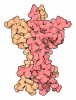

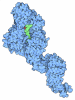
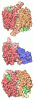

 Assembly

 Escherichia coli BL21(DE3) (bacteria) / References: UniProt: Q13158
 Sample preparation
 Electron microscopy imaging
 FIELD EMISSION GUN / Accelerating voltage: 300 kV / Illumination mode: FLOOD BEAM
 Processing