 Movie
Movie Controller


+ Open data

- Basic information
| Entry | Database: PDB / ID: 9l1w | |||||||||
|---|---|---|---|---|---|---|---|---|---|---|
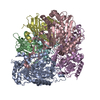
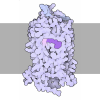
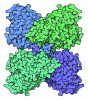
| Title | 3-phenylpropionate bound dioxygenase HcaE-HcaF | |||||||||
 Components Components |
| |||||||||
 Keywords Keywords | ELECTRON TRANSPORT / Rieske-type aromatic dioxygenase | |||||||||
| Function / homology |  Function and homology information Function and homology information3-phenylpropanoate dioxygenase / 3-phenylpropionate dioxygenase activity / 3-phenylpropionate catabolic process / 2 iron, 2 sulfur cluster binding / iron ion binding Similarity search - Function | |||||||||
| Biological species |   Escherichia coli K-12 (bacteria) Escherichia coli K-12 (bacteria) | |||||||||
| Method | ELECTRON MICROSCOPY / single particle reconstruction / cryo EM / Resolution: 3.1 Å | |||||||||
 Authors Authors | Jiang, W.X. / Wu, M. / Cheng, X.Q. / Ma, L.X. / Xing, Q. | |||||||||
| Funding support |  China, 2items China, 2items
| |||||||||
 Citation Citation | Journal: J Hazard Mater / Year: 2025 Title: Structure-guided engineering of a Rieske-type aromatic dioxygenase for enhanced consumption of 3-phenylpropionic acid in Escherichia coli. Authors: Wenxue Jiang / Miao Wu / Zhou Gong / Linhua Han / Xiaoqi Cheng / Xiaoqin Tang / Xiaolong Yu / Xu Dong / Yibin Cheng / Lixin Ma / Qiong Xing / Abstract: Industrial derived aromatic hydrocarbons are persistent environmental pollutants due to their chemical stability, posing both ecological and health risks. Rieske-type aromatic dioxygenases (RDOs), ...Industrial derived aromatic hydrocarbons are persistent environmental pollutants due to their chemical stability, posing both ecological and health risks. Rieske-type aromatic dioxygenases (RDOs), known for their role in dihydroxylation of aromatic rings, play a pivotal role in microbial consumption and degradation of such compounds. While the industrial application of these enzymes has been impeded by their instability and low biodegradation rate. In this study, we focused on optimization and application of the Rieske-type dioxygenase HcaEF from Escherichia coli (E. coli) K-12, which initializes the degradation of 3-phenylpropionic acid (3-PP) and cinnamic acid (CI). Using cryo-electron microscopy (cryo-EM), we determined the high-resolution structures of the apo-form and 3-PP bound form of HcaEF, revealing key insights into substrate specificity and thermal stability. Leveraging these structural insights, we engineered a Q73I variant of HcaEF. Upon introduction of this mutation, the turnover rate increased from 29.6 % to 43.8 %, showing ∼50 % improvement. Overexpression of this variant in E. coli K-12 significantly enhanced the strain's ability to utilize 3-PP, demonstrating the potential for microbial engineering in environmental bioremediation and industrial applications. Our findings not only deepen the understanding of substrate recognition in RDOs, but also pave the way for developing high-efficiency enzymes for aromatic compound bio-utilization. | |||||||||
| History |
|
- Structure visualization
| Structure viewer | Molecule: MolmilJmol/JSmol |
|---|
- Downloads & links
-Download
| PDBx/mmCIF format | 9l1w.cif.gz | 376 KB | Display | PDBx/mmCIF format |
|---|---|---|---|---|
| PDB format | pdb9l1w.ent.gz | 303.2 KB | Display | PDB format |
| PDBx/mmJSON format | 9l1w.json.gz | Tree view | PDBx/mmJSON format | |
| Others |  Other downloads Other downloads |
-Validation report
| Arichive directory | https://data.pdbj.org/pub/pdb/validation_reports/l1/9l1wftp://data.pdbj.org/pub/pdb/validation_reports/l1/9l1w | HTTPS FTP |
|---|
-Related structure data
| Related structure data |  62756MC M: map data used to model this data C: citing same article ( |
|---|---|
| Similar structure data |
-Links
 PDBj
PDBj
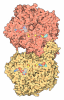
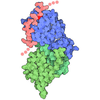
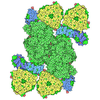

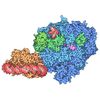
- Assembly
| Deposited unit | 
|
|---|---|
| 1 |
|
-Components
| #1: Protein | Mass: 51166.047 Da / Num. of mol.: 3 Source method: isolated from a genetically manipulated source Source: (gene. exp.) Escherichia coli K-12 (bacteria) / Gene: hcaE, digA, hcaA, hcaA1, phdC1, yfhU, b2538, JW2522Production host: Escherichia coli 'BL21-Gold(DE3)pLysS AG' (bacteria)References: UniProt: P0ABR5, 3-phenylpropanoate dioxygenase #2: Protein | Mass: 20609.248 Da / Num. of mol.: 3 Source method: isolated from a genetically manipulated source Source: (gene. exp.) Escherichia coli K-12 (bacteria) / Gene: hcaF, digB, hcaA2, hcaB, phdC2, yfhV, b2539, JW2523Production host: Escherichia coli 'BL21-Gold(DE3)pLysS AG' (bacteria)References: UniProt: Q47140, 3-phenylpropanoate dioxygenase #3: Chemical |   Mass: 55.845 Da / Num. of mol.: 3 / Source method: obtained synthetically / Formula: Fe / Feature type: SUBJECT OF INVESTIGATION Mass: 55.845 Da / Num. of mol.: 3 / Source method: obtained synthetically / Formula: Fe / Feature type: SUBJECT OF INVESTIGATION#4: Chemical | 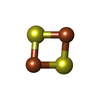 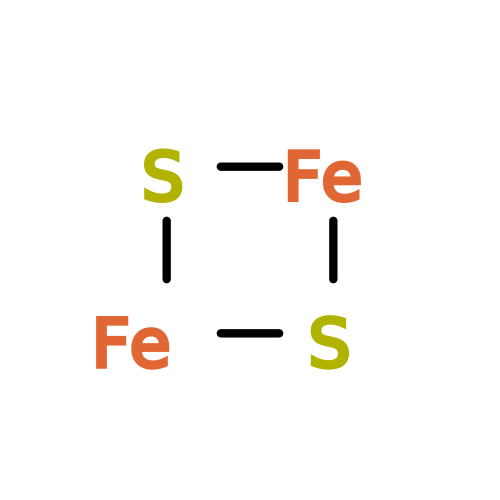 Mass: 175.820 Da / Num. of mol.: 3 / Source method: obtained synthetically / Formula: Fe2S2 / Feature type: SUBJECT OF INVESTIGATION Mass: 175.820 Da / Num. of mol.: 3 / Source method: obtained synthetically / Formula: Fe2S2 / Feature type: SUBJECT OF INVESTIGATION#5: Chemical | 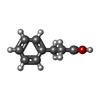 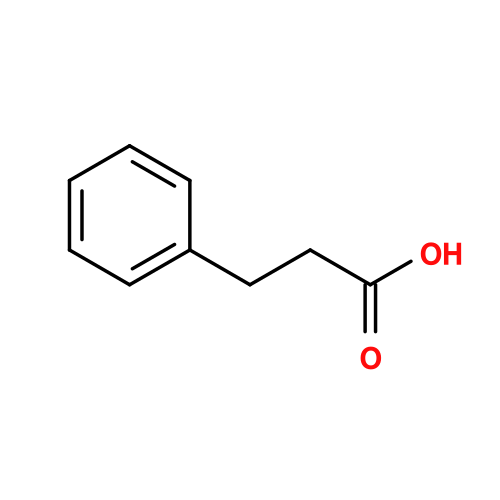 Mass: 150.174 Da / Num. of mol.: 3 / Source method: obtained synthetically / Formula: C9H10O2 / Feature type: SUBJECT OF INVESTIGATION Mass: 150.174 Da / Num. of mol.: 3 / Source method: obtained synthetically / Formula: C9H10O2 / Feature type: SUBJECT OF INVESTIGATIONHas ligand of interest | Y | Has protein modification | Y | |
|---|
-Experimental details
-Experiment
| Experiment | Method: ELECTRON MICROSCOPY |
|---|---|
| EM experiment | Aggregation state: PARTICLE / 3D reconstruction method: single particle reconstruction |
- Sample preparation
| Component | Name: complex of 3-phenylpropionate bound dioxygenase HcaE-HcaF Type: COMPLEX / Entity ID: #1-#2 / Source: RECOMBINANT |
|---|---|
| Source (natural) | Organism: Escherichia coli K-12 (bacteria) |
| Source (recombinant) | Organism: Escherichia coli 'BL21-Gold(DE3)pLysS AG' (bacteria) |
| Buffer solution | pH: 8 |
| Specimen | Embedding applied: NO / Shadowing applied: NO / Staining applied: NO / Vitrification applied: YES |
| Vitrification | Cryogen name: ETHANE |
- Electron microscopy imaging
| Experimental equipment | 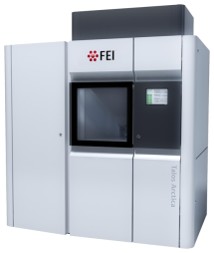 Model: Talos Arctica / Image courtesy: FEI Company |
|---|---|
| Microscopy | Model: FEI TALOS ARCTICA |
| Electron gun | Electron source:  FIELD EMISSION GUN / Accelerating voltage: 300 kV / Illumination mode: OTHER FIELD EMISSION GUN / Accelerating voltage: 300 kV / Illumination mode: OTHER |
| Electron lens | Mode: BRIGHT FIELD / Nominal defocus max: 2000 nm / Nominal defocus min: 1000 nm |
| Image recording | Electron dose: 30 e/Å2 / Film or detector model: GATAN K3 (6k x 4k) |
- Processing
| EM software | Name: PHENIX / Category: model refinement | ||||||||||||||||||||||||
|---|---|---|---|---|---|---|---|---|---|---|---|---|---|---|---|---|---|---|---|---|---|---|---|---|---|
| CTF correction | Type: PHASE FLIPPING AND AMPLITUDE CORRECTION | ||||||||||||||||||||||||
| 3D reconstruction | Resolution: 3.1 Å / Resolution method: FSC 0.143 CUT-OFF / Num. of particles: 152508 / Symmetry type: POINT | ||||||||||||||||||||||||
| Refinement | Highest resolution: 3.1 Å Stereochemistry target values: REAL-SPACE (WEIGHTED MAP SUM AT ATOM CENTERS) | ||||||||||||||||||||||||
| Refine LS restraints |
|
