 Movie
Movie Controller

[English] 日本語
 Yorodumi
- PDB-9k6z: SARS-CoV-2 related bat coronavirus BANAL-52 spike in the locked state -
+ Open data

- Basic information
| Entry | Database: PDB / ID: 9k6z | ||||||||||||||||||||||||||||||
|---|---|---|---|---|---|---|---|---|---|---|---|---|---|---|---|---|---|---|---|---|---|---|---|---|---|---|---|---|---|---|---|
| Title | SARS-CoV-2 related bat coronavirus BANAL-52 spike in the locked state | ||||||||||||||||||||||||||||||
 Components Components | Spike glycoprotein | ||||||||||||||||||||||||||||||
 Keywords Keywords | VIRAL PROTEIN / SARS-CoV-2 related bat coronavirus BANA-52 spike with linoleic acid binding | ||||||||||||||||||||||||||||||
| Function / homology |  Function and homology information Function and homology informationpositive regulation of viral entry into host cell / host cell endoplasmic reticulum-Golgi intermediate compartment membrane / receptor-mediated virion attachment to host cell / host cell surface receptor binding / endocytosis involved in viral entry into host cell / fusion of virus membrane with host plasma membrane / fusion of virus membrane with host endosome membrane / viral envelope / host cell plasma membrane / virion membrane ...positive regulation of viral entry into host cell / host cell endoplasmic reticulum-Golgi intermediate compartment membrane / receptor-mediated virion attachment to host cell / host cell surface receptor binding / endocytosis involved in viral entry into host cell / fusion of virus membrane with host plasma membrane / fusion of virus membrane with host endosome membrane / viral envelope / host cell plasma membrane / virion membrane / membrane / identical protein binding Similarity search - Function | ||||||||||||||||||||||||||||||
| Biological species |  Horseshoe bat sarbecovirus Horseshoe bat sarbecovirus | ||||||||||||||||||||||||||||||
| Method | ELECTRON MICROSCOPY / single particle reconstruction / cryo EM / Resolution: 3.51 Å | ||||||||||||||||||||||||||||||
 Authors Authors | Li, Q.Q. / Cai, X. / Li, X.N. / Zhang, Y.B. / Li, R. / Kang, Z.R. / Wan, D.D. / Wang, J.X. / Yang, J.X. / Shi, J.X. ...Li, Q.Q. / Cai, X. / Li, X.N. / Zhang, Y.B. / Li, R. / Kang, Z.R. / Wan, D.D. / Wang, J.X. / Yang, J.X. / Shi, J.X. / Jin, S.L. / Peng, Y. / Zang, N. / Xie, Z.K. / Wan, Y.S. / Shang, J. | ||||||||||||||||||||||||||||||
| Funding support |  China, 3items China, 3items
| ||||||||||||||||||||||||||||||
 Citation Citation | Journal: J Virol / Year: 2025 Title: Structural and functional constraints on spike activation and host protease utilization limit cell entry of SARS-CoV-2-related bat coronaviruses. Authors: Qingqing Li / Xiao Cai / Xiaoning Li / Yibing Zhang / Ru Li / Zirui Kang / Didi Wan / Jiaxu Wang / Lili Li / Junxia Yang / Jianxiang Shi / Shuiling Jin / Xiangdong Sun / Ying Peng / Na Zang ...Authors: Qingqing Li / Xiao Cai / Xiaoning Li / Yibing Zhang / Ru Li / Zirui Kang / Didi Wan / Jiaxu Wang / Lili Li / Junxia Yang / Jianxiang Shi / Shuiling Jin / Xiangdong Sun / Ying Peng / Na Zang / Zhengkun Xie / Yushun Wan / Jian Shang / Abstract: The persistent threat posed by SARS-CoV-2-related coronaviruses (SC2r-CoVs) in wildlife highlights the risk of zoonotic transmission. Cross-species infectivity is predominantly determined by spike (S) ...The persistent threat posed by SARS-CoV-2-related coronaviruses (SC2r-CoVs) in wildlife highlights the risk of zoonotic transmission. Cross-species infectivity is predominantly determined by spike (S) character and S-mediated cell entry. In this study, we systematically investigated BANAL-52 and BANAL-103, which exhibit the closest genetic proximity to SARS-CoV-2, focusing on their spike structures and functional characteristics. First, despite comparable receptor-binding domain (RBD)-ACE2 interactions, the spikes of BANAL-52 and BANAL-103 displayed significantly reduced ACE2 binding compared to SARS-CoV-2, suggesting impaired S activation. Second, Cryo-EM structural analyses revealed that BANAL-52 S is stabilized in a "locked" state through linoleic acid (LA) binding and an additional N370 glycan, whereas BANAL-103 S adopts a "closed" conformation due to a unique glycan network. Site-directed mutagenesis targeting the LA binding pocket confirmed that Y365 is related to S conformational transitions and viral entry. Third, both BANAL spikes relied predominantly on lysosomal proteases (e.g., cathepsins) for membrane fusion, unlike SARS-CoV-2, which utilizes a broader range of proteases (e.g., TMPRSS2 and furin). The introduction of a furin cleavage site enhanced the fusogenicity of BANAL spikes. Finally, sera from individuals who have recovered from SARS-CoV-2 effectively neutralized BANAL pseudoviruses, underscoring conserved antigenicity. Our findings elucidate structural and proteolytic barriers that restrict the zoonotic potential of these viruses and propose targeted surveillance strategies to preempt the emergence of SC2r-CoVs. IMPORTANCE: The viral entry mechanisms, which are primarily related to the spike character, play a critical role in determining zoonotic potential. Among the currently identified SC2r-CoVs, BANAL-52 ...IMPORTANCE: The viral entry mechanisms, which are primarily related to the spike character, play a critical role in determining zoonotic potential. Among the currently identified SC2r-CoVs, BANAL-52 and BANAL-103 exhibit spike proteins with the highest sequence similarity to SARS-CoV-2, rendering them optimal models for comparative studies on S-mediated cell entry and cross-species transmission. In this study, we systematically investigated the molecular constraints governing the functionality of BANAL spikes, with a focus on S-ACE2 interactions, S activation, S structures, and host protease utilization. Notably, we resolved the cryo-EM structure of BANAL-52 S at neutral pH and the first cryo-EM structure of BANAL-103 S, revealing distinct glycan- and lipid-mediated stabilization of inactive states. Furthermore, cross-neutralization assays demonstrated that sera of convalescents from SARS-CoV-2 inhibited BANAL pseudovirus entry with an efficiency of approximately 80%, thereby highlighting conserved antigenic epitopes and informing the development of broad-spectrum therapeutic strategies against emerging SC2r-CoVs. | ||||||||||||||||||||||||||||||
| History |
|
- Structure visualization
| Structure viewer | Molecule: MolmilJmol/JSmol |
|---|
- Downloads & links
-Download
| PDBx/mmCIF format | 9k6z.cif.gz | 706.5 KB | Display | PDBx/mmCIF format |
|---|---|---|---|---|
| PDB format | pdb9k6z.ent.gz | 484.7 KB | Display | PDB format |
| PDBx/mmJSON format | 9k6z.json.gz | Tree view | PDBx/mmJSON format | |
| Others |  Other downloads Other downloads |
-Validation report
| Arichive directory | https://data.pdbj.org/pub/pdb/validation_reports/k6/9k6zftp://data.pdbj.org/pub/pdb/validation_reports/k6/9k6z | HTTPS FTP |
|---|
-Related structure data
| Related structure data |  62143MC  9k75C M: map data used to model this data C: citing same article ( |
|---|---|
| Similar structure data |

-Links
 PDBj
PDBj- Assembly
| Deposited unit | 
|
|---|---|
| 1 |
|
-Components
| #1: Protein | Mass: 138414.312 Da / Num. of mol.: 3 Source method: isolated from a genetically manipulated source Source: (gene. exp.) Horseshoe bat sarbecovirus / Gene: S / Production host: Mammalia (mammals) / References: UniProt: A0AA49X976#2: Sugar | ChemComp-NAG /  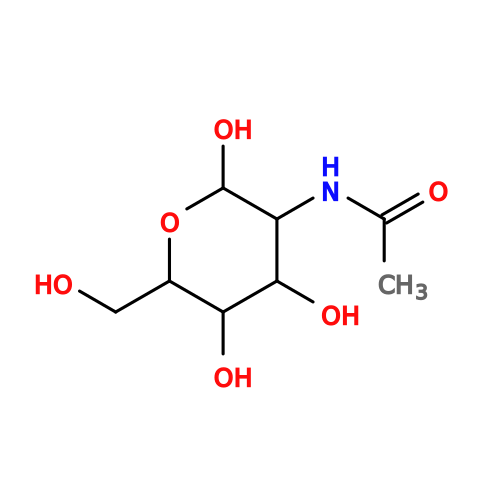 Type: D-saccharide, beta linking / Mass: 221.208 Da / Num. of mol.: 54 / Source method: obtained synthetically / Formula: C8H15NO6 Type: D-saccharide, beta linking / Mass: 221.208 Da / Num. of mol.: 54 / Source method: obtained synthetically / Formula: C8H15NO6#3: Chemical |   Mass: 280.445 Da / Num. of mol.: 3 / Source method: obtained synthetically / Formula: C18H32O2 / Feature type: SUBJECT OF INVESTIGATION Mass: 280.445 Da / Num. of mol.: 3 / Source method: obtained synthetically / Formula: C18H32O2 / Feature type: SUBJECT OF INVESTIGATIONHas ligand of interest | Y | Has protein modification | Y | |
|---|
-Experimental details
-Experiment
| Experiment | Method: ELECTRON MICROSCOPY |
|---|---|
| EM experiment | Aggregation state: PARTICLE / 3D reconstruction method: single particle reconstruction |
- Sample preparation
| Component | Name: SARS-CoV-2 related bat coronavirus BANAL-52 spike protein Type: COMPLEX / Entity ID: #1 / Source: RECOMBINANT |
|---|---|
| Molecular weight | Value: 450 kDa/nm / Experimental value: NO |
| Source (natural) | Organism: Horseshoe bat sarbecovirus |
| Source (recombinant) | Organism: Mammalia (mammals) |
| Details of virus | Type: VIRUS-LIKE PARTICLE |
| Buffer solution | pH: 7.4 |
| Specimen | Embedding applied: NO / Shadowing applied: NO / Staining applied: NO / Vitrification applied: YES |
| Vitrification | Cryogen name: ETHANE |
- Electron microscopy imaging
| Experimental equipment |  Model: Titan Krios / Image courtesy: FEI Company |
|---|---|
| Microscopy | Model: TFS KRIOS |
| Electron gun | Electron source:  FIELD EMISSION GUN / Accelerating voltage: 300 kV / Illumination mode: FLOOD BEAM FIELD EMISSION GUN / Accelerating voltage: 300 kV / Illumination mode: FLOOD BEAM |
| Electron lens | Mode: BRIGHT FIELD / Nominal defocus max: 2500 nm / Nominal defocus min: 500 nm |
| Image recording | Electron dose: 50 e/Å2 / Film or detector model: FEI FALCON IV (4k x 4k) |
- Processing
| CTF correction | Type: PHASE FLIPPING AND AMPLITUDE CORRECTION | ||||||||||||||||||||||||
|---|---|---|---|---|---|---|---|---|---|---|---|---|---|---|---|---|---|---|---|---|---|---|---|---|---|
| 3D reconstruction | Resolution: 3.51 Å / Resolution method: FSC 0.143 CUT-OFF / Num. of particles: 20175 / Symmetry type: POINT | ||||||||||||||||||||||||
| Refinement | Cross valid method: NONE Stereochemistry target values: GeoStd + Monomer Library + CDL v1.2 | ||||||||||||||||||||||||
| Displacement parameters | Biso mean: 54.98 Å2 | ||||||||||||||||||||||||
| Refine LS restraints |
|
