 Movie
Movie Controller

[English] 日本語
 Yorodumi
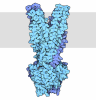
- PDB-9k3x: Cryo-EM structure of E coli pstSCAB in the pretranslocation state -
+ Open data

- Basic information
| Entry | Database: PDB / ID: 9k3x | |||||||||||||||||||||
|---|---|---|---|---|---|---|---|---|---|---|---|---|---|---|---|---|---|---|---|---|---|---|
| Title | Cryo-EM structure of E coli pstSCAB in the pretranslocation state | |||||||||||||||||||||
 Components Components |
| |||||||||||||||||||||
 Keywords Keywords | METAL TRANSPORT / ABC transporter / Phosphate transport / pstSCAB complex | |||||||||||||||||||||
| Function / homology |  Function and homology information Function and homology informationABC-type phosphate transporter / ATPase-coupled phosphate ion transmembrane transporter activity / phosphate ion transport / phosphate transmembrane transporter activity / phosphate ion transmembrane transport / phosphate ion binding / ATP-binding cassette (ABC) transporter complex, substrate-binding subunit-containing / response to radiation / outer membrane-bounded periplasmic space / DNA damage response ...ABC-type phosphate transporter / ATPase-coupled phosphate ion transmembrane transporter activity / phosphate ion transport / phosphate transmembrane transporter activity / phosphate ion transmembrane transport / phosphate ion binding / ATP-binding cassette (ABC) transporter complex, substrate-binding subunit-containing / response to radiation / outer membrane-bounded periplasmic space / DNA damage response / ATP hydrolysis activity / ATP binding / membrane / plasma membrane Similarity search - Function | |||||||||||||||||||||
| Biological species |   Escherichia coli K-12 (bacteria) Escherichia coli K-12 (bacteria) | |||||||||||||||||||||
| Method | ELECTRON MICROSCOPY / single particle reconstruction / cryo EM / Resolution: 2.9 Å | |||||||||||||||||||||
 Authors Authors | Chen, Q.F. / Xiao, H. | |||||||||||||||||||||
| Funding support |  China, 2items China, 2items
| |||||||||||||||||||||
 Citation Citation | Journal: Nat Commun / Year: 2026 Title: Molecular mechanism of phosphate import by the bacterial PstSCAB transporter. Authors: Hu Xiao / Shanqin Li / Ruxi Qi / Yuxiang Hu / Xiaozi Jiang / Jing Luo / Jing Wu / Lei Zhang / Shuman Xu / Defen Lu / Xinwang Yang / Qingfeng Chen / Sheng Liu / Abstract: Inorganic phosphate (Pi) is essential for all living organisms. PstSCAB, a bacterial high-affinity ABC transporter, imports Pi under limiting conditions via five subunits: PstA and PstC forming the ...Inorganic phosphate (Pi) is essential for all living organisms. PstSCAB, a bacterial high-affinity ABC transporter, imports Pi under limiting conditions via five subunits: PstA and PstC forming the transmembrane domain (TMD), periplasmic PstS that switches between free and TMD-docked forms for Pi capture and delivery, and two cytosolic PstB subunits for ATP binding and hydrolysis. Its malfunction affects the virulence of pathogenic bacteria, making it pharmaceutically attractive. However, complete structural pictures of PstSCAB in different states remain lacking. Here, we determine cryo-EM structures of PstSCAB in resting, pretranslocation, and catalytic intermediate states, which reveal that conformational changes in PstS and ATP binding/unbinding in PstB collectively induce rigid-body movements of TMD, generating inward- or outward-facing conformations. In TMD, Pi specificity is determined by positively charged Arg220 (PstA) and Arg237 (PstC). This study advances understanding of bacterial Pi import and supports drug development targeting PstSCAB. | |||||||||||||||||||||
| History |
|
- Structure visualization
| Structure viewer | Molecule: MolmilJmol/JSmol |
|---|
- Downloads & links
-Download
| PDBx/mmCIF format | 9k3x.cif.gz | 273.9 KB | Display | PDBx/mmCIF format |
|---|---|---|---|---|
| PDB format | pdb9k3x.ent.gz | 218 KB | Display | PDB format |
| PDBx/mmJSON format | 9k3x.json.gz | Tree view | PDBx/mmJSON format | |
| Others |  Other downloads Other downloads |
-Validation report
| Arichive directory | https://data.pdbj.org/pub/pdb/validation_reports/k3/9k3xftp://data.pdbj.org/pub/pdb/validation_reports/k3/9k3x | HTTPS FTP |
|---|
-Related structure data
| Related structure data |  62031MC  9k3sC  9k3yC M: map data used to model this data C: citing same article ( |
|---|---|
| Similar structure data |


-Links
 PDBj
PDBj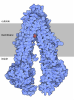
- Assembly
| Deposited unit | 
|
|---|---|
| 1 |
|
-Components
| #1: Protein | Mass: 32320.684 Da / Num. of mol.: 1 Source method: isolated from a genetically manipulated source Source: (gene. exp.) Escherichia coli K-12 (bacteria) / Strain: K-12 / Gene: pstA, phoT, b3726, JW3704 / Production host: Escherichia coli (E. coli) / References: UniProt: P07654 | ||||||||
|---|---|---|---|---|---|---|---|---|---|
| #2: Protein | Mass: 34126.840 Da / Num. of mol.: 1 Source method: isolated from a genetically manipulated source Source: (gene. exp.) Escherichia coli K-12 (bacteria) / Strain: K-12 / Gene: pstC, phoW, b3727, JW3705 / Production host: Escherichia coli (E. coli) / References: UniProt: P0AGH8 | ||||||||
| #3: Protein | Mass: 29060.270 Da / Num. of mol.: 2 Source method: isolated from a genetically manipulated source Source: (gene. exp.) Escherichia coli K-12 (bacteria) / Strain: K-12 / Gene: pstB, phoT, b3725, JW3703 / Production host: Escherichia coli (E. coli) / References: UniProt: P0AAH0, ABC-type phosphate transporter#4: Protein | | Mass: 37024.750 Da / Num. of mol.: 1 Source method: isolated from a genetically manipulated source Source: (gene. exp.) Escherichia coli K-12 (bacteria) / Strain: K-12 / Gene: pstS, phoS, b3728, JW3706 / Production host: Escherichia coli (E. coli) / References: UniProt: P0AG82#5: Chemical | ChemComp-PO4 / | 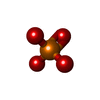 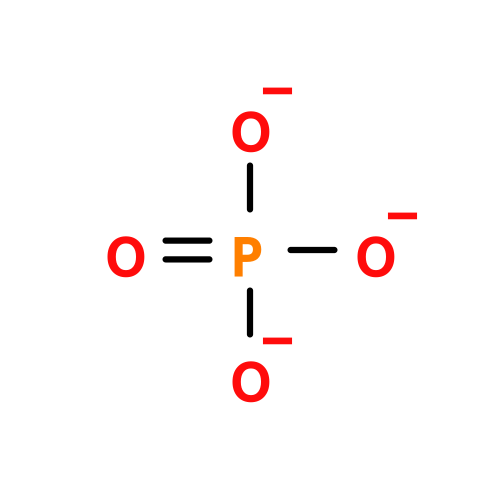 Mass: 94.971 Da / Num. of mol.: 1 / Source method: obtained synthetically / Formula: PO4 / Feature type: SUBJECT OF INVESTIGATION Mass: 94.971 Da / Num. of mol.: 1 / Source method: obtained synthetically / Formula: PO4 / Feature type: SUBJECT OF INVESTIGATIONHas ligand of interest | Y | Has protein modification | N | |
-Experimental details
-Experiment
| Experiment | Method: ELECTRON MICROSCOPY |
|---|---|
| EM experiment | Aggregation state: PARTICLE / 3D reconstruction method: single particle reconstruction |
- Sample preparation
| Component | Name: pstSCAB_4CYS / Type: COMPLEX Details: Cryo-EM structure of E coli pstSCAB in the pretranslocation state Entity ID: #1-#4 / Source: RECOMBINANT |
|---|---|
| Molecular weight | Value: 0.158 MDa / Experimental value: NO |
| Source (natural) | Organism: Escherichia coli (strain K12) (bacteria) |
| Source (recombinant) | Organism: Escherichia coli (E. coli) |
| Buffer solution | pH: 8 |
| Specimen | Conc.: 1 mg/ml / Embedding applied: NO / Shadowing applied: NO / Staining applied: NO / Vitrification applied: YES |
| Vitrification | Cryogen name: ETHANE |
- Electron microscopy imaging
| Experimental equipment |  Model: Titan Krios / Image courtesy: FEI Company |
|---|---|
| Microscopy | Model: TFS KRIOS |
| Electron gun | Electron source:  FIELD EMISSION GUN / Accelerating voltage: 300 kV / Illumination mode: FLOOD BEAM FIELD EMISSION GUN / Accelerating voltage: 300 kV / Illumination mode: FLOOD BEAM |
| Electron lens | Mode: BRIGHT FIELD / Nominal defocus max: 2500 nm / Nominal defocus min: 1200 nm |
| Image recording | Electron dose: 50 e/Å2 / Film or detector model: GATAN K3 (6k x 4k) |
- Processing
| EM software |
| |||||||||
|---|---|---|---|---|---|---|---|---|---|---|
| CTF correction | Type: PHASE FLIPPING AND AMPLITUDE CORRECTION | |||||||||
| 3D reconstruction | Resolution: 2.9 Å / Resolution method: FSC 0.143 CUT-OFF / Num. of particles: 787966 / Symmetry type: POINT | |||||||||
| Atomic model building | Protocol: AB INITIO MODEL |
