 Movie
Movie Controller


+ Open data

- Basic information
| Entry | Database: PDB / ID: 9jl3 | ||||||||||||||||||||||||
|---|---|---|---|---|---|---|---|---|---|---|---|---|---|---|---|---|---|---|---|---|---|---|---|---|---|
| Title | Cryo-EM structure of DRT2-RT-ncRNA binary complex | ||||||||||||||||||||||||
 Components Components |
| ||||||||||||||||||||||||
 Keywords Keywords | ANTIVIRAL PROTEIN / a complex | ||||||||||||||||||||||||
| Function / homology |  Function and homology information Function and homology information | ||||||||||||||||||||||||
| Biological species |  Klebsiella pneumoniae (bacteria) Klebsiella pneumoniae (bacteria) | ||||||||||||||||||||||||
| Method | ELECTRON MICROSCOPY / single particle reconstruction / cryo EM / Resolution: 3.49 Å | ||||||||||||||||||||||||
 Authors Authors | Zhang, H. / Zhang, S. | ||||||||||||||||||||||||
| Funding support |  China, 1items China, 1items
| ||||||||||||||||||||||||
 Citation Citation | Journal: Nucleic Acids Res / Year: 2025 Title: Molecular mechanism of the type 2 defense-associated reverse transcriptase. Authors: Zhikun Liu / Fumeng Liao / Wenqi Wu / Chendi Zhang / Caidie Yue / Aoyan Chen / Shuqin Zhang / Yingcan Liu / Bin Liu / Jie Han / Chuyun Zhang / Xiaoshen Wang / Xuzichao Li / Zhuang Li / Heng Zhang / Hang Yin / Abstract: Defense-associated reverse transcriptase (DRT) systems play a crucial role in prokaryotic defense mechanisms against phage infections. Among the DRT family, DRT2, DRT3, and DRT9 systems employ ...Defense-associated reverse transcriptase (DRT) systems play a crucial role in prokaryotic defense mechanisms against phage infections. Among the DRT family, DRT2, DRT3, and DRT9 systems employ protein-noncoding RNA (ncRNA) co-regulatory mechanisms to execute defense functions. Here, we focus on the DRT2 system from Klebsiella pneumoniae, which consists of a reverse transcriptase (RT) and an essential ncRNA component. Using biochemical and structural approaches, we determine the structure of the DRT2 system and reveal detailed interaction modes between the DRT2-RT protein and the ncRNA, especially mediated by specialized anchoring loops and pseudoknot-related structures. The RT protein adopts a conventional "right-hand" fold, while a flexible region of the ncRNA exhibits dynamic conformations, likely serving as the template for reverse transcription. DRT2 mediates reverse transcription through a conserved DDD catalytic triad that coordinates a divalent Mg²⁺ ion. Notably, a short DNA primer-ncRNA duplex is accommodated in a positively charged pocket formed by the thumb and fingers domains, and both interaction analysis and mutagenesis studies confirm that duplex stabilization is essential for activity. Structural comparison and phylogenetic studies of DRT2 and other RT proteins, such as group II introns and UG/Abi RTs, highlight the unique adaptation with a straight extended thumb domain and specialized structures for ncRNA-binding, exemplifying an evolutionary trajectory of RT proteins. In conclusion, our findings expand the understanding of the distinctive characteristics of the DRT2 system and the diversity of prokaryotic antiviral strategies. | ||||||||||||||||||||||||
| History |
|
- Structure visualization
| Structure viewer | Molecule: MolmilJmol/JSmol |
|---|
- Downloads & links
-Download
| PDBx/mmCIF format | 9jl3.cif.gz | 179.1 KB | Display | PDBx/mmCIF format |
|---|---|---|---|---|
| PDB format | pdb9jl3.ent.gz | 130.5 KB | Display | PDB format |
| PDBx/mmJSON format | 9jl3.json.gz | Tree view | PDBx/mmJSON format | |
| Others |  Other downloads Other downloads |
-Validation report
| Arichive directory | https://data.pdbj.org/pub/pdb/validation_reports/jl/9jl3ftp://data.pdbj.org/pub/pdb/validation_reports/jl/9jl3 | HTTPS FTP |
|---|
-Related structure data
| Related structure data |  61577MC M: map data used to model this data C: citing same article ( |
|---|---|
| Similar structure data |
-Links
 PDBj
PDBj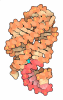
- Assembly
| Deposited unit | 
|
|---|---|
| 1 |
|
-Components
| #1: Protein | Mass: 49788.645 Da / Num. of mol.: 1 Source method: isolated from a genetically manipulated source Source: (gene. exp.) Klebsiella pneumoniae (bacteria) / Gene: drt2, AAFQ03_23310, BCV49_04045, QDV38_25290 / Production host:  Escherichia coli (E. coli) / References: UniProt: A0ABF7SXL6 Escherichia coli (E. coli) / References: UniProt: A0ABF7SXL6 |
|---|---|
| #2: DNA/RNA hybrid | Mass: 91534.867 Da / Num. of mol.: 1 Source method: isolated from a genetically manipulated source Source: (gene. exp.) Klebsiella pneumoniae (bacteria) / Production host: Escherichia coli (E. coli) |
| #3: Chemical | ChemComp-MG /   Mass: 24.305 Da / Num. of mol.: 1 / Source method: obtained synthetically / Formula: Mg Mass: 24.305 Da / Num. of mol.: 1 / Source method: obtained synthetically / Formula: Mg |
| Has ligand of interest | N |
| Has protein modification | N |
-Experimental details
-Experiment
| Experiment | Method: ELECTRON MICROSCOPY |
|---|---|
| EM experiment | Aggregation state: PARTICLE / 3D reconstruction method: single particle reconstruction |
- Sample preparation
| Component | Name: a complex / Type: COMPLEX / Entity ID: #2, #1 / Source: RECOMBINANT |
|---|---|
| Source (natural) | Organism: Klebsiella pneumoniae (bacteria) |
| Source (recombinant) | Organism: Escherichia coli (E. coli) |
| Buffer solution | pH: 7.5 |
| Specimen | Embedding applied: NO / Shadowing applied: NO / Staining applied: NO / Vitrification applied: YES |
| Vitrification | Cryogen name: ETHANE |
- Electron microscopy imaging
| Experimental equipment |  Model: Titan Krios / Image courtesy: FEI Company |
|---|---|
| Microscopy | Model: TFS KRIOS |
| Electron gun | Electron source:  FIELD EMISSION GUN / Accelerating voltage: 300 kV / Illumination mode: FLOOD BEAM FIELD EMISSION GUN / Accelerating voltage: 300 kV / Illumination mode: FLOOD BEAM |
| Electron lens | Mode: BRIGHT FIELD / Nominal defocus max: 2200 nm / Nominal defocus min: 1200 nm |
| Image recording | Electron dose: 54 e/Å2 / Film or detector model: GATAN K3 (6k x 4k) |
- Processing
| EM software |
| ||||||||||||||||||||||||
|---|---|---|---|---|---|---|---|---|---|---|---|---|---|---|---|---|---|---|---|---|---|---|---|---|---|
| CTF correction | Type: PHASE FLIPPING ONLY | ||||||||||||||||||||||||
| 3D reconstruction | Resolution: 3.49 Å / Resolution method: FSC 0.143 CUT-OFF / Num. of particles: 347211 / Symmetry type: POINT | ||||||||||||||||||||||||
| Refinement | Highest resolution: 3.49 Å Stereochemistry target values: REAL-SPACE (WEIGHTED MAP SUM AT ATOM CENTERS) | ||||||||||||||||||||||||
| Refine LS restraints |
|
