 Movie
Movie Controller


+ Open data

- Basic information
| Entry | Database: PDB / ID: 9j84 | |||||||||||||||||||||
|---|---|---|---|---|---|---|---|---|---|---|---|---|---|---|---|---|---|---|---|---|---|---|
| Title | Structureal mechanism of human TRPM3 ion channel inhibition | |||||||||||||||||||||
 Components Components | Maltose/maltodextrin-binding periplasmic protein,Transient receptor potential cation channel subfamily M member 3 | |||||||||||||||||||||
 Keywords Keywords | MEMBRANE PROTEIN / Transient receptor potential cation channel / subfamily M / member 3 | |||||||||||||||||||||
| Function / homology |  Function and homology information Function and homology informationzinc ion transmembrane transport / detection of maltose stimulus / TRP channels / carbohydrate transport / monoatomic cation transmembrane transport / carbohydrate transmembrane transporter activity / maltose binding / maltose transport / monoatomic cation transport / maltodextrin transmembrane transport ...zinc ion transmembrane transport / detection of maltose stimulus / TRP channels / carbohydrate transport / monoatomic cation transmembrane transport / carbohydrate transmembrane transporter activity / maltose binding / maltose transport / monoatomic cation transport / maltodextrin transmembrane transport / ATP-binding cassette (ABC) transporter complex, substrate-binding subunit-containing / monoatomic cation channel activity / phosphatidylinositol-4,5-bisphosphate binding / ATP-binding cassette (ABC) transporter complex / cell chemotaxis / calcium ion transmembrane transport / G-protein beta/gamma-subunit complex binding / calcium channel activity / calcium ion transport / outer membrane-bounded periplasmic space / protein homotetramerization / periplasmic space / calmodulin binding / DNA damage response / membrane / plasma membrane Similarity search - Function | |||||||||||||||||||||
| Biological species |   Escherichia coli K-12 (bacteria) Escherichia coli K-12 (bacteria) Homo sapiens (human) Homo sapiens (human) | |||||||||||||||||||||
| Method | ELECTRON MICROSCOPY / single particle reconstruction / cryo EM / Resolution: 4.21 Å | |||||||||||||||||||||
 Authors Authors | Yang, T.T. / Cheng, X.Y. | |||||||||||||||||||||
| Funding support | 1items
| |||||||||||||||||||||
 Citation Citation | Journal: To Be Published Title: Structureal mechanism of human TRPM3 ion channel inhibition Authors: Yang, T.T. / Cheng, X.Y. | |||||||||||||||||||||
| History |
|
- Structure visualization
| Structure viewer | Molecule: MolmilJmol/JSmol |
|---|
- Downloads & links
-Download
| PDBx/mmCIF format | 9j84.cif.gz | 513.9 KB | Display | PDBx/mmCIF format |
|---|---|---|---|---|
| PDB format | pdb9j84.ent.gz | Display | PDB format | |
| PDBx/mmJSON format | 9j84.json.gz | Tree view | PDBx/mmJSON format | |
| Others |  Other downloads Other downloads |
-Validation report
| Arichive directory | https://data.pdbj.org/pub/pdb/validation_reports/j8/9j84ftp://data.pdbj.org/pub/pdb/validation_reports/j8/9j84 | HTTPS FTP |
|---|
-Related structure data
| Related structure data |  61215MC M: map data used to model this data C: citing same article ( |
|---|---|
| Similar structure data |
-Links
 PDBj
PDBj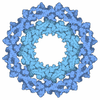
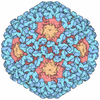
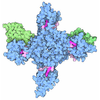
- Assembly
| Deposited unit | 
|
|---|---|
| 1 |
|
-Components
| #1: Protein | Mass: 183408.453 Da / Num. of mol.: 4 Source method: isolated from a genetically manipulated source Source: (gene. exp.) Escherichia coli K-12 (bacteria), (gene. exp.) Homo sapiens (human)Gene: malE, b4034, JW3994, TRPM3, KIAA1616, LTRPC3 / Production host: Homo sapiens (human) / References: UniProt: P0AEX9, UniProt: Q9HCF6#2: Chemical | ChemComp-A1EA5 / ~{ Mass: 418.510 Da / Num. of mol.: 4 / Source method: obtained synthetically / Formula: C20H26N4O4S / Feature type: SUBJECT OF INVESTIGATION Has ligand of interest | Y | Has protein modification | N | |
|---|
-Experimental details
-Experiment
| Experiment | Method: ELECTRON MICROSCOPY |
|---|---|
| EM experiment | Aggregation state: PARTICLE / 3D reconstruction method: single particle reconstruction |
- Sample preparation
| Component | Name: human TRPM3 ion channel / Type: COMPLEX / Entity ID: #1 / Source: RECOMBINANT | ||||||||||||
|---|---|---|---|---|---|---|---|---|---|---|---|---|---|
| Molecular weight | Experimental value: NO | ||||||||||||
| Source (natural) |
| ||||||||||||
| Source (recombinant) | Organism: Homo sapiens (human) | ||||||||||||
| Buffer solution | pH: 7.5 | ||||||||||||
| Specimen | Embedding applied: NO / Shadowing applied: NO / Staining applied: NO / Vitrification applied: YES | ||||||||||||
| Vitrification | Cryogen name: ETHANE |
- Electron microscopy imaging
| Experimental equipment | 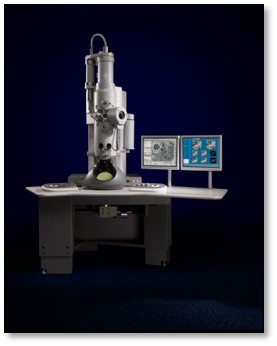 Model: Tecnai Spirit / Image courtesy: FEI Company |
|---|---|
| Microscopy | Model: FEI TECNAI SPIRIT |
| Electron gun | Electron source:  FIELD EMISSION GUN / Accelerating voltage: 300 kV / Illumination mode: FLOOD BEAM FIELD EMISSION GUN / Accelerating voltage: 300 kV / Illumination mode: FLOOD BEAM |
| Electron lens | Mode: BRIGHT FIELD / Nominal defocus max: 2000 nm / Nominal defocus min: 1000 nm |
| Image recording | Electron dose: 50.13 e/Å2 / Film or detector model: FEI FALCON III (4k x 4k) |
- Processing
| EM software |
| |||||||||
|---|---|---|---|---|---|---|---|---|---|---|
| CTF correction | Type: PHASE FLIPPING AND AMPLITUDE CORRECTION | |||||||||
| 3D reconstruction | Resolution: 4.21 Å / Resolution method: FSC 0.143 CUT-OFF / Num. of particles: 106477 / Symmetry type: POINT |
