 Movie
Movie Controller


+ Open data

- Basic information
| Entry | Database: PDB / ID: 9irg | ||||||||||||||||||||||||
|---|---|---|---|---|---|---|---|---|---|---|---|---|---|---|---|---|---|---|---|---|---|---|---|---|---|
| Title | Cryo-EM Structure of RNA | ||||||||||||||||||||||||
 Components Components |
| ||||||||||||||||||||||||
 Keywords Keywords | RNA BINDING PROTEIN/RNA / RNA BINDING PROTEIN-RNA complex | ||||||||||||||||||||||||
| Function / homology | CRISPR-associated protein Csy3 / CRISPR-associated protein (Cas_Csy3) / defense response to virus / RNA / RNA (> 10) / RNA (> 100) / CRISPR-associated protein Csy3 Function and homology information Function and homology information | ||||||||||||||||||||||||
| Biological species |  Pectobacterium atrosepticum SCRI1043 (bacteria)Thiocystis violascens (bacteria) Pectobacterium atrosepticum SCRI1043 (bacteria)Thiocystis violascens (bacteria) | ||||||||||||||||||||||||
| Method | ELECTRON MICROSCOPY / single particle reconstruction / cryo EM / Resolution: 4.59 Å | ||||||||||||||||||||||||
 Authors Authors | Gao, X. / Cui, S. / Zhu, H. / Zhu, K. / Shang, K. | ||||||||||||||||||||||||
| Funding support | 1items
| ||||||||||||||||||||||||
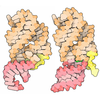
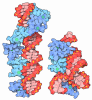
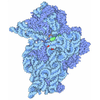
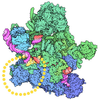
 Citation Citation | Journal: Mol Cell / Year: 2026 Title: RNA anti-CRISPRs deplete Cas proteins to inhibit the CRISPR-Cas system. Authors: Xiaopan Gao / Kaixiang Zhu / Weihe Zhang / Lin Wang / Linyue Wang / Lei Hua / Tongxin Niu / Bo Qin / Xia Yu / Hongtao Zhu / Sheng Cui /  Abstract: RNA-based anti-CRISPRs (Racrs) interfere with the type I-F CRISPR-Cas system by mimicking the repeats found in CRISPR arrays. Here, we determined the cryo-electron microscopy (cryo-EM) structures of ...RNA-based anti-CRISPRs (Racrs) interfere with the type I-F CRISPR-Cas system by mimicking the repeats found in CRISPR arrays. Here, we determined the cryo-electron microscopy (cryo-EM) structures of the type I-F crRNA-guided surveillance complex (Csy complex) from Pectobacterium atrosepticum and three RacrIF1-induced aberrant subcomplexes. Additionally, we observed that Cas7f proteins could bind to non-specific nucleic acids, forming right-handed superhelical filaments composed of different Cas7 copies. Mechanistically, RacrIF1 lacks the specific S-conformation observed in the corresponding position of the 5' handle in canonical CRISPR complexes, and it instead adopts a periodic "5 + 1" pattern. This conformation creates severe steric hindrance for Cas5f-Cas8f heterodimer and undermines their binding. Furthermore, Cas7f nonspecifically binds nucleic acids and can form infinite superhelical filaments along Racrs molecules. This oligomerization sequesters Cas6f and Cas7f from binding, therefore blocking the formation of functional CRISPR-Cas effector complexes and ultimately blocking antiviral immunity. Our study provides a structural basis underlying Racrs-mediated CRISPRs inhibition. | ||||||||||||||||||||||||
| History |
|
- Structure visualization
| Structure viewer | Molecule: MolmilJmol/JSmol |
|---|
- Downloads & links
-Download
| PDBx/mmCIF format | 9irg.cif.gz | 2.7 MB | Display | PDBx/mmCIF format |
|---|---|---|---|---|
| PDB format | pdb9irg.ent.gz | Display | PDB format | |
| PDBx/mmJSON format | 9irg.json.gz | Tree view | PDBx/mmJSON format | |
| Others |  Other downloads Other downloads |
-Validation report
| Arichive directory | https://data.pdbj.org/pub/pdb/validation_reports/ir/9irgftp://data.pdbj.org/pub/pdb/validation_reports/ir/9irg | HTTPS FTP |
|---|
-Related structure data
| Related structure data |  60813MC  9irfC  9iriC  9xcfC  9xcgC M: map data used to model this data C: citing same article ( |
|---|---|
| Similar structure data |


-Links
 PDBj
PDBj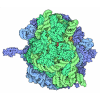
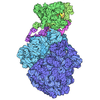
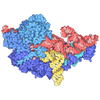
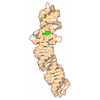
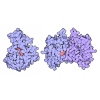
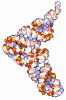
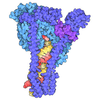
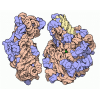
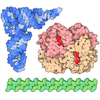
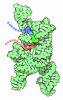
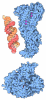
- Assembly
| Deposited unit | 
|
|---|---|
| 1 |
|
-Components
| #1: Protein | Mass: 36948.512 Da / Num. of mol.: 26 Source method: isolated from a genetically manipulated source Source: (gene. exp.) Pectobacterium atrosepticum SCRI1043 (bacteria)Gene: csy3, ECA3683 / Production host:  Escherichia coli (E. coli) / References: UniProt: Q6D0W6 Escherichia coli (E. coli) / References: UniProt: Q6D0W6#2: RNA chain | | Mass: 52476.230 Da / Num. of mol.: 1 Source method: isolated from a genetically manipulated source Source: (gene. exp.) Thiocystis violascens (bacteria) / Production host: Escherichia coli (E. coli)Has protein modification | N | |
|---|
-Experimental details
-Experiment
| Experiment | Method: ELECTRON MICROSCOPY |
|---|---|
| EM experiment | Aggregation state: PARTICLE / 3D reconstruction method: single particle reconstruction |
- Sample preparation
| Component | Name: complex of RNA / Type: COMPLEX / Entity ID: all / Source: RECOMBINANT |
|---|---|
| Source (natural) | Organism: Pectobacterium atrosepticum SCRI1043 (bacteria) |
| Source (recombinant) | Organism: Escherichia coli (E. coli) |
| Buffer solution | pH: 7.4 |
| Specimen | Embedding applied: NO / Shadowing applied: NO / Staining applied: NO / Vitrification applied: YES |
| Vitrification | Cryogen name: ETHANE |
- Electron microscopy imaging
| Experimental equipment |  Model: Titan Krios / Image courtesy: FEI Company |
|---|---|
| Microscopy | Model: TFS KRIOS |
| Electron gun | Electron source:  FIELD EMISSION GUN / Accelerating voltage: 300 kV / Illumination mode: FLOOD BEAM FIELD EMISSION GUN / Accelerating voltage: 300 kV / Illumination mode: FLOOD BEAM |
| Electron lens | Mode: BRIGHT FIELD / Nominal magnification: 2500 X / Nominal defocus max: 2500 nm / Nominal defocus min: 1800 nm / Calibrated defocus max: 2500 nm / Alignment procedure: COMA FREE |
| Specimen holder | Cryogen: NITROGEN / Specimen holder model: FEI TITAN KRIOS AUTOGRID HOLDER |
| Image recording | Electron dose: 55 e/Å2 / Film or detector model: GATAN K3 (6k x 4k) |
- Processing
| EM software |
| ||||||||||||||||
|---|---|---|---|---|---|---|---|---|---|---|---|---|---|---|---|---|---|
| CTF correction | Type: PHASE FLIPPING ONLY | ||||||||||||||||
| 3D reconstruction | Resolution: 4.59 Å / Resolution method: FSC 0.143 CUT-OFF / Num. of particles: 9887 / Symmetry type: POINT | ||||||||||||||||
| Refinement | Stereochemistry target values: REAL-SPACE (WEIGHTED MAP SUM AT ATOM CENTERS) |
