 Movie
Movie Controller

[English] 日本語
 Yorodumi
- PDB-9i1j: Cryo-EM structure of mouse RNF213:UBE2L3 transthiolation intermed... -
+ Open data

- Basic information
| Entry | Database: PDB / ID: 9i1j | ||||||
|---|---|---|---|---|---|---|---|
| Title | Cryo-EM structure of mouse RNF213:UBE2L3 transthiolation intermediate, chemically stabilized, and ATPgS | ||||||
 Components Components |
| ||||||
 Keywords Keywords | LIGASE / E3 ligase / ubiquitin / AAA ATPase | ||||||
| Function / homology |  Function and homology information Function and homology informationlipid ubiquitination / negative regulation of non-canonical Wnt signaling pathway / lipid droplet formation / cell cycle phase transition / ubiquitin-protein transferase activator activity / xenophagy / Antigen processing: Ubiquitination & Proteasome degradation / protein K11-linked ubiquitination / sprouting angiogenesis / Transferases; Acyltransferases; Aminoacyltransferases ...lipid ubiquitination / negative regulation of non-canonical Wnt signaling pathway / lipid droplet formation / cell cycle phase transition / ubiquitin-protein transferase activator activity / xenophagy / Antigen processing: Ubiquitination & Proteasome degradation / protein K11-linked ubiquitination / sprouting angiogenesis / Transferases; Acyltransferases; Aminoacyltransferases / : / cellular response to glucocorticoid stimulus / E2 ubiquitin-conjugating enzyme / cellular response to steroid hormone stimulus / ubiquitin conjugating enzyme activity / regulation of lipid metabolic process / protein K63-linked ubiquitination / immune system process / ubiquitin ligase complex / protein autoubiquitination / lipid droplet / Synthesis of active ubiquitin: roles of E1 and E2 enzymes / positive regulation of protein ubiquitination / PINK1-PRKN Mediated Mitophagy / Regulation of TNFR1 signaling / RING-type E3 ubiquitin transferase / protein modification process / Regulation of necroptotic cell death / Hydrolases; Acting on acid anhydrides; Acting on acid anhydrides to facilitate cellular and subcellular movement / protein polyubiquitination / ubiquitin-protein transferase activity / ubiquitin protein ligase activity / Antigen processing: Ubiquitination & Proteasome degradation / E3 ubiquitin ligases ubiquitinate target proteins / angiogenesis / ubiquitin-dependent protein catabolic process / transcription coactivator activity / cell population proliferation / defense response to bacterium / protein ubiquitination / ubiquitin protein ligase binding / regulation of DNA-templated transcription / enzyme binding / ATP hydrolysis activity / RNA binding / zinc ion binding / nucleoplasm / ATP binding / nucleus / cytosol / cytoplasm Similarity search - Function | ||||||
| Biological species |   Mus musculus (house mouse) Mus musculus (house mouse) Homo sapiens (human) Homo sapiens (human) | ||||||
| Method | ELECTRON MICROSCOPY / single particle reconstruction / cryo EM / Resolution: 3.8 Å | ||||||
 Authors Authors | Grabarczyk, D.B. / Ahel, J. / Clausen, T. | ||||||
| Funding support |  Austria, 1items Austria, 1items
| ||||||
 Citation Citation | Journal: Nat Commun / Year: 2025 Title: ATP functions as a pathogen-associated molecular pattern to activate the E3 ubiquitin ligase RNF213. Authors: Juraj Ahel / Arda Balci / Victoria Faas / Daniel B Grabarczyk / Roosa Harmo / Daniel R Squair / Jiazhen Zhang / Elisabeth Roitinger / Frederic Lamoliatte / Sunil Mathur / Luiza Deszcz / ...Authors: Juraj Ahel / Arda Balci / Victoria Faas / Daniel B Grabarczyk / Roosa Harmo / Daniel R Squair / Jiazhen Zhang / Elisabeth Roitinger / Frederic Lamoliatte / Sunil Mathur / Luiza Deszcz / Lillie E Bell / Anita Lehner / Thomas L Williams / Hanna Sowar / Anton Meinhart / Nicola T Wood / Tim Clausen / Satpal Virdee / Adam J Fletcher /  Abstract: The giant E3 ubiquitin ligase RNF213 is a conserved component of mammalian cell-autonomous immunity, limiting the replication of bacteria, viruses and parasites. To understand how RNF213 reacts to ...The giant E3 ubiquitin ligase RNF213 is a conserved component of mammalian cell-autonomous immunity, limiting the replication of bacteria, viruses and parasites. To understand how RNF213 reacts to these unrelated pathogens, we employ chemical and structural biology to find that ATP binding to its ATPases Associated with diverse cellular Activities (AAA) core activates its E3 function. We develop methodology for proteome-wide E3 activity profiling inside living cells, revealing that RNF213 undergoes a reversible switch in E3 activity in response to cellular ATP abundance. Interferon stimulation of macrophages raises intracellular ATP levels and primes RNF213 E3 activity, while glycolysis inhibition depletes ATP and downregulates E3 activity. These data imply that ATP bears hallmarks of a danger/pathogen associated molecular pattern, coordinating cell-autonomous defence. Furthermore, quantitative labelling of RNF213 with E3-activity probes enabled us to identify the catalytic cysteine required for substrate ubiquitination and obtain a cryo-EM structure of the RNF213-E2-ubiquitin conjugation enzyme transfer intermediate, illuminating an unannotated E2 docking site. Together, our data demonstrate that RNF213 represents a new class of ATP-dependent E3 enzyme, employing distinct catalytic and regulatory mechanisms adapted to its specialised role in the broad defence against intracellular pathogens. #1: Journal: Acta Crystallogr D Struct Biol / Year: 2019 Title: Macromolecular structure determination using X-rays, neutrons and electrons: recent developments in Phenix. Authors: Dorothee Liebschner / Pavel V Afonine / Matthew L Baker / Gábor Bunkóczi / Vincent B Chen / Tristan I Croll / Bradley Hintze / Li Wei Hung / Swati Jain / Airlie J McCoy / Nigel W Moriarty ...Authors: Dorothee Liebschner / Pavel V Afonine / Matthew L Baker / Gábor Bunkóczi / Vincent B Chen / Tristan I Croll / Bradley Hintze / Li Wei Hung / Swati Jain / Airlie J McCoy / Nigel W Moriarty / Robert D Oeffner / Billy K Poon / Michael G Prisant / Randy J Read / Jane S Richardson / David C Richardson / Massimo D Sammito / Oleg V Sobolev / Duncan H Stockwell / Thomas C Terwilliger / Alexandre G Urzhumtsev / Lizbeth L Videau / Christopher J Williams / Paul D Adams /   Abstract: Diffraction (X-ray, neutron and electron) and electron cryo-microscopy are powerful methods to determine three-dimensional macromolecular structures, which are required to understand biological ...Diffraction (X-ray, neutron and electron) and electron cryo-microscopy are powerful methods to determine three-dimensional macromolecular structures, which are required to understand biological processes and to develop new therapeutics against diseases. The overall structure-solution workflow is similar for these techniques, but nuances exist because the properties of the reduced experimental data are different. Software tools for structure determination should therefore be tailored for each method. Phenix is a comprehensive software package for macromolecular structure determination that handles data from any of these techniques. Tasks performed with Phenix include data-quality assessment, map improvement, model building, the validation/rebuilding/refinement cycle and deposition. Each tool caters to the type of experimental data. The design of Phenix emphasizes the automation of procedures, where possible, to minimize repetitive and time-consuming manual tasks, while default parameters are chosen to encourage best practice. A graphical user interface provides access to many command-line features of Phenix and streamlines the transition between programs, project tracking and re-running of previous tasks. | ||||||
| History |
|
- Structure visualization
| Structure viewer | Molecule: MolmilJmol/JSmol |
|---|
- Downloads & links
-Download
| PDBx/mmCIF format | 9i1j.cif.gz | 838.8 KB | Display | PDBx/mmCIF format |
|---|---|---|---|---|
| PDB format | pdb9i1j.ent.gz | 665.5 KB | Display | PDB format |
| PDBx/mmJSON format | 9i1j.json.gz | Tree view | PDBx/mmJSON format | |
| Others |  Other downloads Other downloads |
-Validation report
| Summary document | 9i1j_validation.pdf.gz | 1.8 MB | Display | wwPDB validaton report |
|---|---|---|---|---|
| Full document | 9i1j_full_validation.pdf.gz | 1.9 MB | Display | |
| Data in XML | 9i1j_validation.xml.gz | 135.9 KB | Display | |
| Data in CIF | 9i1j_validation.cif.gz | 205.7 KB | Display | |
| Arichive directory | https://data.pdbj.org/pub/pdb/validation_reports/i1/9i1jftp://data.pdbj.org/pub/pdb/validation_reports/i1/9i1j | HTTPS FTP |
-Related structure data
| Related structure data |  52571MC  9i1iC M: map data used to model this data C: citing same article ( |
|---|---|
| Similar structure data |

-Links
 PDBj
PDBj
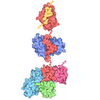
- Assembly
| Deposited unit | 
|
|---|---|
| 1 |
|
-Components
-Protein , 2 types, 2 molecules AB
| #1: Protein | Mass: 552623.375 Da / Num. of mol.: 1 / Mutation: delta N300 Source method: isolated from a genetically manipulated source Source: (gene. exp.) Mus musculus (house mouse) / Gene: Rnf213, Mystr / Production host:  Trichoplusia ni (cabbage looper) Trichoplusia ni (cabbage looper)References: UniProt: E9Q555, RING-type E3 ubiquitin transferase, Hydrolases; Acting on acid anhydrides; Acting on acid anhydrides to facilitate cellular and subcellular movement |
|---|---|
| #2: Protein | Mass: 19197.908 Da / Num. of mol.: 1 Source method: isolated from a genetically manipulated source Source: (gene. exp.) Homo sapiens (human) / Gene: UBE2L3, UBCE7, UBCH7 / Production host:   Escherichia coli (E. coli) Escherichia coli (E. coli)References: UniProt: P68036, E2 ubiquitin-conjugating enzyme |
-Non-polymers , 4 types, 6 molecules 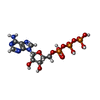


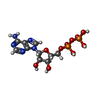
| #3: Chemical | ChemComp-ATP / 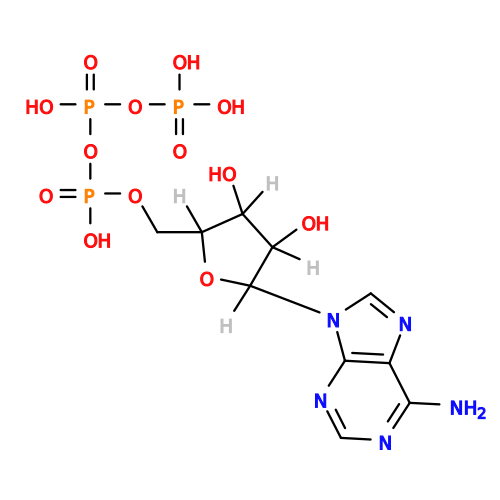 Mass: 507.181 Da / Num. of mol.: 1 / Source method: obtained synthetically / Formula: C10H16N5O13P3 / Feature type: SUBJECT OF INVESTIGATION / Comment: ATP, energy-carrying molecule*YM Mass: 507.181 Da / Num. of mol.: 1 / Source method: obtained synthetically / Formula: C10H16N5O13P3 / Feature type: SUBJECT OF INVESTIGATION / Comment: ATP, energy-carrying molecule*YM | ||
|---|---|---|---|
| #4: Chemical | ChemComp-MG /  Mass: 24.305 Da / Num. of mol.: 1 / Source method: obtained synthetically / Formula: Mg / Feature type: SUBJECT OF INVESTIGATION Mass: 24.305 Da / Num. of mol.: 1 / Source method: obtained synthetically / Formula: Mg / Feature type: SUBJECT OF INVESTIGATION | ||
| #5: Chemical |  Mass: 65.409 Da / Num. of mol.: 2 / Source method: obtained synthetically / Formula: Zn Mass: 65.409 Da / Num. of mol.: 2 / Source method: obtained synthetically / Formula: Zn#6: Chemical | 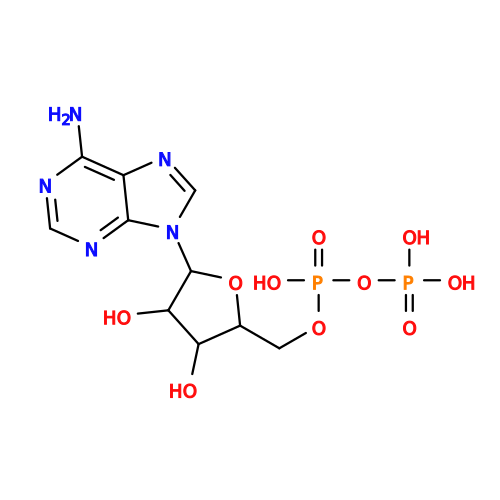 Mass: 427.201 Da / Num. of mol.: 2 / Source method: obtained synthetically / Formula: C10H15N5O10P2 / Feature type: SUBJECT OF INVESTIGATION / Comment: ADP, energy-carrying molecule*YM Mass: 427.201 Da / Num. of mol.: 2 / Source method: obtained synthetically / Formula: C10H15N5O10P2 / Feature type: SUBJECT OF INVESTIGATION / Comment: ADP, energy-carrying molecule*YM |
-Details
| Has ligand of interest | Y |
|---|---|
| Has protein modification | Y |
-Experimental details
-Experiment
| Experiment | Method: ELECTRON MICROSCOPY |
|---|---|
| EM experiment | Aggregation state: PARTICLE / 3D reconstruction method: single particle reconstruction |
- Sample preparation
| Component | Name: Mouse RNF213:UBE2L3 transthiolation intermediate / Type: COMPLEX / Entity ID: #1-#2 / Source: RECOMBINANT |
|---|---|
| Source (natural) | Organism: Mus musculus (house mouse) |
| Source (recombinant) | Organism: Trichoplusia ni (cabbage looper) |
| Buffer solution | pH: 8 |
| Specimen | Embedding applied: NO / Shadowing applied: NO / Staining applied: NO / Vitrification applied: YES |
| Vitrification | Cryogen name: ETHANE |
- Electron microscopy imaging
| Experimental equipment |  Model: Titan Krios / Image courtesy: FEI Company |
|---|---|
| Microscopy | Model: TFS KRIOS |
| Electron gun | Electron source:  FIELD EMISSION GUN / Accelerating voltage: 300 kV / Illumination mode: FLOOD BEAM FIELD EMISSION GUN / Accelerating voltage: 300 kV / Illumination mode: FLOOD BEAM |
| Electron lens | Mode: BRIGHT FIELD / Nominal defocus max: 2500 nm / Nominal defocus min: 800 nm |
| Image recording | Electron dose: 50 e/Å2 / Film or detector model: FEI FALCON IV (4k x 4k) |
- Processing
| EM software | Name: PHENIX / Version: 1.21.2_5419 / Category: model refinement |
|---|---|
| CTF correction | Type: PHASE FLIPPING AND AMPLITUDE CORRECTION |
| 3D reconstruction | Resolution: 3.8 Å / Resolution method: FSC 0.143 CUT-OFF / Num. of particles: 31607 / Symmetry type: POINT |
| Refinement | Highest resolution: 3.8 Å Stereochemistry target values: REAL-SPACE (WEIGHTED MAP SUM AT ATOM CENTERS) |
