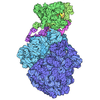
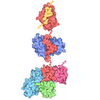
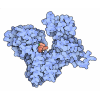
Journal: Science / Year: 2026 Title: Termination of the integrated stress response. Authors: Claudia De Miguel / Sigurdur R Thorkelsson / Agnieszka Fatalska / George Hodgson / Maximillian Dalglish / Chao Wang / Anne Bertolotti / Abstract: Stress responses enable cells to detect, adapt to, and survive challenges. The benefit of these signaling pathways depends on their reversibility. The integrated stress response (ISR) is elicited by ...Stress responses enable cells to detect, adapt to, and survive challenges. The benefit of these signaling pathways depends on their reversibility. The integrated stress response (ISR) is elicited by phosphorylation of eukaryotic translation initiation factor eIF2, which traps and inhibits rate-limiting translation factor eIF2B, thereby attenuating translation initiation. Termination of this pathway thus requires relieving eIF2B from P-eIF2 inhibition. Here, we found that eIF2 phosphatase subunits PPP1R15A and PPP1R15B (R15B) bound P-eIF2 in complex with eIF2B. Biochemical investigations guided by cryo-electron microscopy structures of native eIF2-eIF2B and P-eIF2-eIF2B complexes bound to R15B demonstrated that R15B enabled dephosphorylation of otherwise dephosphorylation-incompetent P-eIF2 on eIF2B. This sheds light on ISR termination, revealing that R15B rescues eIF2B from P-eIF2 inhibition, thereby safeguarding translation and cell fitness.
History
Deposition
Dec 27, 2024
Deposition site: PDBE / Processing site: PDBE
Revision 1.0
Nov 19, 2025
Provider: repository / Type: Initial release
Revision 1.0
Nov 19, 2025
Data content type: EM metadata / Data content type: EM metadata / Provider: repository / Type: Initial release
Revision 1.0
Nov 19, 2025
Data content type: Half map / Part number: 1 / Data content type: Half map / Provider: repository / Type: Initial release
Revision 1.0
Nov 19, 2025
Data content type: Half map / Part number: 2 / Data content type: Half map / Provider: repository / Type: Initial release
Revision 1.0
Nov 19, 2025
Data content type: Image / Data content type: Image / Provider: repository / Type: Initial release
Revision 1.0
Nov 19, 2025
Data content type: Mask / Data content type: Mask / Provider: repository / Type: Initial release
Revision 1.0
Nov 19, 2025
Data content type: Primary map / Data content type: Primary map / Provider: repository / Type: Initial release
Revision 1.0
Nov 19, 2025
Data content type: Half map / Part number: 1 / Data content type: Half map / Provider: repository / Type: Initial release
Revision 1.0
Nov 19, 2025
Data content type: Half map / Part number: 2 / Data content type: Half map / Provider: repository / Type: Initial release
Revision 1.0
Nov 19, 2025
Data content type: Image / Data content type: Image / Provider: repository / Type: Initial release
Revision 1.0
Nov 19, 2025
Data content type: Mask / Data content type: Mask / Provider: repository / Type: Initial release
Revision 1.0
Nov 19, 2025
Data content type: Primary map / Data content type: Primary map / Provider: repository / Type: Initial release
Data content type: EM metadata / Data content type: EM metadata / EM metadata / Group: Database references / Experimental summary / Data content type: EM metadata / EM metadata / EM metadata / Category: citation / citation_author / em_admin Data content type: EM metadata / EM metadata ...EM metadata / EM metadata / EM metadata / EM metadata / EM metadata Item: _citation.journal_volume / _citation.page_first ..._citation.journal_volume / _citation.page_first / _citation.page_last / _citation.year / _em_admin.last_update
In the structure databanks used in Yorodumi, some data are registered as the other names, "COVID-19 virus" and "2019-nCoV". Here are the details of the virus and the list of structure data.
Jan 31, 2019. EMDB accession codes are about to change! (news from PDBe EMDB page)
EMDB accession codes are about to change! (news from PDBe EMDB page)
The allocation of 4 digits for EMDB accession codes will soon come to an end. Whilst these codes will remain in use, new EMDB accession codes will include an additional digit and will expand incrementally as the available range of codes is exhausted. The current 4-digit format prefixed with “EMD-” (i.e. EMD-XXXX) will advance to a 5-digit format (i.e. EMD-XXXXX), and so on. It is currently estimated that the 4-digit codes will be depleted around Spring 2019, at which point the 5-digit format will come into force.
The EM Navigator/Yorodumi systems omit the EMD- prefix.
Related info.:Q: What is EMD? / ID/Accession-code notation in Yorodumi/EM Navigator
Yorodumi is a browser for structure data from EMDB, PDB, SASBDB, etc.
This page is also the successor to EM Navigator detail page, and also detail information page/front-end page for Omokage search.
The word "yorodu" (or yorozu) is an old Japanese word meaning "ten thousand". "mi" (miru) is to see.
Related info.:EMDB / PDB / SASBDB / Comparison of 3 databanks / Yorodumi Search / Aug 31, 2016. New EM Navigator & Yorodumi / Yorodumi Papers / Jmol/JSmol / Function and homology information / Changes in new EM Navigator and Yorodumi
 Movie
Movie Controller


 Open data
 Basic information
 Components
 Keywords
 Function and homology information
 Homo sapiens (human)
 Authors
 United Kingdom, 2items
  Citation
 Structure visualization
 Downloads & links
 Other downloads


 PDBj
PDBj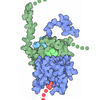


 Assembly
 Sample preparation
 Electron microscopy imaging
 FIELD EMISSION GUN / Accelerating voltage: 300 kV / Illumination mode: FLOOD BEAM
 Processing