- PDB-9hc3: Apo-state structure of the human metabotropic glutamate receptor ... -
+
Open data
ID or keywords:
Loading...
-
Basic information
Entry
Database: PDB / ID: 9hc3
Title
Apo-state structure of the human metabotropic glutamate receptor 5 transmembrane domain freeze-trapped after light activation of photoswitchable ligand alloswitch-1
Components
Metabotropic glutamate receptor 5,Endolysin
Keywords
SIGNALING PROTEIN / G protein-coupled receptor
Function / homology
Function and homology information
: / A2A adenosine receptor binding / sensory perception of hot stimulus / negative regulation of dendritic spine morphogenesis / operant conditioning / G protein-coupled receptor activity involved in regulation of postsynaptic membrane potential / adenylate cyclase inhibiting G protein-coupled glutamate receptor activity / protein localization to nuclear inner membrane / positive regulation of cellular response to hypoxia / phospholipase C-activating G protein-coupled glutamate receptor signaling pathway ...: / A2A adenosine receptor binding / sensory perception of hot stimulus / negative regulation of dendritic spine morphogenesis / operant conditioning / G protein-coupled receptor activity involved in regulation of postsynaptic membrane potential / adenylate cyclase inhibiting G protein-coupled glutamate receptor activity / protein localization to nuclear inner membrane / positive regulation of cellular response to hypoxia / phospholipase C-activating G protein-coupled glutamate receptor signaling pathway / positive regulation of long-term neuronal synaptic plasticity / positive regulation of sensory perception of pain / positive regulation of dopamine secretion / negative regulation of excitatory postsynaptic potential / desensitization of G protein-coupled receptor signaling pathway / G protein-coupled glutamate receptor signaling pathway / positive regulation of neural precursor cell proliferation / Class C/3 (Metabotropic glutamate/pheromone receptors) / nuclear inner membrane / Neurexins and neuroligins / glutamate receptor activity / response to corticosterone / astrocyte projection / response to morphine / temperature homeostasis / protein tyrosine kinase activator activity / viral release from host cell by cytolysis / conditioned place preference / regulation of synaptic transmission, glutamatergic / positive regulation of calcium-mediated signaling / peptidoglycan catabolic process / response to amphetamine / regulation of long-term synaptic depression / protein tyrosine kinase binding / dendritic shaft / synapse organization / postsynaptic density membrane / cognition / Schaffer collateral - CA1 synapse / G protein-coupled receptor activity / cellular response to amyloid-beta / cell wall macromolecule catabolic process / lysozyme / lysozyme activity / positive regulation of cytosolic calcium ion concentration / chemical synaptic transmission / dendritic spine / G alpha (q) signalling events / response to ethanol / defense response to bacterium / learning or memory / positive regulation of MAPK cascade / response to antibiotic / neuronal cell body / regulation of DNA-templated transcription / host cell cytoplasm / dendrite / glutamatergic synapse / identical protein binding / plasma membrane / cytoplasm Similarity search - Function
GPCR, family 3, metabotropic glutamate receptor 5 / Metabotropic glutamate receptor, Homer-binding domain / Homer-binding domain of metabotropic glutamate receptor / GluR_Homer-bdg / GPCR, family 3, metabotropic glutamate receptor / : / G-protein coupled receptors family 3 signature 1. / G-protein coupled receptors family 3 signature 3. / G-protein coupled receptors family 3 signature 2. / GPCR, family 3, nine cysteines domain ...GPCR, family 3, metabotropic glutamate receptor 5 / Metabotropic glutamate receptor, Homer-binding domain / Homer-binding domain of metabotropic glutamate receptor / GluR_Homer-bdg / GPCR, family 3, metabotropic glutamate receptor / : / G-protein coupled receptors family 3 signature 1. / G-protein coupled receptors family 3 signature 3. / G-protein coupled receptors family 3 signature 2. / GPCR, family 3, nine cysteines domain / GPCR, family 3, nine cysteines domain superfamily / Nine Cysteines Domain of family 3 GPCR / GPCR, family 3, conserved site / GPCR, family 3 / G-protein coupled receptors family 3 profile. / GPCR family 3, C-terminal / 7 transmembrane sweet-taste receptor of 3 GCPR / Endolysin T4 type / T4-type lysozyme / : / Glycoside hydrolase, family 24 / Phage lysozyme / Lysozyme domain superfamily / Receptor, ligand binding region / Receptor family ligand binding region / Periplasmic binding protein-like I / Lysozyme-like domain superfamily Similarity search - Domain/homology
In the structure databanks used in Yorodumi, some data are registered as the other names, "COVID-19 virus" and "2019-nCoV". Here are the details of the virus and the list of structure data.
Jan 31, 2019. EMDB accession codes are about to change! (news from PDBe EMDB page)
EMDB accession codes are about to change! (news from PDBe EMDB page)
The allocation of 4 digits for EMDB accession codes will soon come to an end. Whilst these codes will remain in use, new EMDB accession codes will include an additional digit and will expand incrementally as the available range of codes is exhausted. The current 4-digit format prefixed with “EMD-” (i.e. EMD-XXXX) will advance to a 5-digit format (i.e. EMD-XXXXX), and so on. It is currently estimated that the 4-digit codes will be depleted around Spring 2019, at which point the 5-digit format will come into force.
The EM Navigator/Yorodumi systems omit the EMD- prefix.
Related info.:Q: What is EMD? / ID/Accession-code notation in Yorodumi/EM Navigator
Yorodumi is a browser for structure data from EMDB, PDB, SASBDB, etc.
This page is also the successor to EM Navigator detail page, and also detail information page/front-end page for Omokage search.
The word "yorodu" (or yorozu) is an old Japanese word meaning "ten thousand". "mi" (miru) is to see.
Related info.:EMDB / PDB / SASBDB / Comparison of 3 databanks / Yorodumi Search / Aug 31, 2016. New EM Navigator & Yorodumi / Yorodumi Papers / Jmol/JSmol / Function and homology information / Changes in new EM Navigator and Yorodumi
 Movie
Movie Controller

 Yorodumi
 Open data
 Basic information
 Components
 Keywords
 Function and homology information
 Homo sapiens (human)
 Enterobacteria phage T4 (virus)
 X-RAY DIFFRACTION /
  Authors
 Switzerland,
  Germany, 4items
  Citation
 Structure visualization
 Downloads & links
 Other downloads
 PDBj
PDBj
 Assembly
 Trichoplusia ni (cabbage looper) / References: UniProt: P41594, UniProt: P00720, lysozyme
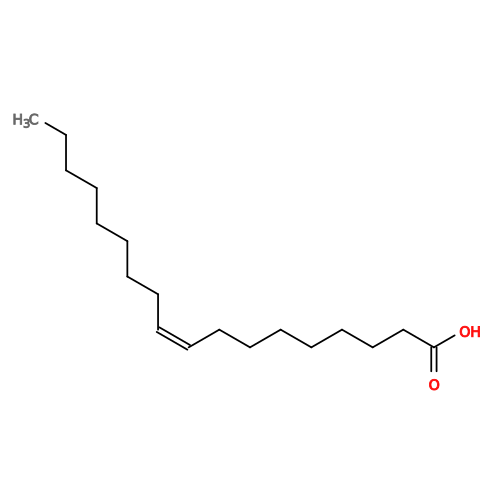 Mass: 282.461 Da / Num. of mol.: 4 / Source method: obtained synthetically / Formula: C18H34O2
 Mass: 18.015 Da / Num. of mol.: 17 / Source method: isolated from a natural source / Formula: H2O
 Sample preparation
 Processing