 Movie
Movie Controller

[English] 日本語
 Yorodumi
- PDB-9hbp: Cryo-EM structure of the canine distemper virus tetrameric attach... -
+ Open data

- Basic information
| Entry | Database: PDB / ID: 9hbp | |||||||||||||||
|---|---|---|---|---|---|---|---|---|---|---|---|---|---|---|---|---|
| Title | Cryo-EM structure of the canine distemper virus tetrameric attachment H glycoprotein in complex with two different Nanobodies | |||||||||||||||
 Components Components |
| |||||||||||||||
 Keywords Keywords | VIRAL PROTEIN / canine distemper virus / hemagglutinine / CDV / H-protein / Complex / Nanobody | |||||||||||||||
| Function / homology |  Function and homology information Function and homology informationhost cell membrane / host cell surface receptor binding / viral envelope / symbiont entry into host cell / virion attachment to host cell / virion membrane Similarity search - Function | |||||||||||||||
| Biological species |  Morbillivirus canis Morbillivirus canis  Lama glama (llama) Lama glama (llama) | |||||||||||||||
| Method | ELECTRON MICROSCOPY / single particle reconstruction / cryo EM / Resolution: 4.3 Å | |||||||||||||||
 Authors Authors | Djabeur, N. / Jeckelmann, J.M. / Fotiadis, D. | |||||||||||||||
| Funding support |  Switzerland, 1items Switzerland, 1items
| |||||||||||||||
 Citation Citation | Journal: Nat Commun / Year: 2026 Title: Protection against lethal canine distemper virus infection by a dual epitope-targeting synthetic antibody. Authors: Melanie Scherer / Nadia Djabeur / Oliver Siering / Jean-Marc Jeckelmann / Marianne Wyss / Marina Cresci / Morgane Di Palma Subran / Rainer Riedl / Patrick Chames / Christian K Pfaller / ...Authors: Melanie Scherer / Nadia Djabeur / Oliver Siering / Jean-Marc Jeckelmann / Marianne Wyss / Marina Cresci / Morgane Di Palma Subran / Rainer Riedl / Patrick Chames / Christian K Pfaller / Bevan Sawatsky / Dimitrios Fotiadis / Philippe Plattet /    Abstract: Despite vaccine availability, the morbilliviruses measles virus and canine distemper virus (CDV) are still causing major health impairments in human and animal populations. Here, we identified two ...Despite vaccine availability, the morbilliviruses measles virus and canine distemper virus (CDV) are still causing major health impairments in human and animal populations. Here, we identified two potent, neutralizing single domain antibodies directed against the tetrameric receptor binding (H) protein of CDV. Structural analyses spotlighted two vulnerable sites within the H protein. While the first overlaps with the receptor binding site, the second encompasses amino acid residues of two protomers located at the distal dimeric head interface, which supports distinct mechanisms of neutralization. Upon application of an engineered tetravalent and biparatopic antibody, ferrets were protected at a remarkably low antibody dose (1 mg/kg) administered intra-peritoneally on days 3 and 7 post-exposure of a lethal CDV challenge. Collectively, this study spotlights the power of integrating multiple mechanisms of neutralization in a single format and provides a roadmap to design next-generation therapeutics against morbilliviral infections as well as other infectious pathogens. | |||||||||||||||
| History |
|
- Structure visualization
| Structure viewer | Molecule: MolmilJmol/JSmol |
|---|
- Downloads & links
-Download
| PDBx/mmCIF format | 9hbp.cif.gz | 913 KB | Display | PDBx/mmCIF format |
|---|---|---|---|---|
| PDB format | pdb9hbp.ent.gz | Display | PDB format | |
| PDBx/mmJSON format | 9hbp.json.gz | Tree view | PDBx/mmJSON format | |
| Others |  Other downloads Other downloads |
-Validation report
| Arichive directory | https://data.pdbj.org/pub/pdb/validation_reports/hb/9hbpftp://data.pdbj.org/pub/pdb/validation_reports/hb/9hbp | HTTPS FTP |
|---|
-Related structure data
| Related structure data |  52024MC C: citing same article ( M: map data used to model this data |
|---|---|
| Similar structure data |


-Links
 PDBj
PDBj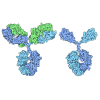
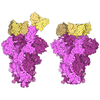
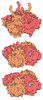
- Assembly
| Deposited unit | 
|
|---|---|
| 1 |
|
-Components
| #1: Protein | Mass: 68311.031 Da / Num. of mol.: 4 Source method: isolated from a genetically manipulated source Source: (gene. exp.) Morbillivirus canis / Strain: A75/17 / Cell line: expiCHO / Cell line (production host): expiCHO / Production host:  Cricetulus griseus (Chinese hamster) / References: UniProt: Q9QPQ8 Cricetulus griseus (Chinese hamster) / References: UniProt: Q9QPQ8#2: Antibody | Mass: 13326.947 Da / Num. of mol.: 4 Source method: isolated from a genetically manipulated source Source: (gene. exp.) Lama glama (llama) / Production host:   Escherichia coli (E. coli) Escherichia coli (E. coli)#3: Antibody | Mass: 13802.476 Da / Num. of mol.: 4 Source method: isolated from a genetically manipulated source Source: (gene. exp.) Lama glama (llama) / Production host: Escherichia coli (E. coli)#4: Sugar | ChemComp-NAG / 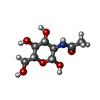 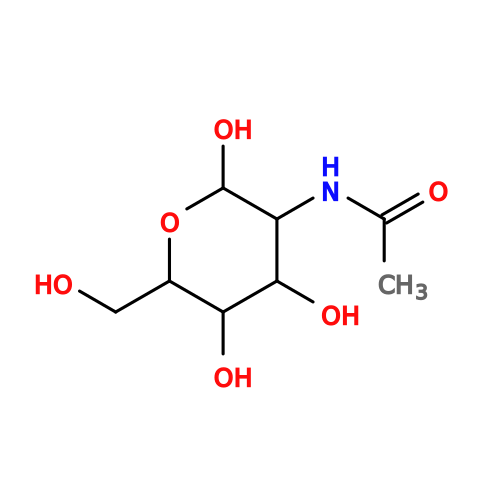 Type: D-saccharide, beta linking / Mass: 221.208 Da / Num. of mol.: 4 / Source method: obtained synthetically / Formula: C8H15NO6 / Feature type: SUBJECT OF INVESTIGATION Type: D-saccharide, beta linking / Mass: 221.208 Da / Num. of mol.: 4 / Source method: obtained synthetically / Formula: C8H15NO6 / Feature type: SUBJECT OF INVESTIGATIONHas ligand of interest | Y | Has protein modification | Y | |
|---|
-Experimental details
-Experiment
| Experiment | Method: ELECTRON MICROSCOPY |
|---|---|
| EM experiment | Aggregation state: PARTICLE / 3D reconstruction method: single particle reconstruction |
- Sample preparation
| Component |
| ||||||||||||||||||||||||||||
|---|---|---|---|---|---|---|---|---|---|---|---|---|---|---|---|---|---|---|---|---|---|---|---|---|---|---|---|---|---|
| Molecular weight | Value: 0.3731 MDa / Experimental value: NO | ||||||||||||||||||||||||||||
| Source (natural) |
| ||||||||||||||||||||||||||||
| Source (recombinant) |
| ||||||||||||||||||||||||||||
| Buffer solution | pH: 7.6 / Details: 20 mM Tris-HCl, 100 mM NaCl, 0.25% OG (w/v) | ||||||||||||||||||||||||||||
| Buffer component |
| ||||||||||||||||||||||||||||
| Specimen | Conc.: 1.2 mg/ml / Embedding applied: NO / Shadowing applied: NO / Staining applied: NO / Vitrification applied: YES Details: Purified CDV-solH in complex with Nb H7 and Nb H9 in a molar ratio = 1/2.5/2.5 | ||||||||||||||||||||||||||||
| Specimen support | Grid material: COPPER / Grid mesh size: 200 divisions/in. / Grid type: Quantifoil R2/1 | ||||||||||||||||||||||||||||
| Vitrification | Instrument: FEI VITROBOT MARK IV / Cryogen name: ETHANE / Humidity: 100 % / Chamber temperature: 277.15 K Details: Blot Time: 4.5 sec Blot Force: -4 Drain Time: 0 Wait time: 0 |
- Electron microscopy imaging
| Experimental equipment |  Model: Titan Krios / Image courtesy: FEI Company |
|---|---|
| Microscopy | Model: TFS KRIOS |
| Electron gun | Electron source:  FIELD EMISSION GUN / Accelerating voltage: 300 kV / Illumination mode: SPOT SCAN FIELD EMISSION GUN / Accelerating voltage: 300 kV / Illumination mode: SPOT SCAN |
| Electron lens | Mode: BRIGHT FIELD / Nominal defocus max: 2500 nm / Nominal defocus min: 800 nm / Cs: 2.7 mm / Alignment procedure: COMA FREE |
| Specimen holder | Cryogen: NITROGEN / Specimen holder model: FEI TITAN KRIOS AUTOGRID HOLDER |
| Image recording | Electron dose: 30 e/Å2 / Film or detector model: FEI FALCON IV (4k x 4k) / Num. of real images: 9162 |
| EM imaging optics | Energyfilter name: TFS Selectris / Energyfilter slit width: 20 eV |
- Processing
| EM software |
| ||||||||||||||||||||||||||||||||||||||||||||||||||||||||||||||||||||||||||||||||||||||||
|---|---|---|---|---|---|---|---|---|---|---|---|---|---|---|---|---|---|---|---|---|---|---|---|---|---|---|---|---|---|---|---|---|---|---|---|---|---|---|---|---|---|---|---|---|---|---|---|---|---|---|---|---|---|---|---|---|---|---|---|---|---|---|---|---|---|---|---|---|---|---|---|---|---|---|---|---|---|---|---|---|---|---|---|---|---|---|---|---|---|
| CTF correction | Type: PHASE FLIPPING AND AMPLITUDE CORRECTION | ||||||||||||||||||||||||||||||||||||||||||||||||||||||||||||||||||||||||||||||||||||||||
| Particle selection | Num. of particles selected: 304110 | ||||||||||||||||||||||||||||||||||||||||||||||||||||||||||||||||||||||||||||||||||||||||
| Symmetry | Point symmetry: C1 (asymmetric) | ||||||||||||||||||||||||||||||||||||||||||||||||||||||||||||||||||||||||||||||||||||||||
| 3D reconstruction | Resolution: 4.3 Å / Resolution method: FSC 0.143 CUT-OFF / Num. of particles: 118721 / Algorithm: FOURIER SPACE / Num. of class averages: 3 / Symmetry type: POINT | ||||||||||||||||||||||||||||||||||||||||||||||||||||||||||||||||||||||||||||||||||||||||
| Atomic model building | Protocol: RIGID BODY FIT | ||||||||||||||||||||||||||||||||||||||||||||||||||||||||||||||||||||||||||||||||||||||||
| Atomic model building | 3D fitting-ID: 1
|

